
We read your photo as:
How many odd numbers greater than 4000 can be formed using the digits 2, 3, 4, 5, and 6, if each digit is used once in each numeral?
ScanSolve AI Answer
This answer stops before the end.
It was cut off when it was first written. Ask ScanSolve this question again for the full working.
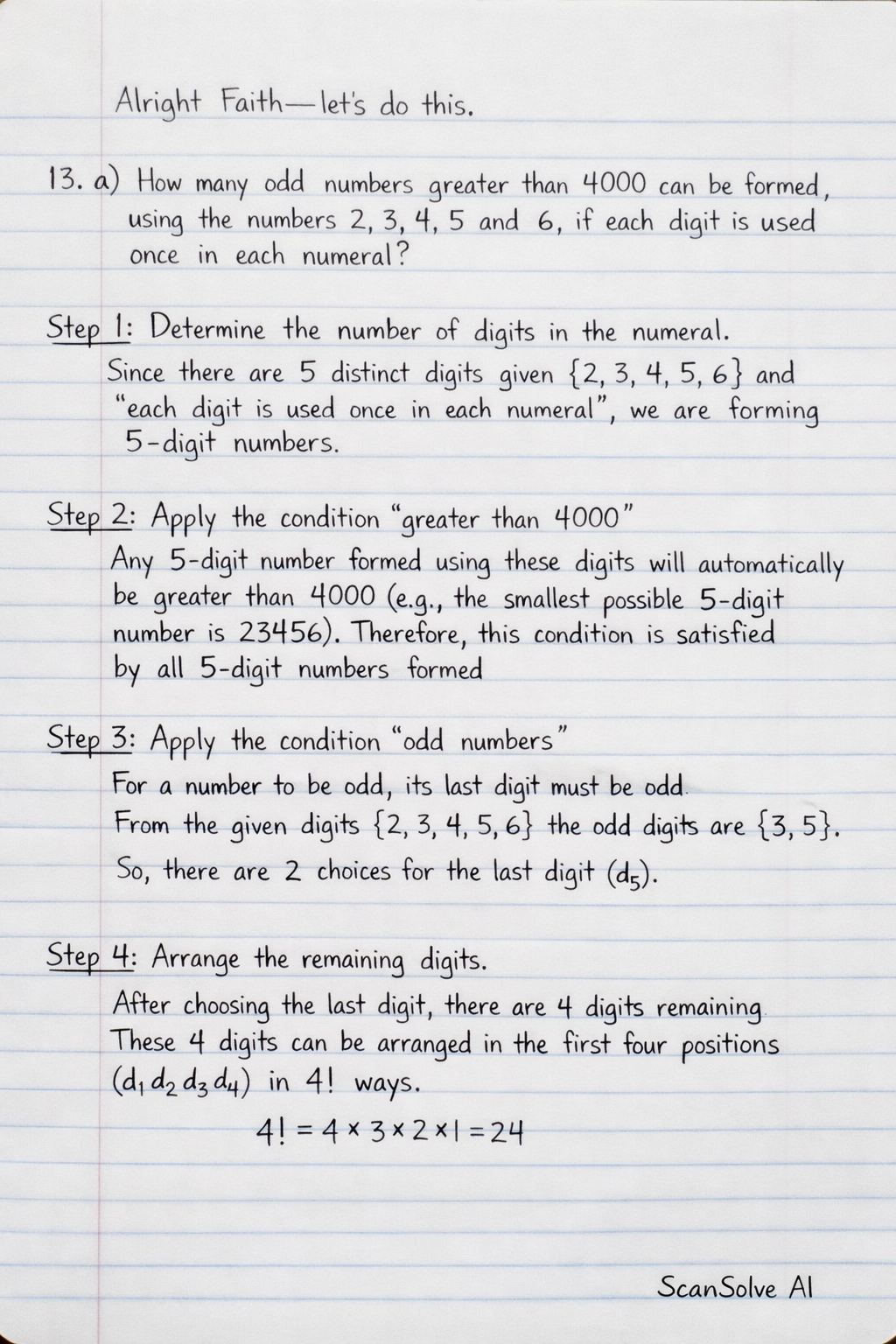
13. a) How many odd numbers greater than 4000 can be formed, using the numbers 2, 3, 4, 5 and 6, if each digit is used once in each numeral?
Step 1: Determine the number of digits in the numeral.
Since there are 5 distinct digits given ({2, 3, 4, 5, 6}) and "each digit is used once in each numeral", we are forming 5-digit numbers.
Step 2: Apply the condition "greater than 4000".
Any 5-digit number formed using these digits will automatically be greater than 4000 (e.g., the smallest possible 5-digit number is 23456). Therefore, this condition is satisfied by all 5-digit numbers formed.
Step 3: Apply the condition "odd numbers".
For a number to be odd, its last digit must be odd. From the given digits {2, 3, 4, 5, 6}, the odd digits are {3, 5}.
So, there are 2 choices for the last digit ().
Step 4: Arrange the remaining digits.
After choosing the last digit, there are 4 digits remaining. These 4 digits can be arranged in the first four positions () in ways.
Step 5: Calculate the total number of odd numbers.
Multiply the number of choices for the last digit by the number of ways to arrange the remaining digits.
Total odd numbers = (Choices for ) (Arrangements of )
There are 48 odd numbers greater than 4000 that can be formed.
13. b) A biased die is thrown 6 times and the probability of getting an odd number is . Find the probability of obtaining:
This is a binomial probability problem.
Let (number of trials).
Let .
Let .
The binomial probability formula is .
b)(i) an even number 5 times;
Step 1: Identify the parameters for this case.
We want 5 even numbers and 1 odd number.
So, for even numbers. The probability of success (getting an even number) is .
Step 2: Calculate the binomial coefficient.
Still stuck on this one?
Ask a follow-up, and the answer starts from this question.
More Mathematics Questions
Handwritten Step-by-Step Solution
Get this as a handwritten image on WhatsApp — like a tutor wrote it for you.
Try on WhatsApp