
We read your photo as:
Write the definition of the derivative from first principles.
Mathematics
ScanSolve AI Answer
Answer
Step-by-step solution
11 stepsHere are the derivatives of the given functions using first principles:
1)
Write the definition of the derivative from first principles.
Substitute and into the formula.
Use the sum-to-product identity .
Here, and .
Rearrange the terms to use the standard limit .
Apply the limit as .
2)
Write the definition of the derivative from first principles.
Substitute and into the formula.
Rewrite as and combine the fractions in the numerator.
Use the sine subtraction formula .
Here, and .
Separate the limit into known parts.
Apply the limit as .
Was this helpful?
Still stuck on this one?
Ask a follow-up, and the answer starts from this question.
Got a different question?Ask your own question
More Mathematics Questions
QState the definition of the derivative from first principles.QTo determine the derivative of the functions from first principles, we use the definition:QI) Define derivatives of a function from first principle. ii) Find the derivatives of f(x) = 3x2…QFind the derivative using first principleQCalculate the derivative of f(x) = 3x − 1 from first principles.
Browse by topic:Calculus
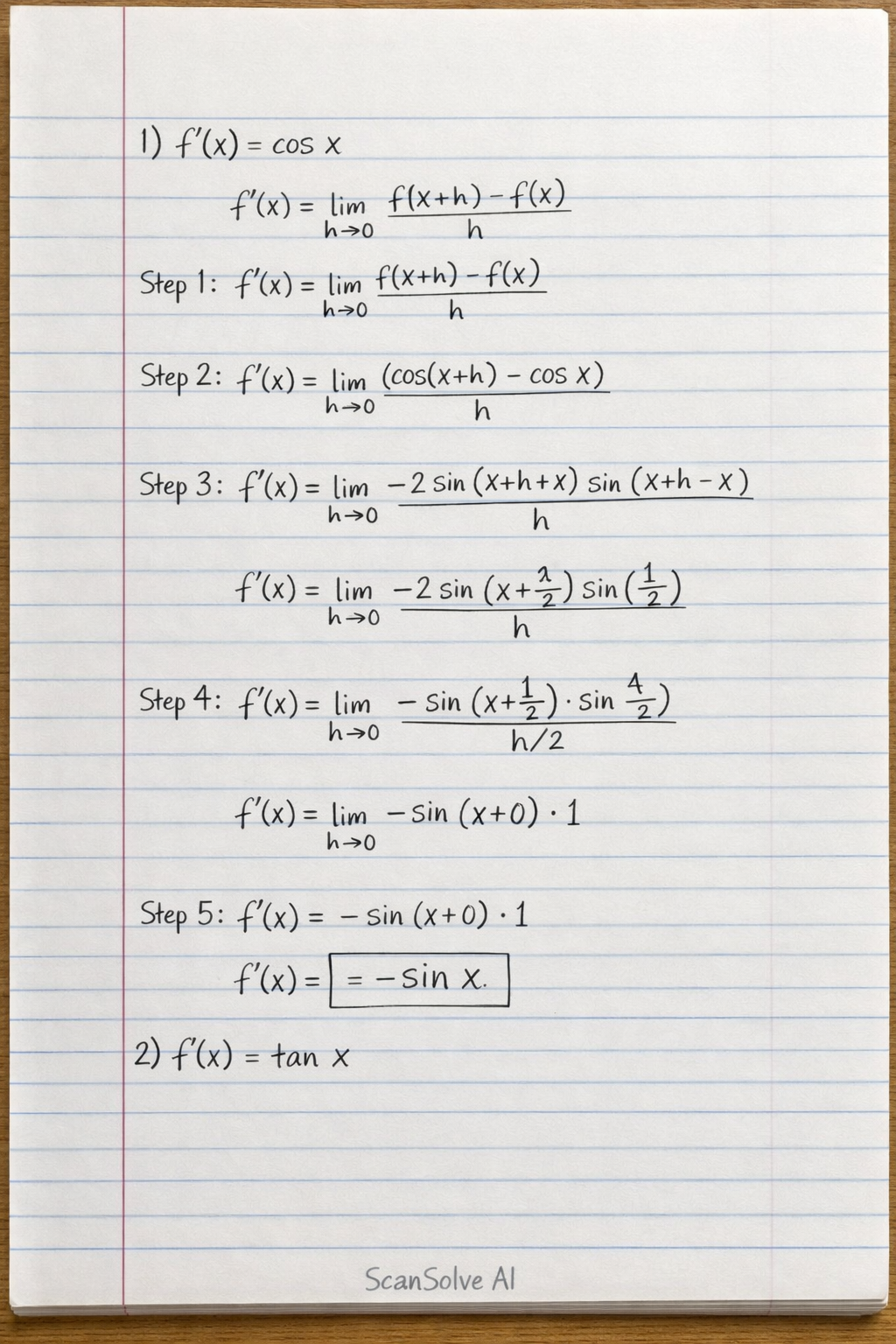
Handwritten Step-by-Step Solution
Get this as a handwritten image on WhatsApp — like a tutor wrote it for you.
Try on WhatsApp