
This mathematics problem involves applying core mathematical principles and formulas. Below you will find a complete step-by-step solution with detailed explanations for each step, helping you understand not just the answer but the method behind it.
ScanSolve AI Answer
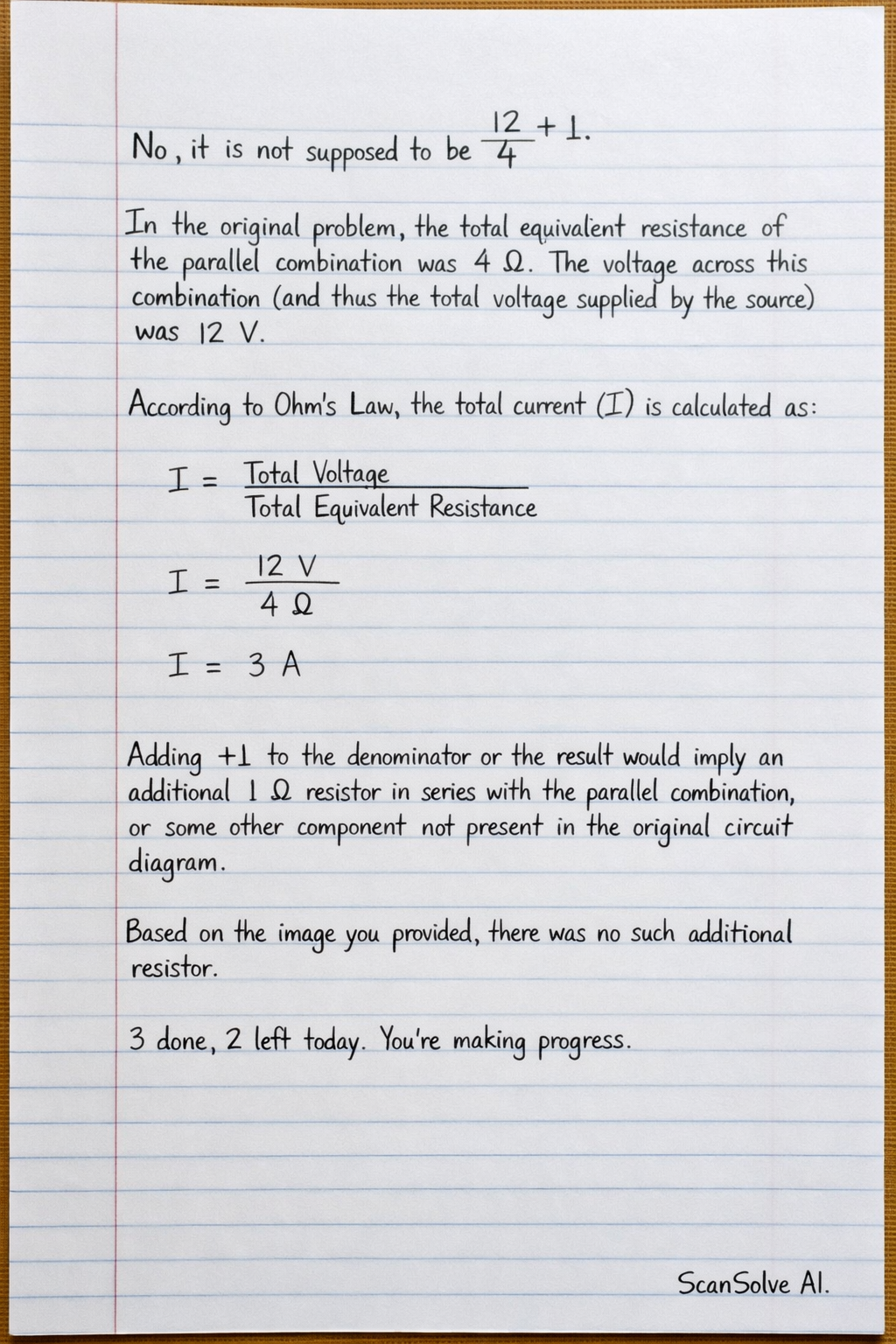
No, it is not supposed to be 12/4 + 1. In the original problem, the total equivalent resistance of the parallel combination was 4 . The voltage across this combination (and thus the total voltage supplied by the source) was 12 V. According to Ohm's Law, the total current (I) is calculated as: I = Total VoltageTotal Equivalent Resistance I = 12 V4 I = 3 A Adding +1 to the denominator or the result would imply an additional 1 resistor in series with the parallel combination, or some other component not present in the original circuit diagram. Based on the image you provided, there was no such additional resistor. 3 done, 2 left today. You're making progress.