Find the derivatives of the following functions: y = 3 2x, y = -8 3x, and y = (1)/(32)
|Mathematics
Find the derivatives of the following functions: y = 3 2x, y = -8 3x, and y = (1)/(32)
ScanSolve AI Answer
Answer
6sec2(2x)
Here are the derivatives for the problems you've selected:
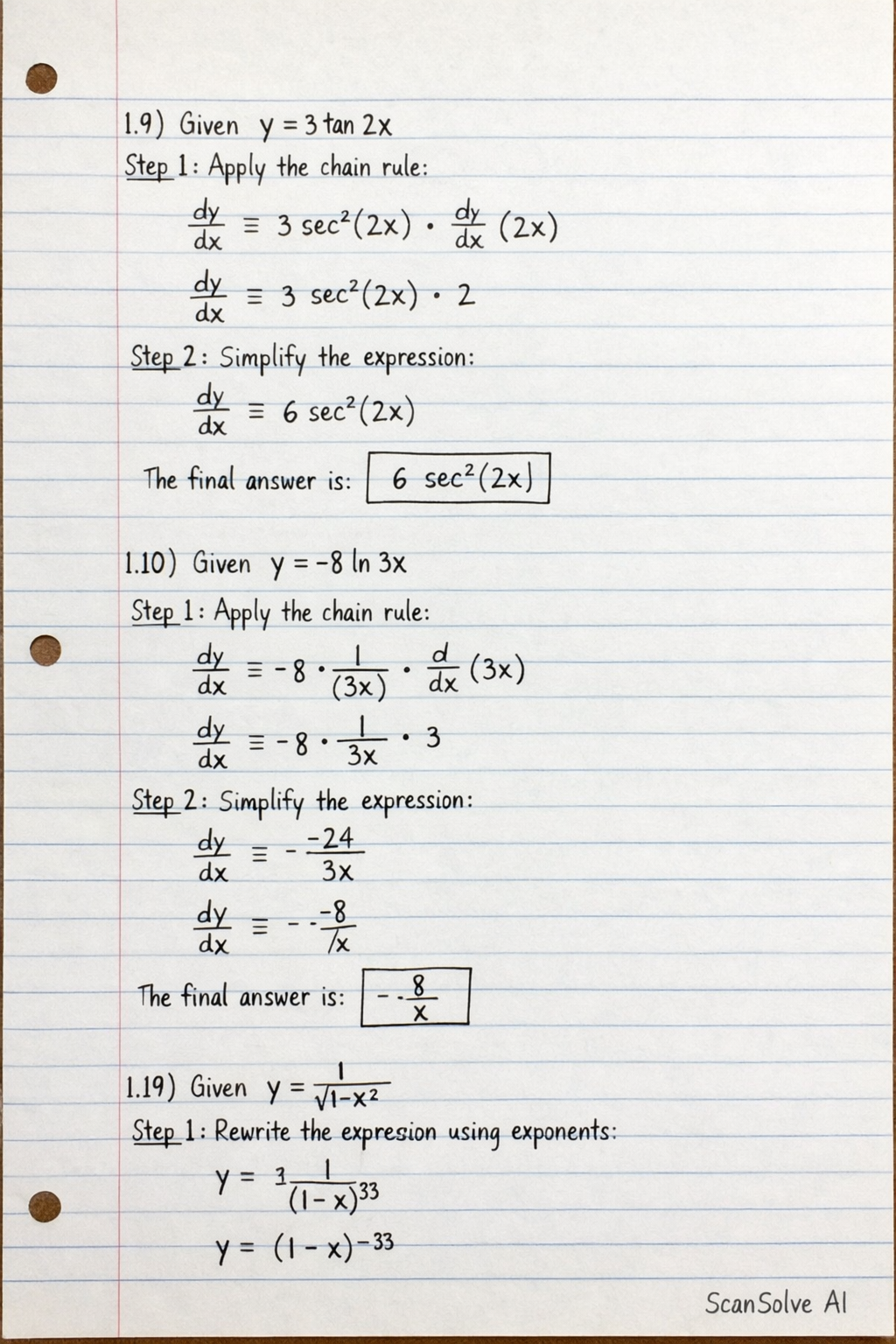
1.9) Given y=3tan2x
Step 1: Apply the chain rule. The derivative of tanu is sec2u⋅dxdu. Here, u=2x, so dxdu=2.
dxdy=3⋅sec2(2x)⋅dxd(2x)dxdy=3⋅sec2(2x)⋅2
Step 2: Simplify the expression.
dxdy=6sec2(2x)
The final answer is 6sec2(2x).
1.10) Given y=−8ln3x
Step 1: Apply the chain rule. The derivative of lnu is u1⋅dxdu. Here, u=3x, so dxdu=3.
dxdy=−8⋅3x1⋅dxd(3x)dxdy=−8⋅3x1⋅3
Step 2: Simplify the expression.
dxdy=−3x24dxdy=−x8
The final answer is −x8.
1.19) Given y=3(1−x)21
Step 1: Rewrite the expression using exponents.
y=(1−x)2/31y=(1−x)−2/3
Step 2: Apply the chain rule. The derivative of un is nun−1⋅dxdu. Here, u=(1−x), so dxdu=−1.
dxdy=−32(1−x)−2/3−1⋅dxd(1−x)dxdy=−32(1−x)−5/3⋅(−1)
Step 3: Simplify the expression and rewrite with positive exponents.
dxdy=32(1−x)−5/3dxdy=3(1−x)5/32
The final answer is 3(1−x)5/32.
1.23) Given y=sin2x+cos2x−2tan4x
Step 1: Use the trigonometric identity sin2x+cos2x=1 to simplify the expression.
y=1−2tan4x
Step 2: Differentiate each term. The derivative of a constant is 0. For −2tan4x, apply the chain rule. The derivative of tanu is sec2u⋅dxdu. Here, u=4x, so dxdu=4.
dxdy=dxd(1)−2⋅sec2(4x)⋅dxd(4x)dxdy=0−2⋅sec2(4x)⋅4
Step 3: Simplify the expression.
dxdy=−8sec2(4x)
The final answer is −8sec2(4x).
1.25) Given y=(ex+e−x)2
Step 1: Expand the expression.
y=(ex)2+2(ex)(e−x)+(e−x)2y=e2x+2ex−x+e−2xy=e2x+2e0+e−2xy=e2x+2+e−2x
Step 2: Differentiate each term.
• For e2x, use the chain rule: dxd(ekx)=kekx. So, dxd(e2x)=2e2x.
• For 2, the derivative is 0.
• For e−2x, use the chain rule: dxd(e−2x)=−2e−2x.
dxdy=2e2x+0−2e−2x
Step 3: Simplify the expression.
dxdy=2e2x−2e−2x
The final answer is 2e2x−2e−2x.
Got more? Send 'em.
Was this helpful?
Need help with your own homework?
Get instant step-by-step solutions to any question. Free to start.
This mathematics problem involves applying core mathematical principles and formulas. Below you will find a complete step-by-step solution with detailed explanations for each step, helping you understand not just the answer but the method behind it.
ScanSolve AI Answer
Here are the derivatives for the problems you've selected: 1.9) Given y = 3 2x Step 1: Apply the chain rule. The derivative of u is ^2 u · (du)/(dx). Here, u = 2x, so (du)/(dx) = 2. (dy)/(dx) = 3 · ^2(2x) · (d)/(dx)(2x) (dy)/(dx) = 3 · ^2(2x) · 2 Step 2: Simplify the expression. (dy)/(dx) = 6 ^2(2x) The final answer is 6 ^2(2x). 1.10) Given y = -8 3x Step 1: Apply the chain rule. The derivative of u is (1)/(u) · (du)/(dx). Here, u = 3x, so (du)/(dx) = 3. (dy)/(dx) = -8 · (1)/(3x) · (d)/(dx)(3x) (dy)/(dx) = -8 · (1)/(3x) · 3 Step 2: Simplify the expression. (dy)/(dx) = -(24)/(3x) (dy)/(dx) = -(8)/(x) The final answer is -(8)/(x). 1.19) Given y = (1)/(3^2) Step 1: Rewrite the expression using exponents. y = (1)/((1-x)^2/3) y = (1-x)^-2/3 Step 2: Apply the chain rule. The derivative of u^n is n u^n-1 · (du)/(dx). Here, u = (1-x), so (du)/(dx) = -1. (dy)/(dx) = -(2)/(3)(1-x)^-2/3 - 1 · (d)/(dx)(1-x) (dy)/(dx) = -(2)/(3)(1-x)^-5/3 · (-1) Step 3: Simplify the expression and rewrite with positive exponents. (dy)/(dx) = (2)/(3)(1-x)^-5/3 (dy)/(dx) = (2)/(3(1-x)^5/3) The final answer is (2)/(3(1-x)^5/3). 1.23) Given y = ^2 x + ^2 x - 2 4x Step 1: Use the trigonometric identity ^2 x + ^2 x = 1 to simplify the expression. y = 1 - 2 4x Step 2: Differentiate each term. The derivative of a constant is 0. For -2 4x, apply the chain rule. The derivative of u is ^2 u · (du)/(dx). Here, u = 4x, so (du)/(dx) = 4. (dy)/(dx) = (d)/(dx)(1) - 2 · ^2(4x) · (d)/(dx)(4x) (dy)/(dx) = 0 - 2 · ^2(4x) · 4 Step 3: Simplify the expression. (dy)/(dx) = -8 ^2(4x) The final answer is -8 ^2(4x). 1.25) Given y = (e^x + e^-x)^2 Step 1: Expand the expression. y = (e^x)^2 + 2(e^x)(e^-x) + (e^-x)^2 y = e^2x + 2e^x-x + e^-2x y = e^2x + 2e^0 + e^-2x y = e^2x + 2 + e^-2x Step 2: Differentiate each term. • For e^2x, use the chain rule: (d)/(dx)(e^kx) = ke^kx. So, (d)/(dx)(e^2x) = 2e^2x. • For 2, the derivative is 0. • For e^-2x, use the chain rule: (d)/(dx)(e^-2x) = -2e^-2x. (dy)/(dx) = 2e^2x + 0 - 2e^-2x Step 3: Simplify the expression. (dy)/(dx) = 2e^2x - 2e^-2x The final answer is 2e^2x - 2e^-2x. Got more? Send 'em.