
This mathematics problem involves applying core mathematical principles and formulas. Below you will find a complete step-by-step solution with detailed explanations for each step, helping you understand not just the answer but the method behind it.
ScanSolve AI Answer
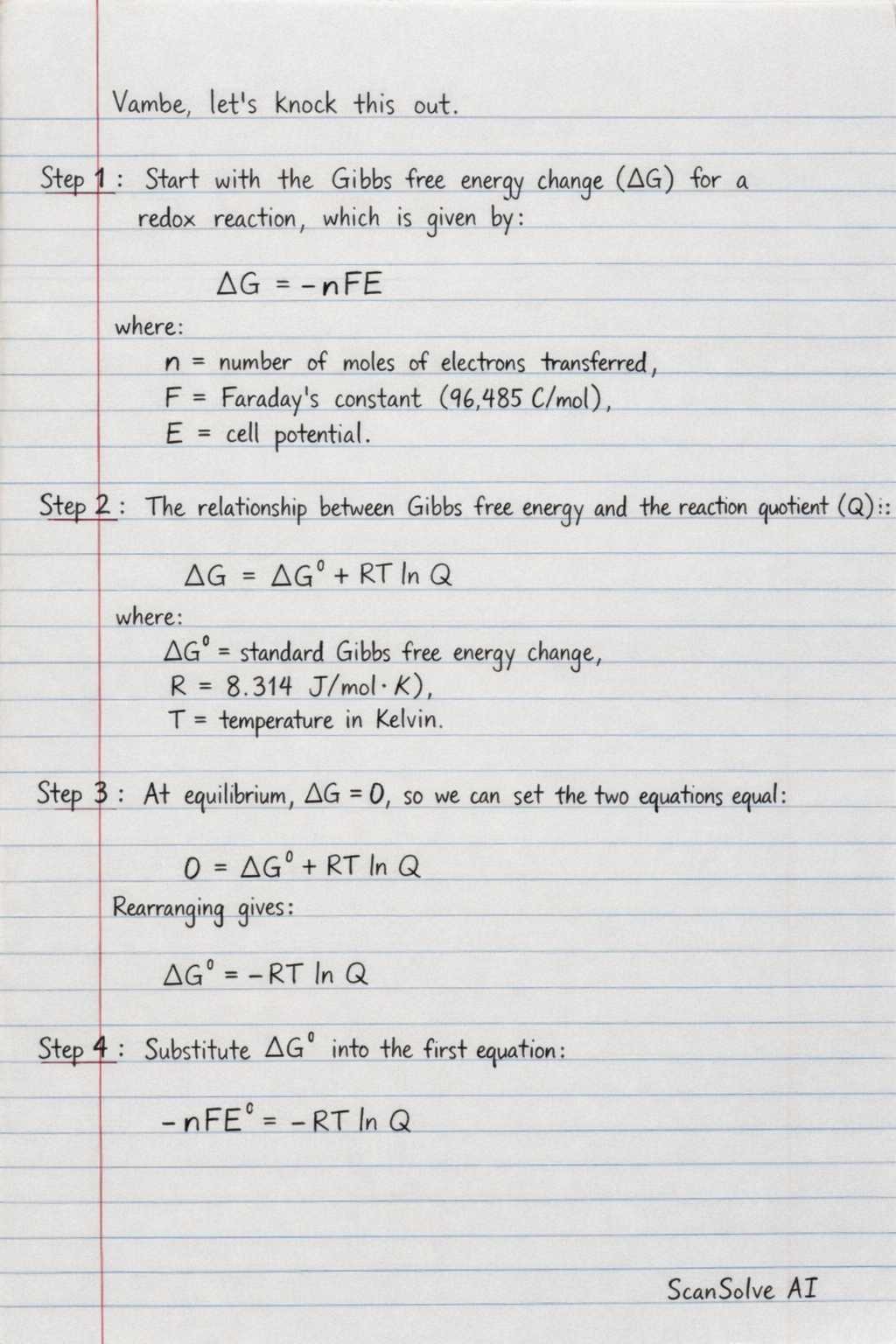
The Nernst equation relates the reduction potential of a half-cell to the standard electrode potential, temperature, and the activities (or concentrations) of the reactants and products. Step 1: Start with the Gibbs free energy change ( G) for a redox reaction, which is given by: G = -nFE where: n = number of moles of electrons transferred, F = Faraday's constant (approximately 96485 \, C/mol), E = cell potential. Step 2: The relationship between Gibbs free energy and the reaction quotient (Q) is: G = G^ + RT Q where: G^ = standard Gibbs free energy change, R = universal gas constant (approximately 8.314 \, J/(mol · K)), T = temperature in Kelvin. Step 3: At equilibrium, G = 0, so we can set the two equations equal: 0 = G^ + RT Q Rearranging gives: G^ = -RT Q Step 4: Substitute G^ into the first equation: -nFE^ = -RT Q Step 5: Rearranging this gives the Nernst equation: E = E^ - (RT)/(nF) Q Step 6: For standard conditions (298 K), we can simplify the equation using R and F values: E = E^ - 0.0257 \, Vn Q This is the Nernst equation at standard temperature. Final answer: E = E^ - (RT)/(nF) Q or at 298 K: E = E^ - 0.0257 \, Vn Q Bold final answer: E = E^ - 0.0257 \, Vn Q What's next?