

This mathematics problem involves applying core mathematical principles and formulas. Below you will find a complete step-by-step solution with detailed explanations for each step, helping you understand not just the answer but the method behind it.
ScanSolve AI Answer
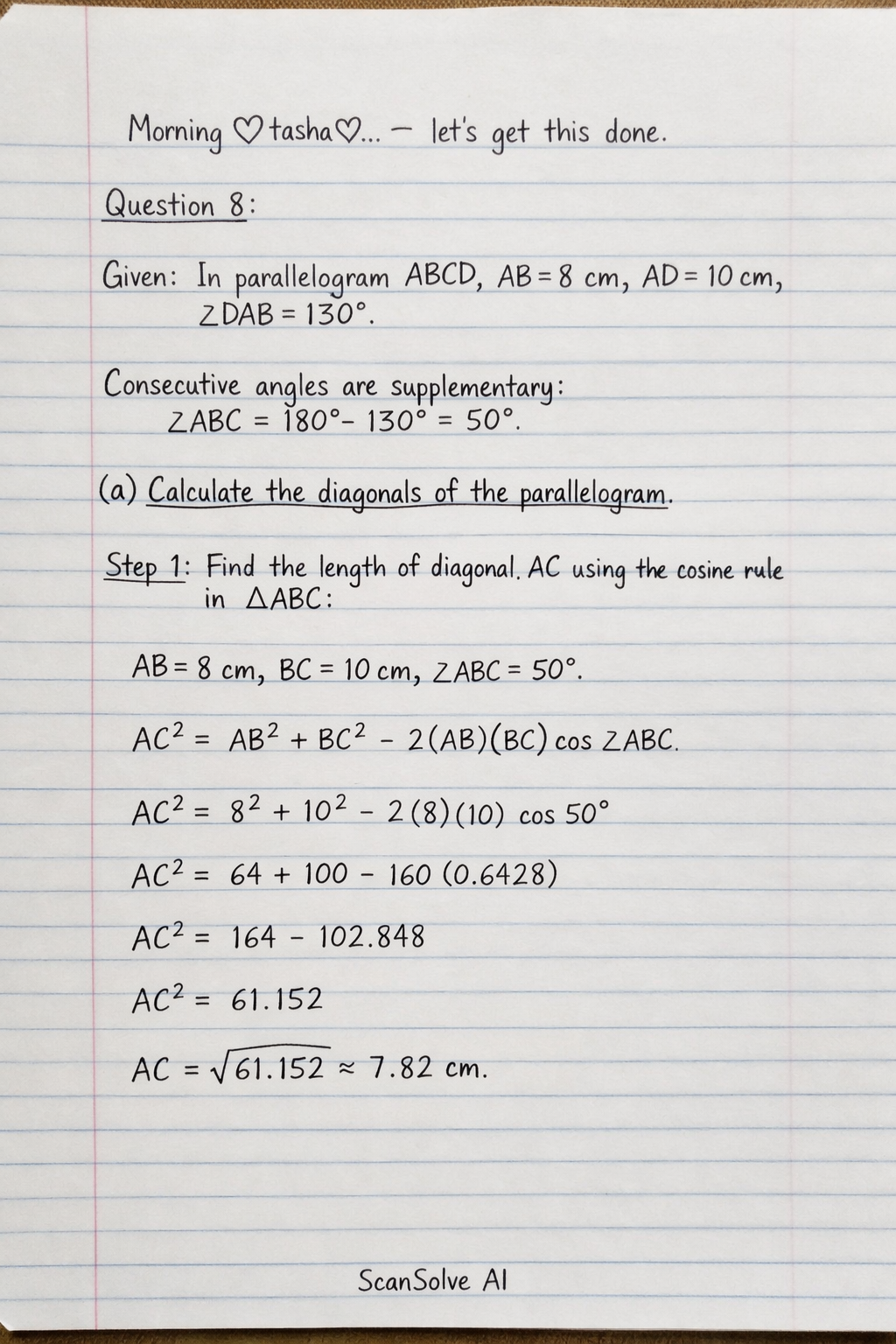
Morning ♡tasha♡....🧸 — let's get this done. Question 8: Given a parallelogram with sides 8 cm and 10 cm, and the angle between them is 130^. Let the parallelogram be ABCD, with AB = 8 cm, AD = 10 cm, and DAB = 130^. In a parallelogram, consecutive angles are supplementary, so ABC = 180^ - 130^ = 50^. a) Calculate the diagonals of the parallelogram. Step 1: Calculate the length of diagonal AC using the cosine rule in ABC. Sides are AB = 8 cm, BC = AD = 10 cm, and ABC = 50^. AC^2 = AB^2 + BC^2 - 2(AB)(BC)( ABC) AC^2 = 8^2 + 10^2 - 2(8)(10)(50^) AC^2 = 64 + 100 - 160(0.6428) AC^2 = 164 - 102.848 AC^2 = 61.152 AC = sqrt(61.152) ≈ 7.82 cm Step 2: Calculate the length of diagonal BD using the cosine rule in ABD. Sides are AB = 8 cm, AD = 10 cm, and DAB = 130^. BD^2 = AB^2 + AD^2 - 2(AB)(AD)( DAB) BD^2 = 8^2 + 10^2 - 2(8)(10)(130^) BD^2 = 64 + 100 - 160(-0.6428) BD^2 = 164 + 102.848 BD^2 = 266.848 BD = sqrt(266.848) ≈ 16.34 cm The diagonals are approximately 7.82 cm and 16.34 cm. b) Calculate angle DBC. Step 3: Calculate DBC using the cosine rule in BCD. In BCD, BC = 10 cm, CD = AB = 8 cm, and BD = 16.34 cm. Let DBC = . CD^2 = BC^2 + BD^2 - 2(BC)(BD)() 8^2 = 10^2 + (16.34)^2 - 2(10)(16.34)() 64 = 100 + 266.9956 - 326.8() 64 = 366.9956 - 326.8() 326.8() = 366.9956 - 64 326.8() = 302.9956 () = (302.9956)/(326.8) ≈ 0.9271 = (0.9271) ≈ 21.95^ The angle DBC is approximately 21.95^. Question 9: One side of rhombus ABCD is 8 cm in length. If DAB = 64^, find BD and AC. In a rhombus, all sides are equal, so AB = BC = CD = DA = 8 cm. Step 1: Find diagonal BD using the cosine rule in ABD. Sides are AB = 8 cm, AD = 8 cm, and DAB = 64^. BD^2 = AB^2 + AD^2 - 2(AB)(AD)( DAB) BD^2 = 8^2 + 8^2 - 2(8)(8)(64^) BD^2 = 64 + 64 - 128(0.4384) BD^2 = 128 - 56.0992 BD^2 = 71.9008 BD = sqrt(71.9008) ≈ 8.48 cm Step 2: Find diagonal AC. In a rhombus, consecutive angles are supplementary, so ABC = 180^ - 64^ = 116^. Use the cosine rule in ABC. Sides are AB = 8 cm, BC = 8 cm, and ABC = 116^. AC^2 = AB^2 + BC^2 - 2(AB)(BC)( ABC) AC^2 = 8^2 + 8^2 - 2(8)(8)(116^) AC^2 = 64 + 64 - 128(-0.4384) AC^2 = 128 + 56.0992 AC^2 = 184.0992 AC = sqrt(184.0992) ≈ 13.57 cm The diagonals are BD ≈ 8.48 cm and AC ≈ 13.57 cm. Question 10: ABCD is a rhombus. ABC = 140^, and AB = 20 cm. Calculate (a) AC and (b) ACB. In a rhombus, all sides are equal, so AB = BC = CD = DA = 20 cm. a) Calculate AC. Step 1: Find diagonal AC using the cosine rule in ABC. Sides are AB = 20 cm, BC = 20 cm, and ABC = 140^. AC^2 = AB^2 + BC^2 - 2(AB)(BC)( ABC) AC^2 = 20^2 + 20^2 - 2(20)(20)(140^) AC^2 = 400 + 400 - 800(-0.7660) AC^2 = 800 + 612.8 AC^2 = 1412.8 AC = sqrt(1412.8) ≈ 37.59 cm The length of AC is approximately 37.59 cm. b) Calculate ACB. Step 2: Calculate ACB. In ABC, AB = BC = 20 cm, so it is an isosceles triangle. The base angles are equal: BAC = BCA. The sum of angles in a triangle is 180^. BAC + BCA + ABC = 180^ 2 × ACB + 140^ = 180^ 2 × ACB = 180^ - 140^ 2 × ACB = 40^ ACB = (40^)/(2) = 20^ The angle ACB is 20^. Send me the next one 📸