

This mathematics problem involves applying core mathematical principles and formulas. Below you will find a complete step-by-step solution with detailed explanations for each step, helping you understand not just the answer but the method behind it.
ScanSolve AI Answer
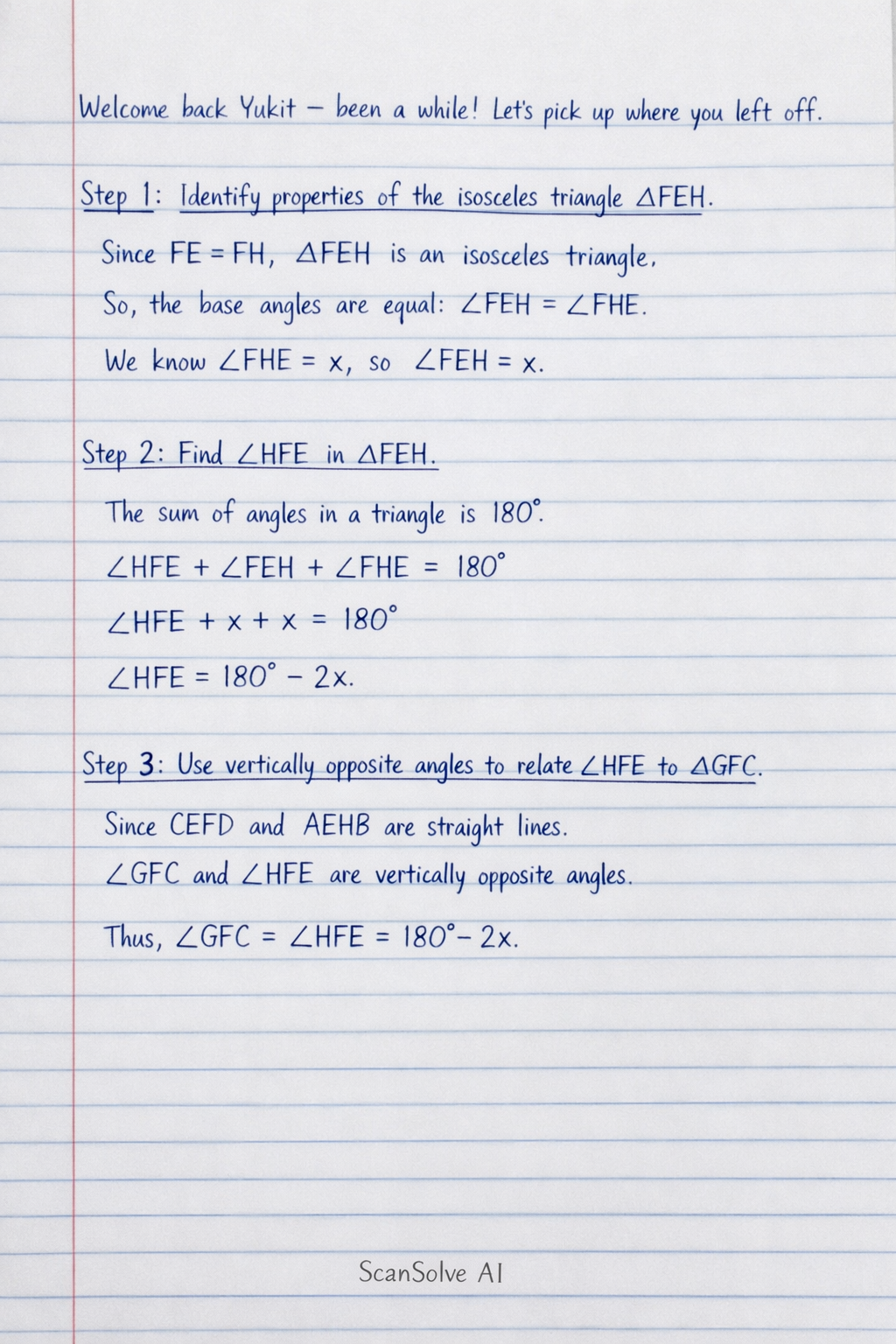
To find the values of x and y, we will use the properties of straight lines, vertically opposite angles, and the sum of angles in a triangle. Step 1: Identify properties of the isosceles triangle FEH. Given that FE = FH, FEH is an isosceles triangle. Therefore, the base angles are equal: FEH = FHE. From the diagram, FHE = x. So, FEH = x. Step 2: Find HFE in FEH. The sum of angles in a triangle is 180^. HFE + FEH + FHE = 180^ HFE + x + x = 180^ HFE = 180^ - 2x Step 3: Use vertically opposite angles to relate HFE to GFC. Since CEFD and AEHB are straight lines, GFC and HFE are vertically opposite angles. Therefore, GFC = HFE = 180^ - 2x. Step 4: Find x using the sum of angles in GFC. In GFC, we have G = 60^ and C = 105^. The sum of angles in GFC is 180^. G + C + GFC = 180^ 60^ + 105^ + (180^ - 2x) = 180^ 165^ + 180^ - 2x = 180^ 345^ - 2x = 180^ 2x = 345^ - 180^ 2x = 165^ x = (165^)/(2) x = 82.5^ Step 5: Calculate HFE and FEH. Now that we have x = 82.5^: FEH = x = 82.5^ HFE = 180^ - 2(82.5^) = 180^ - 165^ = 15^ Step 6: Find GFE using vertically opposite angles and GFE. Since AEHB and CEFD are straight lines, GEF and CEB are vertically opposite angles. Also, CEB is an exterior angle to GFE. Alternatively, FEH = x = 82.5^. GEF and FEH are adjacent angles on the straight line CEFD. No, this is wrong. GEF and CEB are vertically opposite angles. CEB is an exterior angle to GFE. CEB = G + GFE. Since FEH = x = 82.5^, and CEB is vertically opposite to FEH, then CEB = x = 82.5^. So, 82.5^ = 60^ + GFE. GFE = 82.5^ - 60^ = 22.5^ Step 7: Find HFD using vertically opposite angles. HFD and GFE are vertically opposite angles. Therefore, HFD = GFE = 22.5^. Step 8: Find y using the sum of angles in DFH. In DFH, we have D = 130^ and HFD = 22.5^. The sum of angles in DFH is 180^. D + HFD + DHF = 180^ 130^ + 22.5^ + DHF = 180^ 152.5^ + DHF = 180^ DHF = 180^ - 152.5^ = 27.5^ Now, y = HFB. HFB and DHF are adjacent angles on the straight line AEHB. No, this is wrong. AEHB is a straight line. DHF and FHE are adjacent angles. DHF = 27.5^. FHE = x = 82.5^. DHE = DHF + FHE = 27.5^ + 82.5^ = 110^. This is not useful. Let's re-evaluate the relationship for y. y = HFB. HFB and AFE are vertically opposite angles. Consider the straight line CEFD. CFE + EFD = 180^. EFD = EFH + HFD = 15^ + 22.5^ = 37.5^. So, CFE = 180^ - 37.5^ = 142.5^. CFE and DFG are vertically opposite. So DFG = 142.5^. This is not consistent with HFE = 15^. Let's re-check the vertically opposite angles around F. CEFD is a straight line. AEHB is a straight line. HFE = 15^. GFE = 22.5^. HFD = 22.5^ (vertically opposite to GFE). DFG is vertically opposite to CFE. CFE is vertically opposite to DFG. CFE = DFG. Angles on straight line CEFD: CFE + EFG + GFD = 180^. No. Angles on straight line CEFD: CFE + EFD = 180^. EFD = EFH + HFD = 15^ + 22.5^ = 37.5^. So CFE = 180^ - 37.5^ = 142.5^. This means DFG = 142.5^. Now consider the angles on the straight line AEHB. AFE + EFH + HFB = 180^. AFE and BFH are vertically opposite. So AFE = y. EFH = 15^. HFB = y. So, y + 15^ + y = 180^. This implies 2y = 165^, y = 82.5^. This assumes F is on the line AEHB, which it is not. F is on CEFD. Let's use the exterior angle of DFH. The exterior angle at F is CFE. CFE = D + DHF. We found CFE = 142.5^. 142.5^ = 130^ + DHF. DHF = 142.5^ - 130^ = 12.5^. Now, we need y = HFB. HFB is an angle in HFB. Consider the straight line AEHB. DHF = 12.5^. FHE = x = 82.5^. DHF and FHE are adjacent angles. DHF + FHE = DHE. This is not useful. Let's use the exterior angle of FHB. The exterior angle at H is DHF. No. The exterior angle at H is AHF. AHF = FBH + BFH. AHF and EHF are supplementary. No. AHF and BHF are supplementary. DHF = 12.5^. FHE = x = 82.5^. DHF + FHE = DHE = 12.5^ + 82.5^ = 95^. Let's use the exterior angle of DFH at H. BHF = D + DFH. DFH = DFG + GFE. No. DFH = DFG + GFE. No. DFH = DFE. No. DFH is an angle in DFH. HFD = 22.5^. So BHF = 130^ + 22.5^ = 152.5^. We know FHE = x = 82.5^. BHF + FHE = 152.5^ + 82.5^ = 235^. This is not 180^. This means BHF and FHE are not adjacent angles on a straight line. Let's re-examine the diagram and the definition of y. y = HFB. This is an angle in HFB. Consider DFH. D = 130^. HFD = 22.5^. DHF = 180^ - 130^ - 22.5^ = 27.5^. Now, consider the straight line AEHB. DHF = 27.5^. FHE = x = 82.5^. DHF and FHE are adjacent angles. DHF + FHE = DHE = 27.5^ + 82.5^ = 110^. Let's use the exterior angle of GFE. G = 60^. GEF = CEB = x = 82.5^. GFE = 180^ - 60^ - 82.5^ = 37.5^. This is a contradiction with Step 6. Let's re-evaluate Step 6. Re-evaluating Step 6: FEH = x = 82.5^. CEB is vertically opposite to FEH. So CEB = x = 82.5^. In GFE, G = 60^. GEF is an angle in GFE. GEF and CEB are not vertically opposite. GEF and AEF are adjacent angles. GEF and CEG are vertically opposite. CEG = CEB + BEG. No. Let's use the exterior angle of GEC. G = 60^, C = 105^. The exterior angle at E for GEC is AEF. AEF = G + C = 60^ + 105^ = 165^. AEF and HEB are vertically opposite. So HEB = 165^. Angles on straight line AEHB: AEF + FEH + HEB = 180^. No. Angles on straight line AEHB: AEF + FEB = 180^. FEB = FEH + HEB. No. Let's use the exterior angle of GFE. The exterior angle at E is CEB. CEB = G + GFE. FEH = x = 82.5^. CEB and FEH are vertically opposite. So CEB = x = 82.5^. Therefore, 82.5^ = 60^ + GFE. GFE = 82.5^ - 60^ = 22.5^. This calculation is correct. Step 7 (Revised): Find HFD using vertically opposite angles. HFD and GFE are vertically opposite angles. Therefore, HFD = GFE = 22.5^. Step 8 (Revised): Find DHF in DFH. In DFH, we have D = 130^ and HFD = 22.5^. The sum of angles in DFH is 180^. D + HFD + DHF = 180^ 130^ + 22.5^ + DHF = 180^ 152.5^ + DHF = 180^ DHF = 180^ - 152.5^ = 27.5^ Step 9: Find y using angles on the straight line AEHB. AEHB is a straight line. The angles DHF, FHE, and HFB are not on the straight line AEHB. The angles on the straight line AEHB are AHF + FHB = 180^. FHE = x = 82.5^. DHF = 27.5^. DHF and FHE are adjacent angles. DHF + FHE = DHE = 27.5^ + 82.5^ = 110^. Let's use the exterior angle of FHB. The exterior angle at H is DHF. No. The exterior angle at H is AHF. AHF = FBH + BFH. AHF and FHE are adjacent angles. AHF + FHE = 180^ (angles on straight line AEHB). AHF + 82.5^ = 180^. AHF = 180^ - 82.5^ = 97.5^. Now, consider FHB. We need HFB = y. We have FBH. We have BHF. BHF and AHF are supplementary. BHF = 180^ - AHF = 180^ - 97.5^ = 82.5^. So, BHF = 82.5^. In FHB, we have ✂️ _That answer was long and got cut off. Reply continue and I'll finish it._