
We read your photo as:
Nyatakan jenis setiap segi tiga yang berikut. Seterusnya, lukis paksi simetri, jika ada.
ScanSolve AI Answer
Answer
You're right, my apologies for the cut-off! Let's tackle this new question.
Here are the types of triangles and their axes of symmetry:
-
1. The triangle has sides of lengths , , and . Since all three sides are equal, it is an equilateral triangle. An equilateral triangle has 3 axes of symmetry. Each axis passes through a vertex and the midpoint of the opposite side.
-
2. The triangle has sides of lengths , , and . Since all three sides are of different lengths, it is a scalene triangle. A scalene triangle has no axes of symmetry.
-
3. The triangle has sides of lengths , , and . Since two sides are equal ( and ), it is an isosceles triangle. An isosceles triangle has 1 axis of symmetry. This axis passes through the vertex between the two equal sides and the midpoint of the base ( side).
Still stuck on this one?
Ask a follow-up, and the answer starts from this question.
More Mathematics Questions
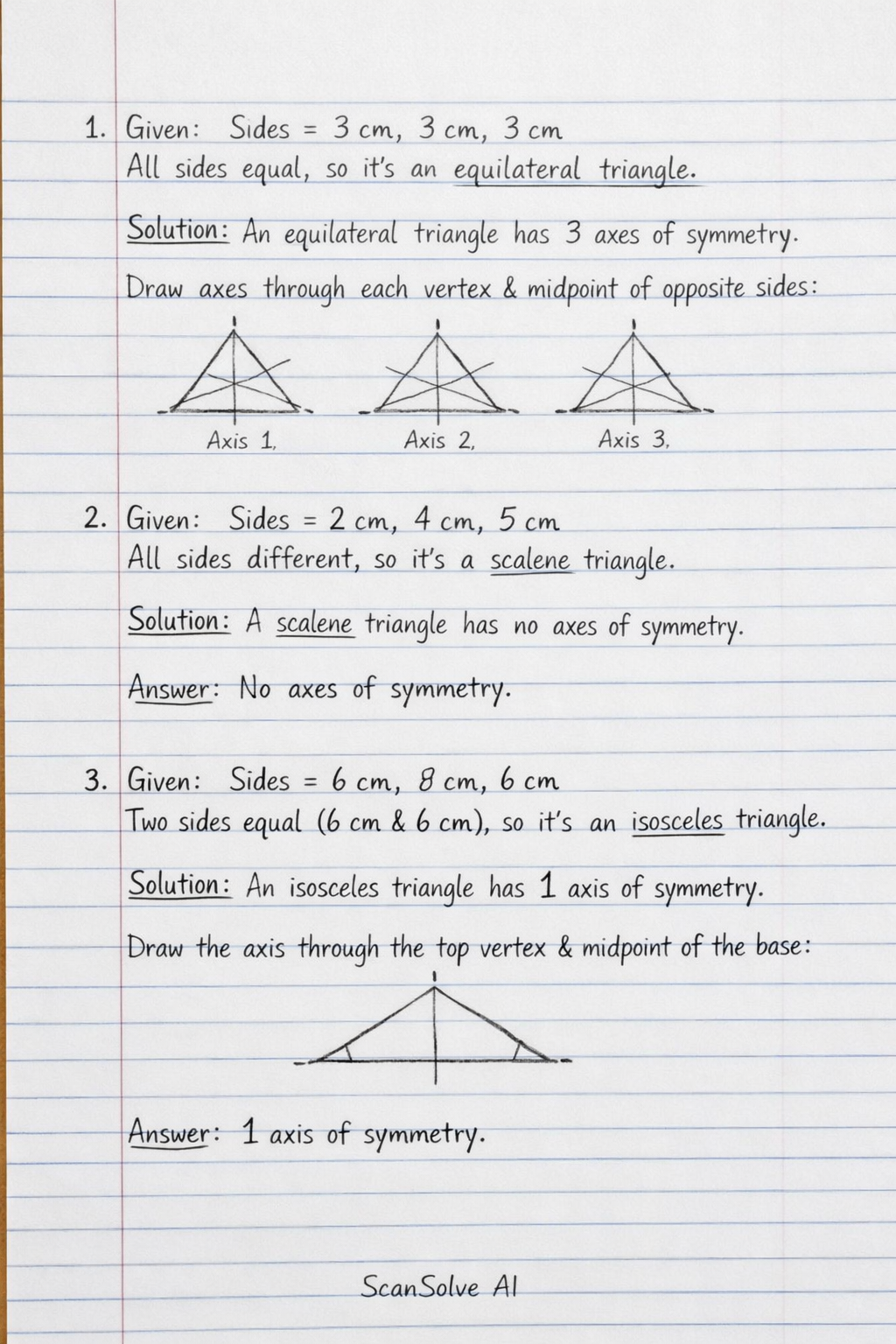
Handwritten Step-by-Step Solution
Get this as a handwritten image on WhatsApp — like a tutor wrote it for you.
Try on WhatsApp