

This mathematics problem involves applying core mathematical principles and formulas. Below you will find a complete step-by-step solution with detailed explanations for each step, helping you understand not just the answer but the method behind it.
ScanSolve AI Answer
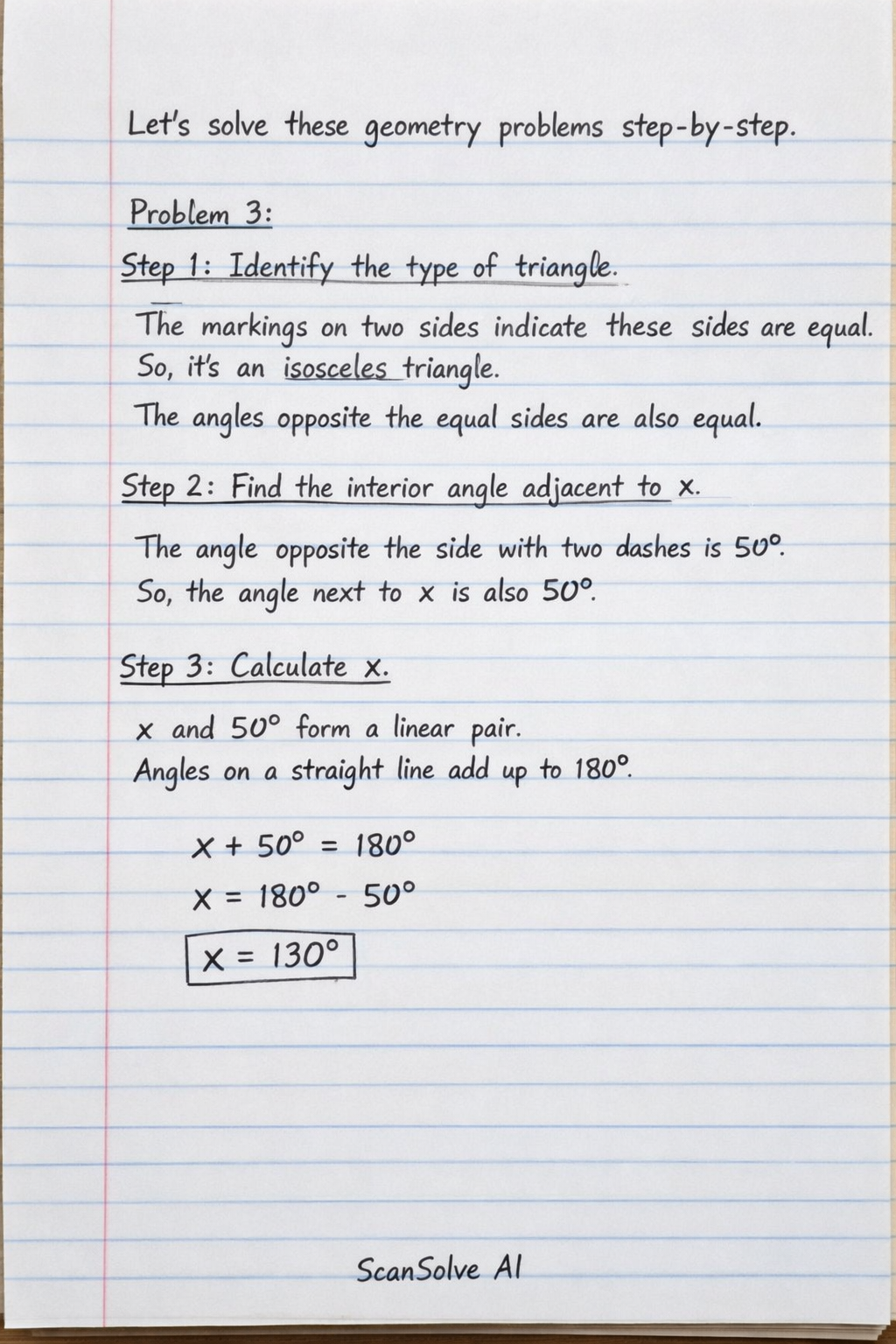
Let's solve these geometry problems step-by-step. Problem 3: Step 1: Identify the type of triangle. The markings on two sides of the triangle indicate that these sides are equal in length. This means it is an isosceles triangle. In an isosceles triangle, the angles opposite the equal sides are also equal. Step 2: Find the interior angle adjacent to x. The angle opposite the side marked with two dashes is 50^. The angle opposite the other side marked with two dashes is the interior angle adjacent to x. Therefore, this interior angle is also 50^. Step 3: Calculate x. The angle x and the interior angle 50^ form a linear pair (angles on a straight line). The sum of angles on a straight line is 180^. x + 50^ = 180^ x = 180^ - 50^ x = 130^ Problem 4: Step 1: Find the interior angle at the bottom left vertex. The exterior angle at the bottom left vertex is 120^. The interior angle and this exterior angle form a linear pair. Interior angle_1 = 180^ - 120^ Interior angle_1 = 60^ Step 2: Find the interior angle at the bottom right vertex. The exterior angle at the bottom right vertex is 75^. The interior angle and this exterior angle form a linear pair. Interior angle_2 = 180^ - 75^ Interior angle_2 = 105^ Step 3: Calculate x. The sum of the interior angles in any triangle is 180^. x + Interior angle_1 + Interior angle_2 = 180^ x + 60^ + 105^ = 180^ x + 165^ = 180^ x = 180^ - 165^ x = 15^ 3 done, 2 left today. You're making progress.