
We read your photo as:
Differential the Following by First Principle: a. Y = 2x2 b. Y = 1/X. Evaluate The Following: Lim (2x2 + 2x - 1) X→2
Mathematics
ScanSolve AI Answer
Step-by-step solution
5 stepshere's the solution for question 2.a, differentiating by the first principle:
The first principle of differentiation states that for a function , its derivative is given by:
Identify and .
Given .
Then, .Expand .
Calculate .
Divide by .
Take the limit as .
The derivative by first principle is:
Was this helpful?
Still stuck on this one?
Ask a follow-up, and the answer starts from this question.
Got a different question?Ask your own question
More Mathematics Questions
QEvaluate all the following: i) Lim 2x+3 / 4x+3 ii) Lim x->0 x/(x2+2) iii) y=(3x3-8x2-1)6 iv) 4xy+y2…QFind First And Second Partial Differential Coo. Evaluate Lim (x2 + 1) (x−1) / x->2. Determine the…QDifferentiate the following with respect to x: 1. y = x^(1/2) + 1/x² − 3/x³ + 4x^(1/4)QDifferentiate y = (1)/(1+2 x) with respect to x.QFind the derivation of each of the following expressions. a. 3x 2+2x+3 / 2x2 b. (3x+2)(x−2) c…
Browse by topic:Calculus
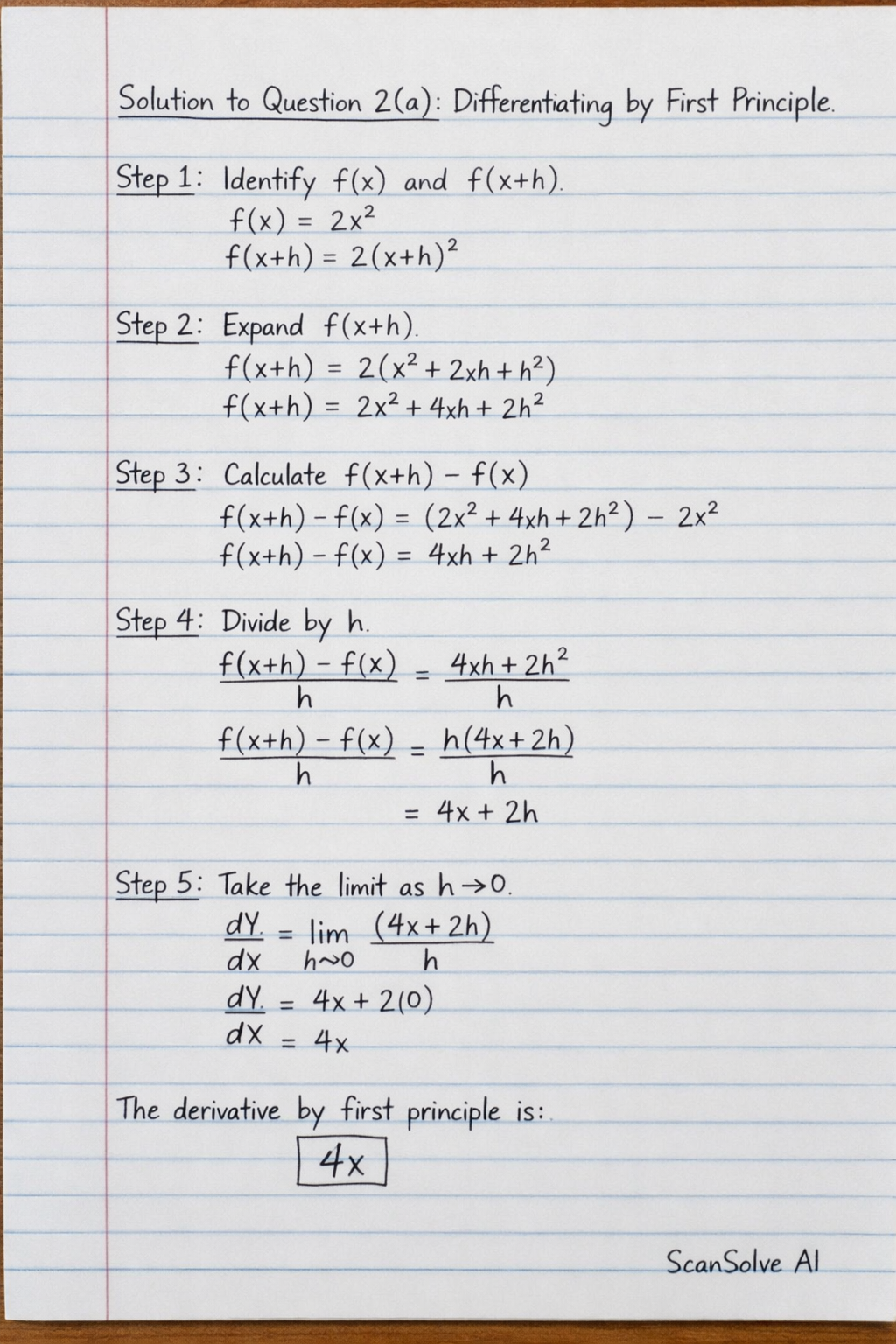
Handwritten Step-by-Step Solution
Get this as a handwritten image on WhatsApp — like a tutor wrote it for you.
Try on WhatsApp