

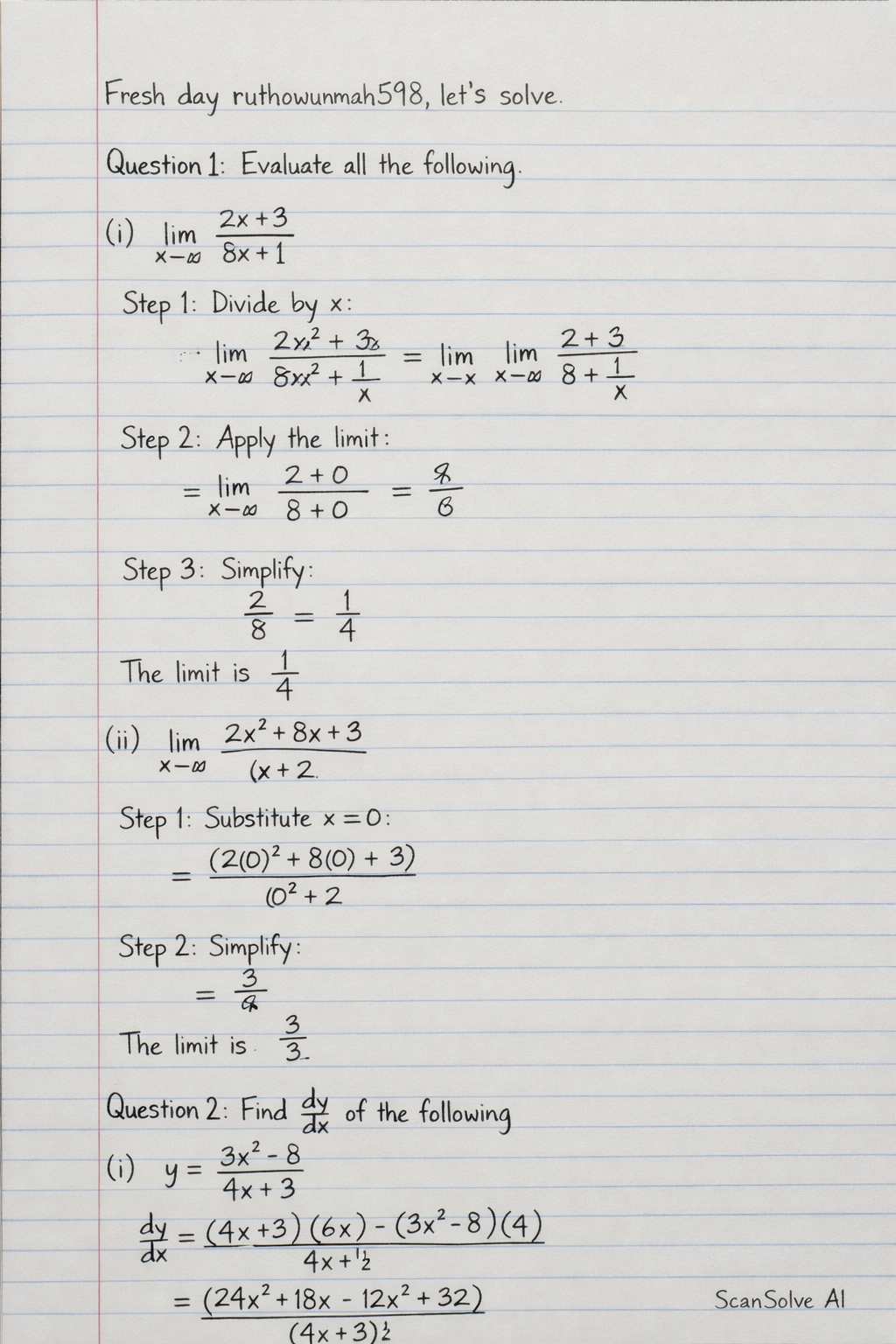
This mathematics problem involves applying core mathematical principles and formulas. Below you will find a complete step-by-step solution with detailed explanations for each step, helping you understand not just the answer but the method behind it.
ScanSolve AI Answer
Question 1: Evaluate all the following i) _x (2x+3)/(8x+1) Step 1: Divide the numerator and denominator by the highest power of x, which is x. _x (2x)/(x)+(3)/(x)(8x)/(x)+(1)/(x) = _x (2+3)/(x)8+(1)/(x) Step 2: Apply the limit. As x , (3)/(x) 0 and (1)/(x) 0. (2+0)/(8+0) = (2)/(8) Step 3: Simplify the fraction. (2)/(8) = (1)/(4) The limit is (1)/(4). ii) _x 0 (2x^2+8x+3)/(x^2+2) Step 1: Substitute x=0 into the expression, as the denominator is not zero at x=0. (2(0)^2+8(0)+3)/((0)^2+2) Step 2: Simplify the expression. (0+0+3)/(0+2) = (3)/(2) The limit is (3)/(2). Question 2: Find (dy)/(dx) of the following i) y = (3x^2-8)/(4x+3) Step 1: Apply the quotient rule, (dy)/(dx) = (u'v - uv')/(v^2), where u = 3x^2-8 and v = 4x+3. Then u' = 6x and v' = 4. (dy)/(dx) = ((6x)(4x+3) - (3x^2-8)(4))/((4x+3)^2) Step 2: Expand the terms in the numerator. (dy)/(dx) = (24x^2+18x - (12x^2-32))/((4x+3)^2) Step 3: Simplify the numerator by distributing the negative sign and combining like terms. (dy)/(dx) = (24x^2+18x - 12x^2+32)/((4x+3)^2) = (12x^2+18x+32)/((4x+3)^2) The derivative is (12x^2+18x+32)/((4x+3)^2). ii) y = (3x^3-8x^2-1)^6 Step 1: Apply the chain rule, (dy)/(dx) = n[f(x)]^n-1 · f'(x), where f(x) = 3x^3-8x^2-1 and n=6. First, find f'(x): f'(x) = (d)/(dx)(3x^3-8x^2-1) = 9x^2-16x. (dy)/(dx) = 6(3x^3-8x^2-1)^6-1 · (9x^2-16x) Step 2: Simplify the exponent and rearrange the terms. (dy)/(dx) = 6(9x^2-16x)(3x^3-8x^2-1)^5 The derivative is 6(9x^2-16x)(3x^3-8x^2-1)^5. iii) 4xy + y^2 = x^2+2 Step 1: Differentiate both sides of the equation with respect to x. Remember to use the product rule for 4xy and the chain rule for y^2. (d)/(dx)(4xy) + (d)/(dx)(y^2) = (d)/(dx)(x^2) + (d)/(dx)(2) (4 · y + 4x · (dy)/(dx)) + (2y · (dy)/(dx)) = 2x + 0 4y + 4x(dy)/(dx) + 2y(dy)/(dx) = 2x Step 2: Group terms containing (dy)/(dx) on one side and other terms on the other side. 4x(dy)/(dx) + 2y(dy)/(dx) = 2x - 4y Step 3: Factor out (dy)/(dx) from the terms on the left side. (dy)/(dx)(4x + 2y) = 2x - 4y Step 4: Solve for (dy)/(dx) by dividing both sides by (4x+2y). (dy)/(dx) = (2x - 4y)/(4x + 2y) Step 5: Simplify the expression by dividing the numerator and denominator by 2. (dy)/(dx) = (2(x - 2y))/(2(2x + y)) = (x - 2y)/(2x + y) The derivative is (x - 2y)/(2x + y). Send me the next one 📸