
We read your photo as:
Differentiate y = (x2+3x)(x−2) and find the gradient at x=1. Integrate (3x2+4x) dx and find the area under the curve from x=0 to x=2.
ScanSolve AI Answer
Use the left and right arrow keys to trace the curve, up and down to jump between key points, and plus and minus to zoom.
| Point | x | y |
|---|---|---|
| x-intercept | 0 | 0 |
| Minimum | 1.12 | −4.06 |
| x-intercept | 2 | 0 |
Step-by-step solution
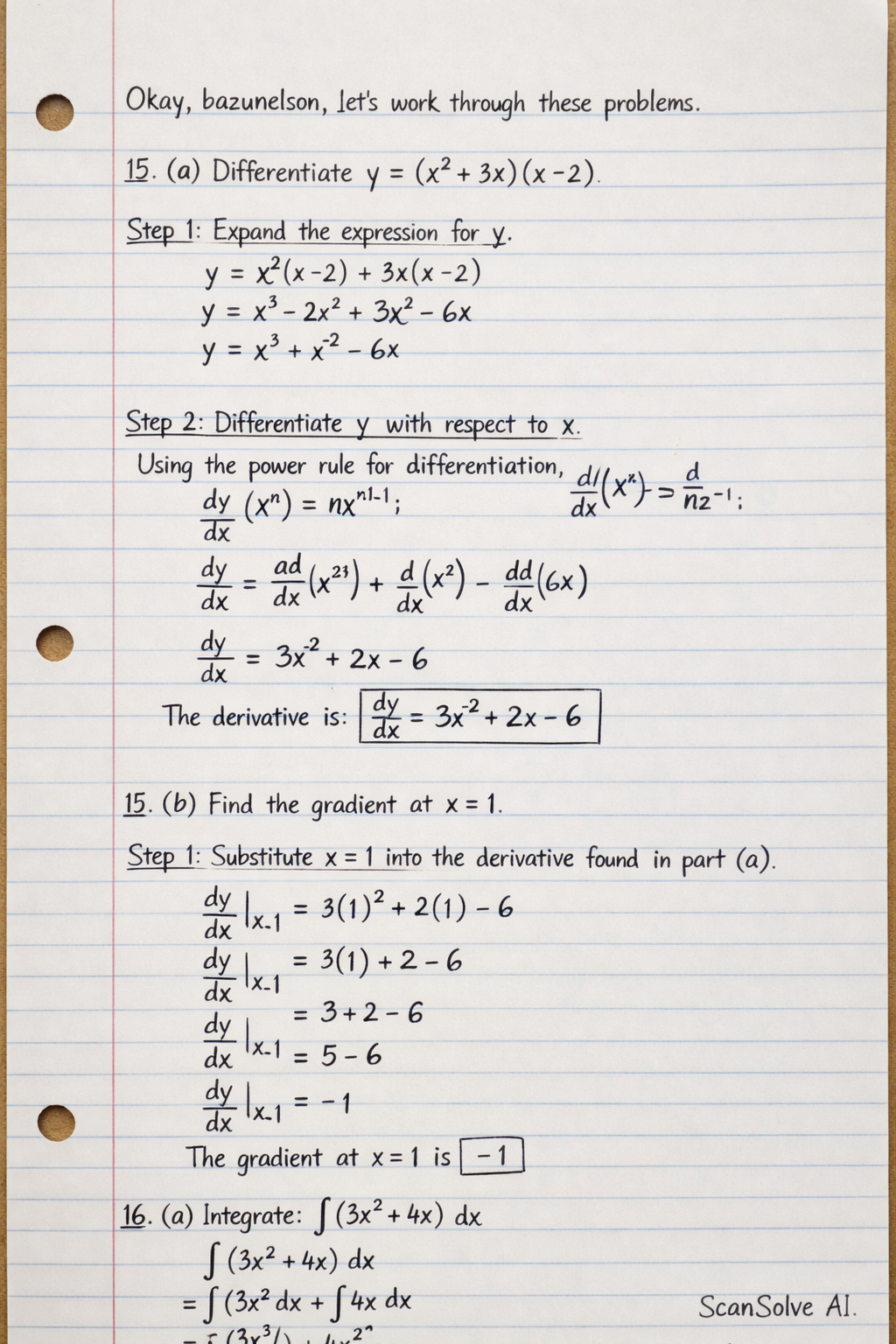
25 stepsOkay, bazuunelson, let's work through these problems.
15. (a) Differentiate
Expand the expression for .
Differentiate with respect to .
Using the power rule for differentiation, :
The derivative is .
15. (b) Find the gradient at
Substitute into the derivative found in part (a).
The gradient at is .
16. (a) Integrate:
Apply the power rule for integration, .
Simplify the expression.
The integral is .
16. (b) Find area under curve from to
Evaluate the definite integral using the result from part (a).
The area is given by .
Substitute the upper and lower limits.
The area under the curve is .
17. (a) Solve:
Express 16 as a power of 2.
Rewrite the equation with the same base.
Equate the exponents.
Solve for .
The solution is .
17. (b) Express your answer in simplest form
The answer from part (a) is . This is already in its simplest form.
The answer is .18. (a) A bag contains 4 red and 6 blue balls. Find probability of picking red
Determine the total number of balls.
Total balls = Number of red balls + Number of blue balls
Total balls =Calculate the probability of picking a red ball.
Probability (Red) =
Probability (Red) =Simplify the probability.
Probability (Red) =
The probability of picking a red ball is .18. (b) If two balls are picked, find probability both are red
Calculate the probability of the first ball being red.
Probability (1st Red) =
Calculate the probability of the second ball being red, given the first was red (without replacement).
After picking one red ball, there are 3 red balls left and a total of 9 balls.
Probability (2nd Red | 1st Red) =Multiply the probabilities to find the probability of both being red.
Probability (Both Red) = Probability (1st Red) Probability (2nd Red | 1st Red)
The probability of picking two red balls is .
19. (a) Find the equation of a circle with center and radius 4
Recall the standard equation of a circle.
The equation of a circle with center and radius is .
Substitute the given values.
Given center and radius .
The equation of the circle is .
19. (b) Find the area of the circle
Recall the formula for the area of a circle.
Area .
Substitute the given radius .
The area of the circle is .
20. (a) A sequence has first term 5 and common difference 3. Find the 15th term
Identify the type of sequence and the given values.
This is an arithmetic sequence with first term and common difference . We need to find the 15th term, so .
Use the formula for the -th term of an arithmetic sequence.
The 15th term is .
20. (b) Find the sum of first 15 terms
Use the formula for the sum of the first terms of an arithmetic sequence.
We can use . We have , , and from part (a).
Calculate the sum.
The sum of the first 15 terms is .
Still stuck on this one?
Ask a follow-up, and the answer starts from this question.
More Mathematics Questions
Handwritten Step-by-Step Solution
Get this as a handwritten image on WhatsApp — like a tutor wrote it for you.
Try on WhatsApp