

This mathematics problem involves applying core mathematical principles and formulas. Below you will find a complete step-by-step solution with detailed explanations for each step, helping you understand not just the answer but the method behind it.
ScanSolve AI Answer
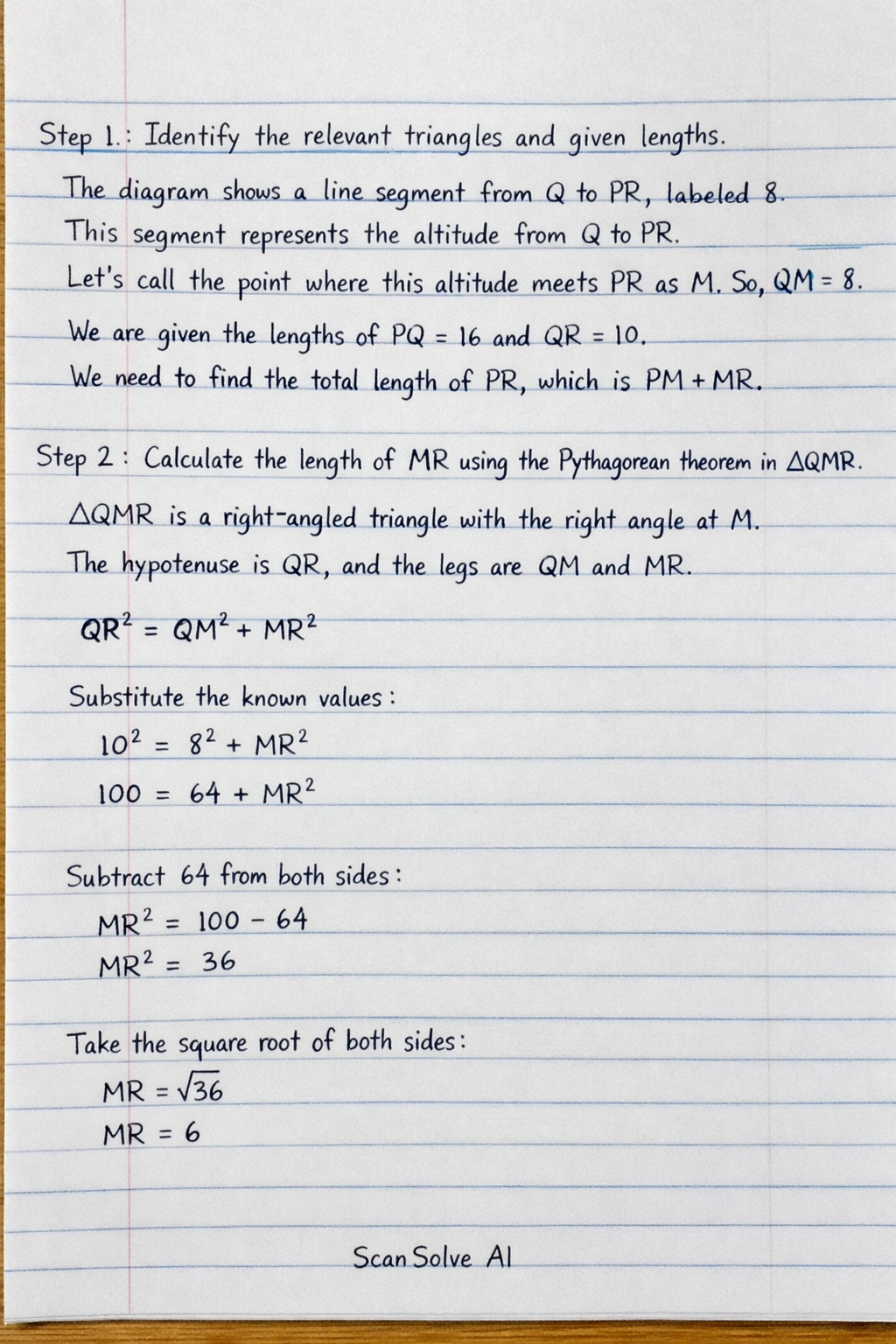
Step 1: Identify the relevant triangles and given lengths. The diagram shows a line segment from Q to PR, labeled 8. This segment represents the altitude from Q to PR. Let's call the point where this altitude meets PR as M. So, QM = 8. We are given the lengths of PQ = 16 and QR = 10. We need to find the total length of PR, which is PM + MR. Step 2: Calculate the length of MR using the Pythagorean theorem in QMR. QMR is a right-angled triangle with the right angle at M. The hypotenuse is QR, and the legs are QM and MR. QR^2 = QM^2 + MR^2 Substitute the known values: 10^2 = 8^2 + MR^2 100 = 64 + MR^2 Subtract 64 from both sides: MR^2 = 100 - 64 MR^2 = 36 Take the square root of both sides: MR = sqrt(36) MR = 6 Step 3: Calculate the length of PM using the Pythagorean theorem in PQM. PQM is also a right-angled triangle with the right angle at M. The hypotenuse is PQ, and the legs are QM and PM. PQ^2 = QM^2 + PM^2 Substitute the known values: 16^2 = 8^2 + PM^2 256 = 64 + PM^2 Subtract 64 from both sides: PM^2 = 256 - 64 PM^2 = 192 Take the square root of both sides: PM = sqrt(192) To simplify sqrt(192), find the largest perfect square factor: 192 = 64 × 3. PM = sqrt(64 × 3) = sqrt(64) × sqrt(3) = 8sqrt(3) Step 4: Calculate the total distance PR. The distance PR is the sum of PM and MR. PR = PM + MR PR = 8sqrt(3) + 6 Step 5: Calculate the numerical value and round to the nearest unit. Using the approximate value sqrt(3) ≈ 1.73205: PR ≈ 8 × 1.73205 + 6 PR ≈ 13.8564 + 6 PR ≈ 19.8564 Rounding to the nearest unit: PR ≈ 20 The distance from P to R is approximately 20 units. The distance from P to R is 20 units. That's 2 down. 3 left today — send the next one.