
We read your photo as:
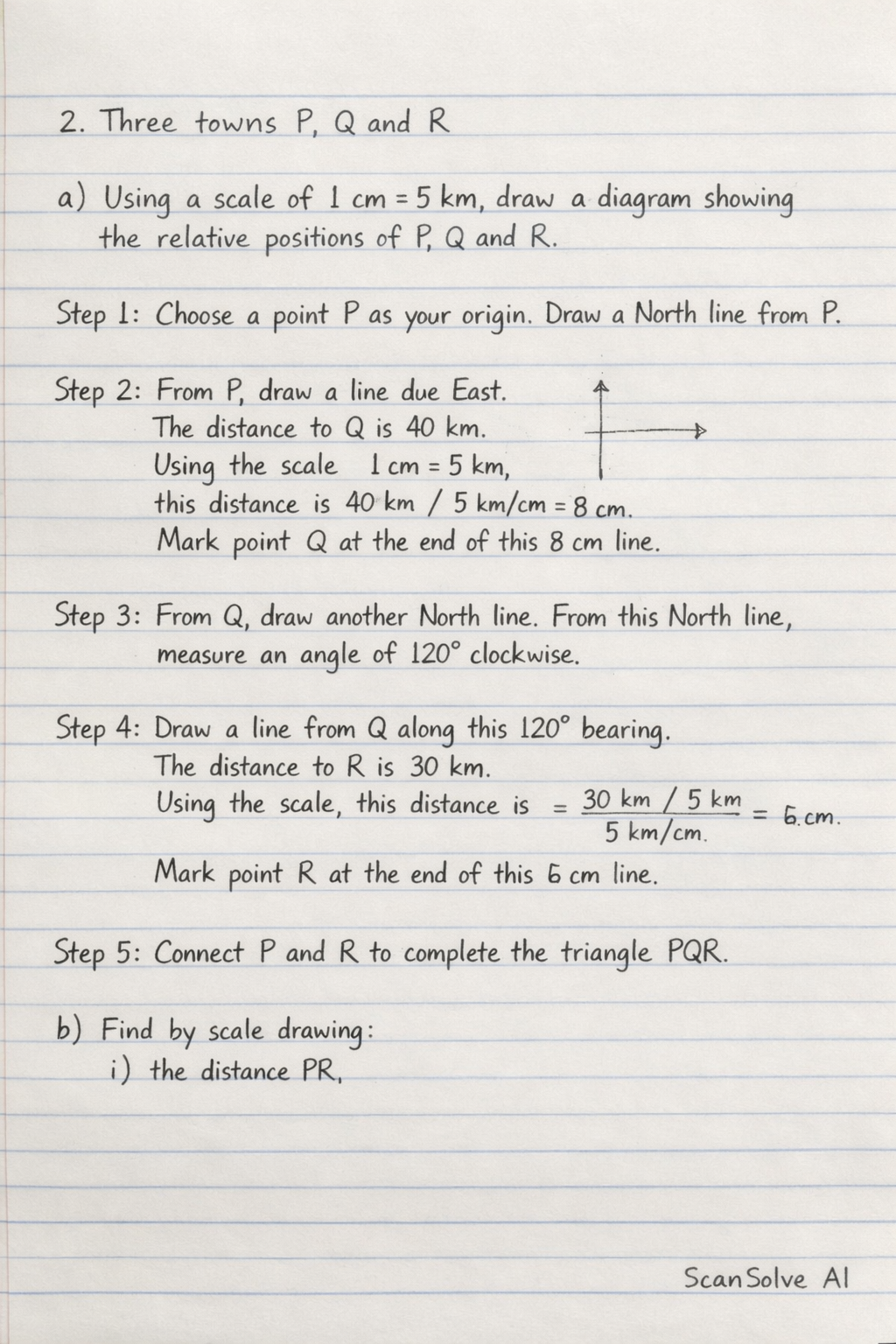
Three towns P, Q and R are such that Q is 40 km due east of P and R is 30 km on a bearing of 120° from Q. a) Using a scale of 1 cm to represent 5 km, draw a diagram showing the relative positions of P, Q and R. b) Find by scale drawing: i) the distance PR, ii) the bearing of P from R.
ScanSolve AI Answer
Answers
2 partsStep-by-step solution
9 stepshere are the solutions to your questions:
2. Three towns P, Q and R
Part a· 5 steps
Using a scale of 1 cm to represent 5 km, draw a diagram showing the relative positions of P, Q and R.
Choose a point P as your origin.
Draw a North line from P.
From P, draw a line due East.
The distance to Q is 40 km. Using the scale , this distance is . Mark point Q at the end of this 8 cm line.
From Q, draw another North line.
From this North line, measure an angle of clockwise.
Draw a line from Q along this bearing.
The distance to R is 30 km. Using the scale, this distance is . Mark point R at the end of this 6 cm line.
Connect P and R to complete the triangle PQR.
Part b(i)
the distance PR,
Find by scale drawing
Measure the length of the line PR on your scale diagram using a ruler.
Multiply the measured length (in cm) by the scale factor of to get the actual distance in kilometers.
- Note: As an AI, I cannot physically draw and measure. Therefore, I cannot provide the exact numerical answer from a scale drawing. However, if you perform the drawing accurately, you should measure PR to be approximately , which corresponds to an actual distance of approximately .
Part b(ii)
the bearing of P from R.
From point R on your diagram, draw a North line.
Using a protractor, measure the angle clockwise from this North line to the line segment RP.
- Note: As an AI, I cannot physically draw and measure. Therefore, I cannot provide the exact numerical answer from a scale drawing. However, if you perform the drawing accurately, you should measure the bearing to be approximately .
3. Without using a calculator or logarithm tables, evaluate:
The expression to be evaluated in question 3 is not clear in the image. Please provide the expression so I can help you solve it.
Try one yourself
A new problem that tests the same skill.
Still stuck on this one?
Ask a follow-up, and the answer starts from this question.
More Mathematics Questions
Handwritten Step-by-Step Solution
Get this as a handwritten image on WhatsApp — like a tutor wrote it for you.
Try on WhatsApp