
We read your photo as:
For each diagram, find: the bearing of P from Q.
ScanSolve AI Answer
Answers
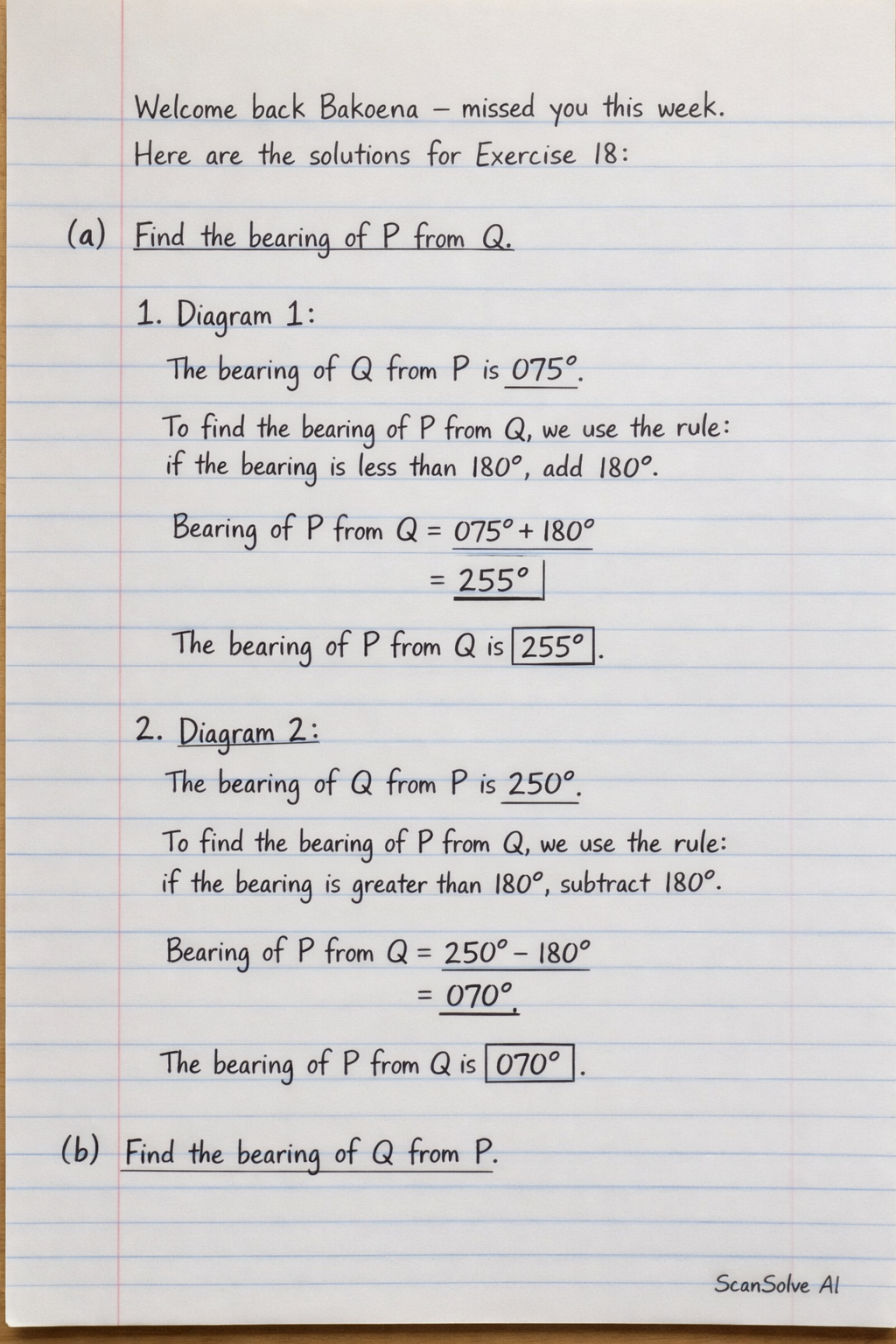
2 partsa) Find the bearing of P from Q.
1. Diagram 1:
The bearing of Q from P is .
To find the bearing of P from Q, we use the rule: if the bearing is less than , add .
The bearing of P from Q is .
2. Diagram 2:
The bearing of Q from P is .
To find the bearing of P from Q, we use the rule: if the bearing is greater than , subtract .
The bearing of P from Q is .
b) Find the bearing of Q from P.
3. Diagram 3:
The bearing of Q from P is given as .
(Assuming the question intends for us to find the reverse bearing, i.e., the bearing of P from Q, as is common in these exercises and consistent with part a). If it literally means "find the bearing of Q from P" when it's already given, the answer is simply . I will proceed with finding the bearing of P from Q.)
The bearing of Q from P is .
To find the bearing of P from Q, we use the rule: if the bearing is less than , add .
The bearing of P from Q is .
4. Diagram 4:
The diagram shows the bearing of P from Q is .
To find the bearing of Q from P, we use the rule: if the bearing is less than , add .
The bearing of Q from P is .
Try one yourself
A new problem that tests the same skill.
Still stuck on this one?
Ask a follow-up, and the answer starts from this question.
More Mathematics Questions
Handwritten Step-by-Step Solution
Get this as a handwritten image on WhatsApp — like a tutor wrote it for you.
Try on WhatsApp