We read your photo as:

In the diagram, /PQ/ = 8 m, /QR/ = 13 m, the bearing of Q from P is 050° and the bearing of R from Q is 130°. Calculate correct to three significant figures, PR (ii) the bearing of R from P; Calculate the shortest distance between point Q and PR, hence the area of triangle PQR. (WASSCE)

Mathematics

ScanSolve AI Answer

Step-by-step solution

6 steps

Here are the calculations for the problem:

Part (a)(i): Calculate PR

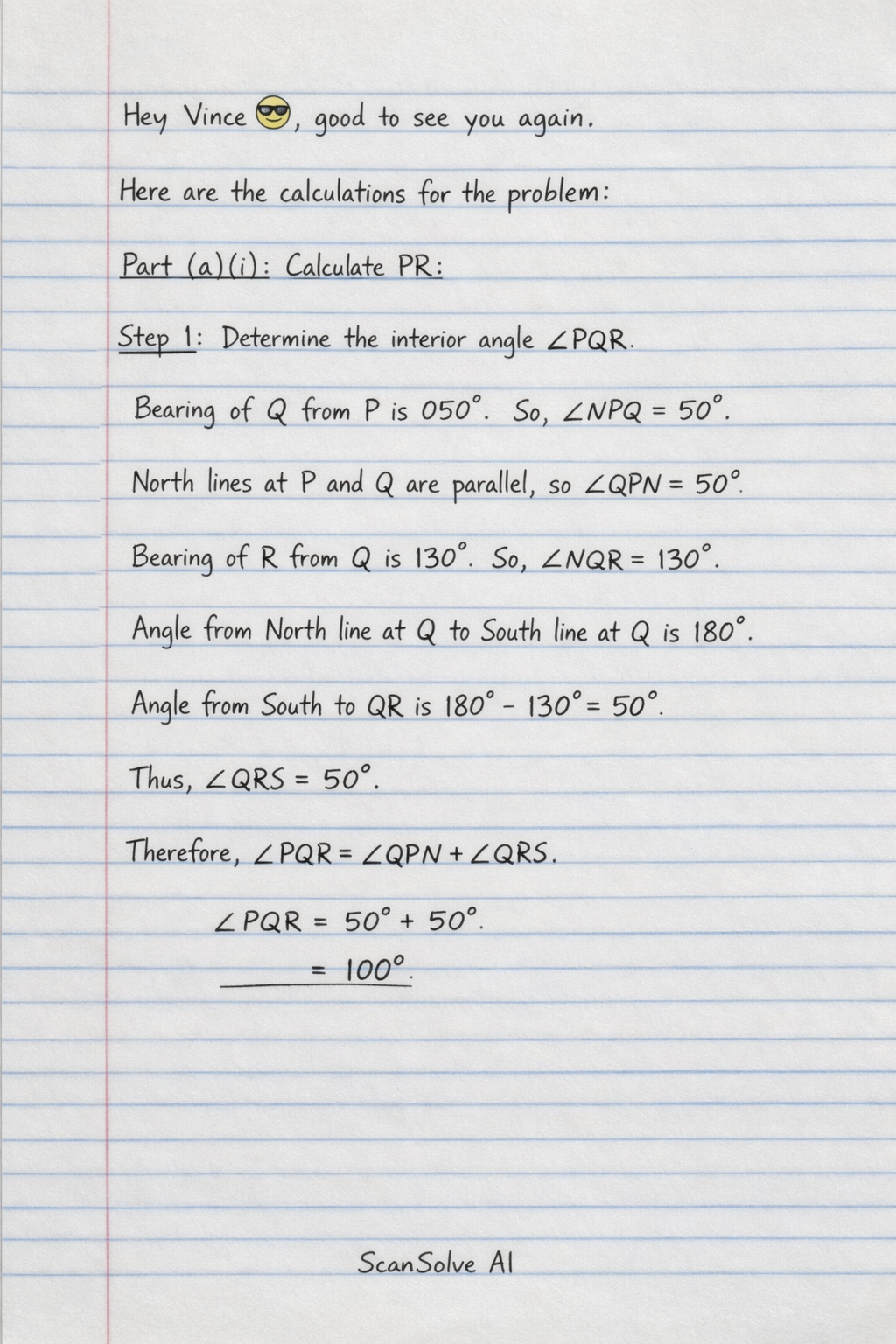
  1. Determine the interior angle ∠PQR\angle PQR.

    The bearing of QQ from PP is 050∘050^\circ. This means the angle from the North line at PP, clockwise to PQPQ, is 50∘50^\circ.
    Since the North lines at PP and QQ are parallel, the alternate interior angle between the North line at QQ (pointing North) and QPQP is 50∘50^\circ.
    The bearing of RR from QQ is 130∘130^\circ. This is the angle from the North line at QQ, clockwise to QRQR.
    The angle from the North line at QQ, clockwise to the South line at QQ is 180∘180^\circ.
    Therefore, the angle between the South line at QQ and QRQR (measured anti-clockwise from South) is 180∘−130∘=50∘180^\circ - 130^\circ = 50^\circ.
    The angle ∠PQR\angle PQR is the sum of the angle between QPQP and the North line at QQ (west side) and the angle between QRQR and the South line at QQ (west side).

    ∠PQR=50∘+50∘=100∘\angle PQR = 50^\circ + 50^\circ = 100^\circ
  2. Calculate the distance PRPR using the Cosine Rule.

    The Cosine Rule states c2=a2+b2−2abcos⁡Cc^2 = a^2 + b^2 - 2ab \cos C. Here, PR2=PQ2+QR2−2(PQ)(QR)cos⁡(∠PQR)PR^2 = PQ^2 + QR^2 - 2(PQ)(QR)\cos(\angle PQR).

    PR2=82+132−2(8)(13)cos⁡(100∘)PR^2 = 8^2 + 13^2 - 2(8)(13)\cos(100^\circ) PR2=64+169−208(−0.1736)PR^2 = 64 + 169 - 208(-0.1736) PR2=233+36.11878PR^2 = 233 + 36.11878 PR2=269.11878PR^2 = 269.11878 PR=269.11878≈16.40489 mPR = \sqrt{269.11878} \approx 16.40489 \text{ m}

    Rounding to three significant figures:

    PR≈16.4 mPR \approx \boxed{\text{16.4 m}}

    Part (a)(ii): Calculate the bearing of R from P

  3. Calculate ∠QPR\angle QPR using the Sine Rule.

    The Sine Rule states asin⁡A=bsin⁡B\frac{a}{\sin A} = \frac{b}{\sin B}. Here, QRsin⁡(∠QPR)=PRsin⁡(∠PQR)\frac{QR}{\sin(\angle QPR)} = \frac{PR}{\sin(\angle PQR)}.

    13sin⁡(∠QPR)=16.40489sin⁡(100∘)\frac{13}{\sin(\angle QPR)} = \frac{16.40489}{\sin(100^\circ)} sin⁡(∠QPR)=13sin⁡(100∘)16.40489\sin(\angle QPR) = \frac{13 \sin(100^\circ)}{16.40489} sin⁡(∠QPR)=13×0.9848077516.40489≈0.77980\sin(\angle QPR) = \frac{13 \times 0.98480775}{16.40489} \approx 0.77980 ∠QPR=arcsin⁡(0.77980)≈51.25∘\angle QPR = \arcsin(0.77980) \approx 51.25^\circ
  4. Calculate the bearing of RR from PP.

    The bearing of QQ from PP is 050∘050^\circ. The bearing of RR from PP is the bearing of QQ from PP plus ∠QPR\angle QPR.

    Bearing of R from P=50∘+51.25∘=101.25∘\text{Bearing of R from P} = 50^\circ + 51.25^\circ = 101.25^\circ

    Rounding to three significant figures:

    Bearing of R from P≈101∘\text{Bearing of R from P} \approx \boxed{101^\circ}

    Part (b): Calculate the shortest distance between point Q and line PR, hence the area of triangle PQR.

  5. Calculate the shortest distance from QQ to PRPR.

    The shortest distance is the altitude (height) from QQ to the base PRPR. Let this distance be hh.
    In the right-angled triangle formed by QQ, PP, and the foot of the perpendicular from QQ to PRPR, we have:

    h=PQsin⁡(∠QPR)h = PQ \sin(\angle QPR) h=8sin⁡(51.25∘)h = 8 \sin(51.25^\circ) h=8×0.7800≈6.240 mh = 8 \times 0.7800 \approx 6.240 \text{ m}

    Rounding to three significant figures:

    Shortest distance≈6.24 m\text{Shortest distance} \approx \boxed{6.24 \text{ m}}
  6. Calculate the area of triangle PQRPQR.

    The area of a triangle can be calculated using the formula: Area =12absin⁡C= \frac{1}{2}ab\sin C.

    Area of △PQR=12(PQ)(QR)sin⁡(∠PQR)\text{Area of } \triangle PQR = \frac{1}{2} (PQ)(QR)\sin(\angle PQR) Area of △PQR=12(8)(13)sin⁡(100∘)\text{Area of } \triangle PQR = \frac{1}{2} (8)(13)\sin(100^\circ) Area of △PQR=52×0.98480775\text{Area of } \triangle PQR = 52 \times 0.98480775 Area of △PQR≈51.20999 m2\text{Area of } \triangle PQR \approx 51.20999 \text{ m}^2

    Rounding to three significant figures:

    Area of △PQR≈51.2 m2\text{Area of } \triangle PQR \approx \boxed{51.2 \text{ m}^2}
Was this helpful?

Still stuck on this one?

Ask a follow-up, and the answer starts from this question.

Got a different question?Ask your own question
Handwritten step-by-step solution preview

Handwritten Step-by-Step Solution

Get this as a handwritten image on WhatsApp — like a tutor wrote it for you.

Try on WhatsApp