
We read your photo as:
Given the bearing of P from Q is 228^ and QPR = 72^, and R is due south of Q, find the bearing of Q from P and the bearing of P from R.
ScanSolve AI Answer
Answers
2 partsStep-by-step solution
5 stepsHere's how to solve the bearing problem:
Part a· 2 steps
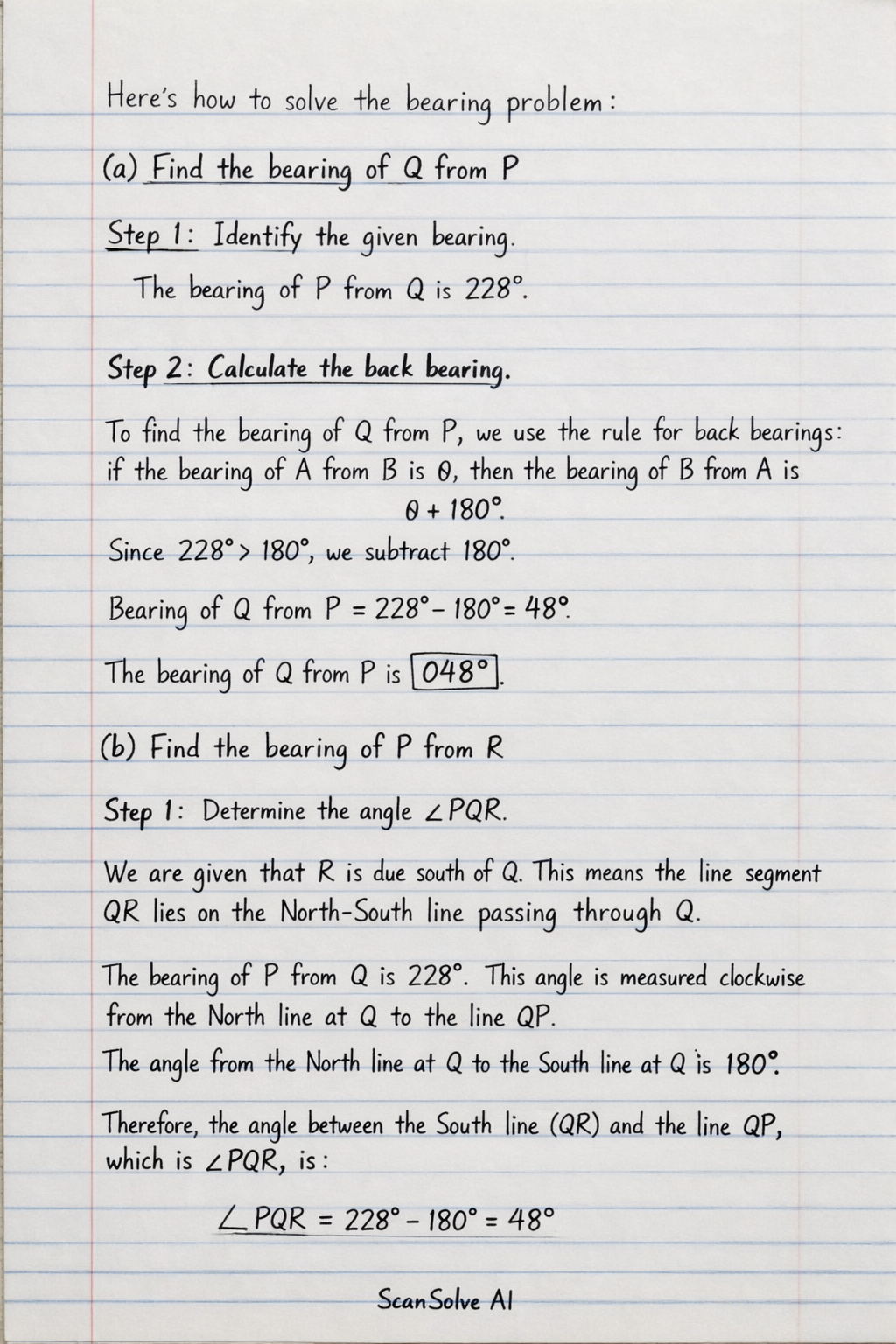
Find the bearing of Q from P
Identify the given bearing.
The bearing of P from Q is .
Calculate the back bearing.
To find the bearing of Q from P, we use the rule for back bearings: if the bearing of A from B is , then the bearing of B from A is . Since , we subtract .
The bearing of Q from P is .
Part b
Find the bearing of P from R
Determine the angle .
We are given that R is due south of Q. This means the line segment QR lies on the North-South line passing through Q.
The bearing of P from Q is . This angle is measured clockwise from the North line at Q to the line QP.
The angle from the North line at Q to the South line at Q is .
Therefore, the angle between the South line (QR) and the line QP, which is , is:Determine the angle in triangle PQR.
We know the sum of angles in a triangle is .
Given .
From Step 1, .
So,Determine the bearing of P from R.
Since R is due south of Q, the line segment RQ points North from R. This means the North line at R is along RQ.
The bearing of P from R is the angle measured clockwise from the North line at R (which is RQ) to the line segment RP.
This angle is exactly .
Therefore, the bearing of P from R is . As a three-figure bearing, it is .
The bearing of P from R is .
Try one yourself
A new problem that tests the same skill.
Still stuck on this one?
Ask a follow-up, and the answer starts from this question.
More Mathematics Questions
Handwritten Step-by-Step Solution
Get this as a handwritten image on WhatsApp — like a tutor wrote it for you.
Try on WhatsApp