

This mathematics problem involves applying core mathematical principles and formulas. Below you will find a complete step-by-step solution with detailed explanations for each step, helping you understand not just the answer but the method behind it.
ScanSolve AI Answer
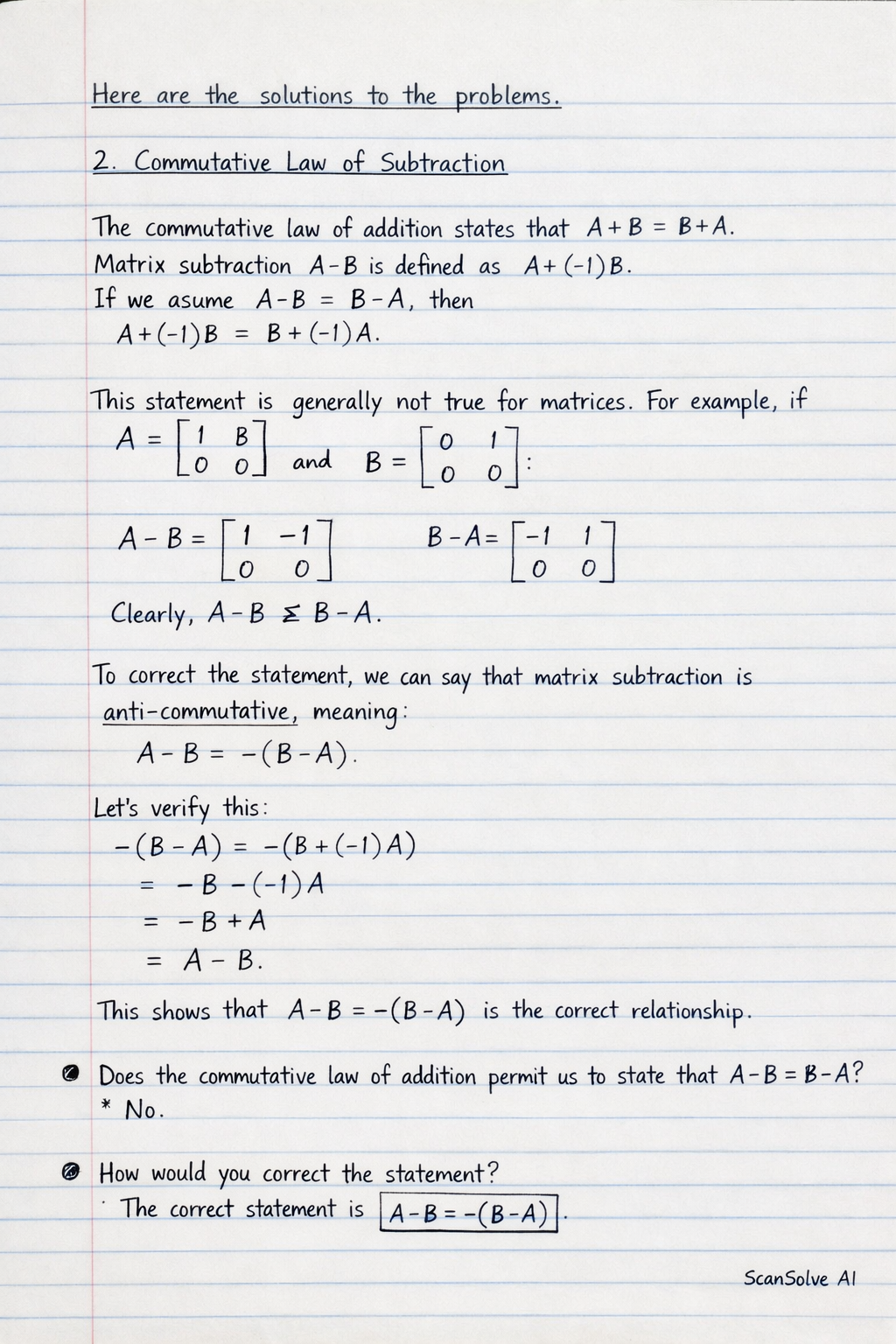
Here are the solutions to the problems. 2. Commutative Law of Subtraction The commutative law of addition states that A+B = B+A. Matrix subtraction A-B is defined as A+(-1)B. If we assume A-B = B-A, then A+(-1)B = B+(-1)A. This statement is generally not true for matrices. For example, if A = 1 & 0 \\ 0 & 0 and B = 0 & 1 \\ 0 & 0 : A-B = 1 & -1 \\ 0 & 0 B-A = -1 & 1 \\ 0 & 0 Clearly, A-B ≠ B-A. The commutative law of addition does not apply directly to subtraction in this way. To correct the statement, we can say that matrix subtraction is anti-commutative, meaning: A-B = -(B-A) Let's verify this: -(B-A) = -(B+(-1)A) = -B - (-1)A = -B + A = A-B This shows that A-B = -(B-A) is the correct relationship. Does the commutative law of addition permit us to state that A-B = B-A? ❌ No. How would you correct the statement? The correct statement is A-B = -(B-A). 3. Test the associative law of multiplication with the following matrices: Given matrices: A = 5 & 3 \\ 0 & 5 , B = -8 & 0 & 7 \\ 1 & 3 & 2 , C = 1 \\ 0 \\ 7 The associative law of multiplication states that (AB)C = A(BC). Step 1: Calculate AB. AB = 5 & 3 \\ 0 & 5 -8 & 0 & 7 \\ 1 & 3 & 2 AB = (5)(-8)+(3)(1) & (5)(0)+(3)(3) & (5)(7)+(3)(2) \\ (0)(-8)+(5)(1) & (0)(0)+(5)(3) & (0)(7)+(5)(2) AB = -40+3 & 0+9 & 35+6 \\ 0+5 & 0+15 & 0+10 AB = -37 & 9 & 41 \\ 5 & 15 & 10 Step 2: Calculate (AB)C. (AB)C = -37 & 9 & 41 \\ 5 & 15 & 10 1 \\ 0 \\ 7 (AB)C = (-37)(1)+(9)(0)+(41)(7) \\ (5)(1)+(15)(0)+(10)(7) (AB)C = -37+0+287 \\ 5+0+70 (AB)C = 250 \\ 75 Step 3: Calculate BC. BC = -8 & 0 & 7 \\ 1 & 3 & 2 1 \\ 0 \\ 7 BC = (-8)(1)+(0)(0)+(7)(7) \\ (1)(1)+(3)(0)+(2)(7) BC = -8+0+49 \\ 1+0+14 BC = 41 \\ 15 Step 4: Calculate A(BC). A(BC) = 5 & 3 \\ 0 & 5 41 \\ 15 A(BC) = (5)(41)+(3)(15) \\ (0)(41)+(5)(15) A(BC) = 205+45 \\ 0+75 A(BC) = 250 \\ 75 Step 5: Compare the results. Since (AB)C = 250 \\ 75 and A(BC) = 250 \\ 75 , we have (AB)C = A(BC). The associative law of multiplication is verified for these matrices. Verified