
We read your photo as:
Write down the bearing of P from A. Find the exact length of AC.
ScanSolve AI Answer
Answer
Step-by-step solution
11 steps2. Write down the bearing of P from A.
Identify the reference point and direction.
The bearing is "from A", so we start at point A. Bearings are measured clockwise from the North line.
Read the angle from the diagram.
The diagram shows an angle of measured clockwise from the North line at A to the line segment AP.
Express the bearing in three digits.
Bearings are always written with three digits.
The bearing of P from A is .3. Find the exact length of AC.
Identify the known values in the right-angled triangle.
We have a right-angled triangle ABC, with .
The angle .
The length of the side adjacent to is .
We need to find the length of the side opposite to , which is AC.Choose the appropriate trigonometric ratio.
Since we know the adjacent side and want to find the opposite side relative to , we use the tangent function:
Substitute the known values into the formula.
Solve for AC.
Substitute the exact value of .
The exact value of is or .
The exact length of AC is .
4. Q is due East of R and due South of P. The bearing of R from P is 230°. Show this information on the diagram.
Since there is no diagram provided for this question, here's how you would construct and label it:
Draw the points and their relative positions.
- Draw point P at the top.
- Since Q is due South of P, draw a vertical line segment downwards from P and label the end point Q. This line segment PQ represents the North-South direction.
- Since Q is due East of R, draw a horizontal line segment to the left from Q and label the end point R. This line segment RQ represents the East-West direction.
- Connect points P and R to form a triangle PQR. The angle at Q () will be .
Mark the bearing of R from P.
- At point P, draw a North line pointing vertically upwards.
- Measure clockwise from this North line. Draw a line from P in this direction, which will be the line segment PR.
- The angle between the North line at P and the line PR, measured clockwise, is .
Deduce the angle inside the triangle.
- The line PQ points South from P. The angle from the North line to the South line (PQ) is .
- The angle from the South line (PQ) to the line PR, measured clockwise, is . So, .
Try one yourself
A new problem that tests the same skill.
Still stuck on this one?
Ask a follow-up, and the answer starts from this question.
More Mathematics Questions
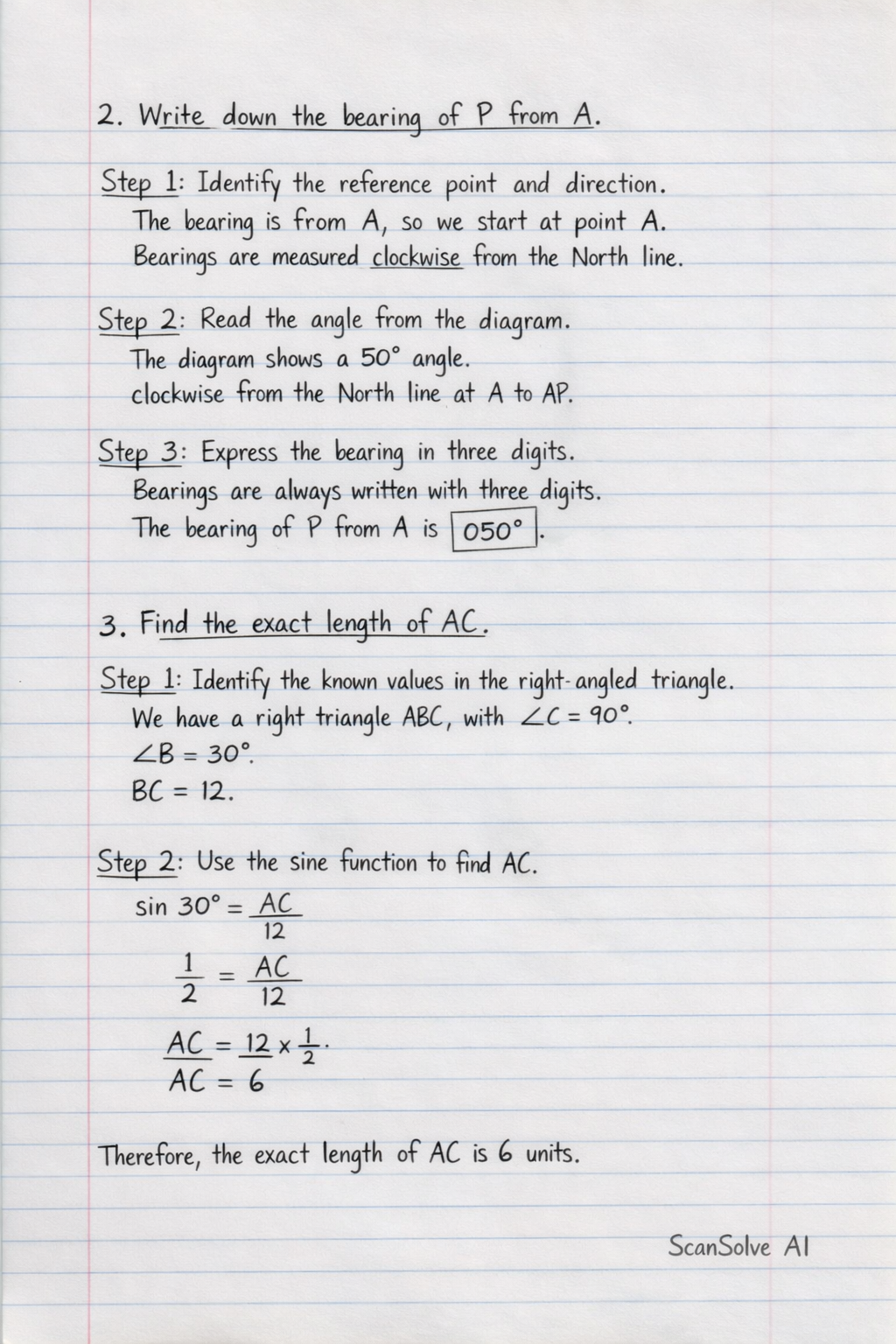
Handwritten Step-by-Step Solution
Get this as a handwritten image on WhatsApp — like a tutor wrote it for you.
Try on WhatsApp