Draw a table for the mapping defined by the rule x → 2x² - 2 on the domain -1, 0, 1, 2, 3, 4.

Mathematics
Draw a table for the mapping defined by the rule x → 2x² - 2 on the domain -1, 0, 1, 2, 3, 4.

ScanSolve AI Answer

Answer

*120*\text{*}120^\circ\text{*}

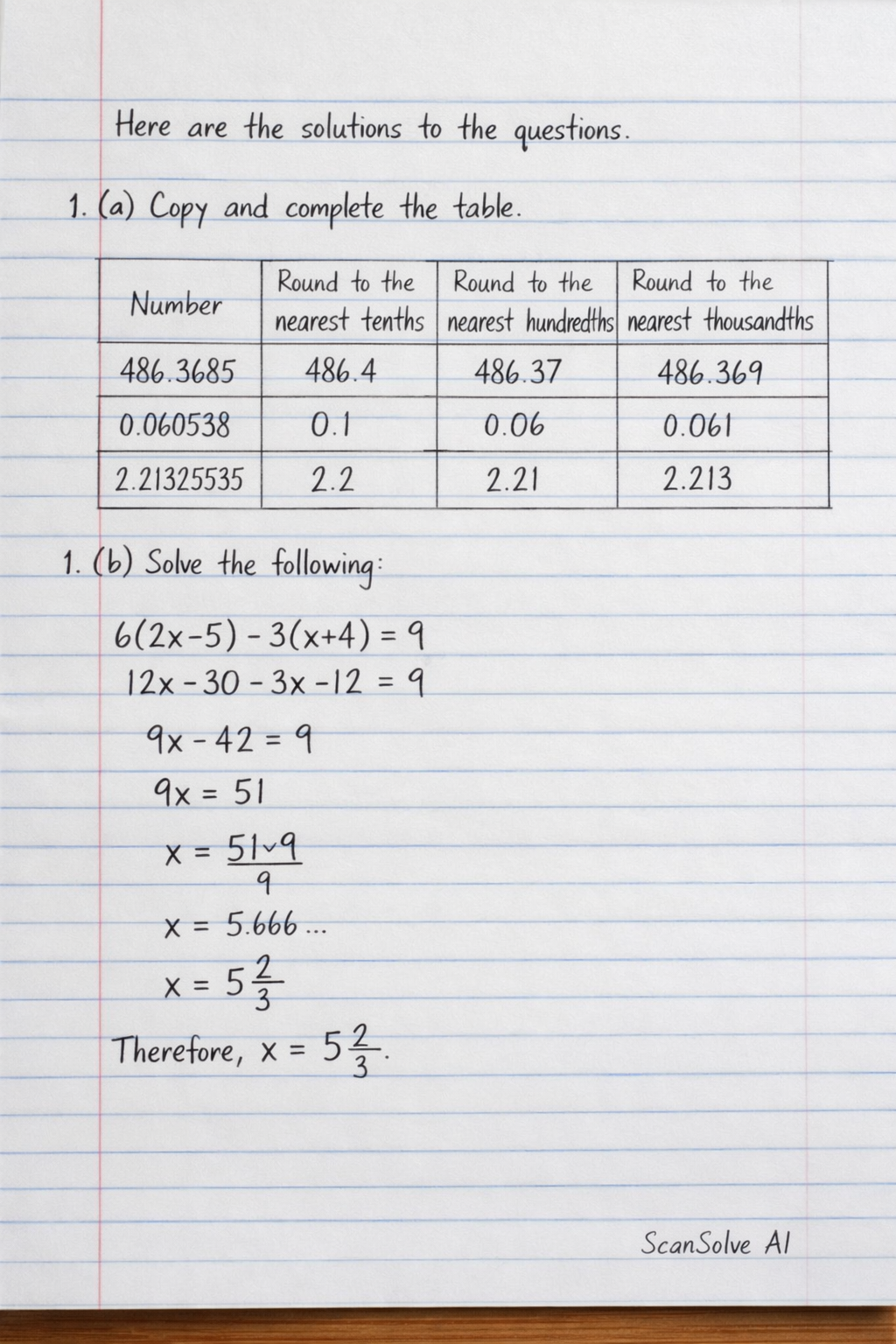
Here are the solutions to the questions.

1. (a) Copy and complete the table.

| Number | Round to the nearest tenths | Round to the nearest hundredths | Round to the nearest thousandths | | :------------ | :-------------------------- | :------------------------------ | :------------------------------- | | 486.3685486.3685 | 486.4486.4 | 486.37486.37 | 486.369486.369 | | 0.0605380.060538 | 0.10.1 | 0.060.06 | 0.0610.061 | | 2.213255352.21325535 | 2.22.2 | 2.212.21 | 2.2132.213 |

1. (b) Solve the following:

  • a) Between two supplementary angles, one angle is twice the other. Find the size of the larger angle. Step 1: Let the two supplementary angles be xx and yy. Since they are supplementary, their sum is 180180^\circ. x+y=180x + y = 180^\circ Step 2: One angle is twice the other, so let y=2xy = 2x. Substitute this into the equation. x+2x=180x + 2x = 180^\circ 3x=1803x = 180^\circ Step 3: Solve for xx. x=1803=60x = \frac{180^\circ}{3} = 60^\circ Step 4: Find the other angle, yy. y=2x=2(60)=120y = 2x = 2(60^\circ) = 120^\circ The larger angle is 120\boxed{*120^\circ*}

  • b) If one part of a complementary angle is 4545^\circ, what is the value of the other side? Step 1: Let the two complementary angles be AA and BB. Since they are complementary, their sum is 9090^\circ. A+B=90A + B = 90^\circ Step 2: Given one angle is 4545^\circ, substitute A=45A = 45^\circ. 45+B=9045^\circ + B = 90^\circ Step 3: Solve for BB. B=9045=45B = 90^\circ - 45^\circ = 45^\circ The value of the other angle is 45\boxed{*45^\circ*}

1. (c) Agogo standing at point P on a school soccer field, moved 20 steps due east to a point Q and then moved 10 steps due south to a point R. Illustrate the movement of Agogo with a diagram. A diagram illustrating the movement would show: • A starting point labeled P. • An arrow pointing right (East) from P, labeled "20 steps", ending at point Q. • An arrow pointing down (South) from Q, labeled "10 steps", ending at point R.

2. (a) Draw a table for the mapping defined by the rule x2x22x \rightarrow 2x^2 - 2 on the domain {1,0,1,2,3,4}\{-1, 0, 1, 2, 3, 4\}.

| xx | y=2x22y = 2x^2 - 2 | | :-- | :------------- | | 1-1 | 2(1)22=2(1)2=02(-1)^2 - 2 = 2(1) - 2 = 0 | | 00 | 2(0)22=2(0)2=22(0)^2 - 2 = 2(0) - 2 = -2 | | 11 | 2(1)22=2(1)2=02(1)^2 - 2 = 2(1) - 2 = 0 | | 22 | 2(2)22=2(4)2=62(2)^2 - 2 = 2(4) - 2 = 6 | | 33 | 2(3)22=2(9)2=162(3)^2 - 2 = 2(9) - 2 = 16 | | 44 | 2(4)22=2(16)2=302(4)^2 - 2 = 2(16) - 2 = 30 |

2. (b) Simplify the following algebraic expressions:

  • i) 3y+2x(x+y)x2+y3y + 2x(x+y) - x^2 + y Step 1: Distribute 2x2x into the parenthesis. 3y+2x2+2xyx2+y3y + 2x^2 + 2xy - x^2 + y Step 2: Group like terms. (3y+y)+(2x2x2)+2xy(3y + y) + (2x^2 - x^2) + 2xy Step 3: Combine like terms. 4y+x2+2xy\boxed{*4y + x^2 + 2xy*}

  • ii) 2a2a(a+2x)+42a - 2a(a+2x) + 4 Step 1: Distribute 2a-2a into the parenthesis. 2a2a24ax+42a - 2a^2 - 4ax + 4 Step 2: The terms are already simplified as there are no like terms to combine. 2a2a24ax+4\boxed{*2a - 2a^2 - 4ax + 4*}

2. (c) The mean (average) of five consecutive natural numbers is 11. Find the first of these numbers. Step 1: Let the first natural number be nn. The five consecutive natural numbers are n,n+1,n+2,n+3,n+4n, n+1, n+2, n+3, n+4. Step 2: Calculate their sum. Sum=n+(n+1)+(n+2)+(n+3)+(n+4)=5n+10\text{Sum} = n + (n+1) + (n+2) + (n+3) + (n+4) = 5n + 10 Step 3: The mean is the sum divided by the count (5). Set this equal to 11. 5n+105=11\frac{5n + 10}{5} = 11 Step 4: Simplify the equation. n+2=11n + 2 = 11 Step 5: Solve for nn. n=112=9n = 11 - 2 = 9 The first of these numbers is 9\boxed{*9*}

3. Complete the table.

First, calculate the total frequency: Total Frequency = 8+7+13+15+5=488 + 7 + 13 + 15 + 5 = 48.

Now, calculate the Angle of Sector for each brand using the formula: Angle=(FrequencyTotalFrequency)×360\text{Angle} = \left(\frac{Frequency}{Total Frequency}\right) \times 360^\circ.

  • Nokia: (848)×360=60\left(\frac{8}{48}\right) \times 360^\circ = 60^\circ
  • Samsung: (748)×360=52.5\left(\frac{7}{48}\right) \times 360^\circ = 52.5^\circ
  • Techno: (1348)×360=97.5\left(\frac{13}{48}\right) \times 360^\circ = 97.5^\circ
  • iPhone: (1548)×360=112.5\left(\frac{15}{48}\right) \times 360^\circ = 112.5^\circ
  • LG: (548)×360=37.5\left(\frac{5}{48}\right) \times 360^\circ = 37.5^\circ

| Phone brand | Tally | Frequency | Angle of sector | | :---------- | :-------------- | :-------- | :-------------- | | Nokia | |||| ||| | 8 | 6060^\circ | | Samsung | |||| || | 7 | 52.552.5^\circ | | Techno | |||| |||| ||| | 13 | 97.597.5^\circ | | iPhone | |||| |||| |||| | 15 | 112.5112.5^\circ | | LG | |||| | 5 | 37.537.5^\circ |

That's 2 down. 3 left today — send the next one.

Was this helpful?

Need help with your own homework?

Get instant step-by-step solutions to any question. Free to start.

Ask Your Question
Handwritten step-by-step solution preview

Handwritten Step-by-Step Solution

Get this as a handwritten image on WhatsApp — like a tutor wrote it for you.

Try on WhatsApp

Still have questions?

Quick Answer

------------ | :-------------------------- | :------------------------------ | :------------------------------- | | 486.3685 | 486.4 | 486.37 | 486.369 | | 0.060538 | 0.1 | 0.06 | 0.061 | | 2.21325535 | 2.2 | 2.21 | 2.213 | 1.

Draw a table for the mapping defined by the rule x → 2x² - 2 on the domain -1, 0, 1, 2, 3, 4.
Mathematics

This mathematics problem involves applying core mathematical principles and formulas. Below you will find a complete step-by-step solution with detailed explanations for each step, helping you understand not just the answer but the method behind it.

ScanSolve AI Answer
Here are the solutions to the questions. 1. (a) Copy and complete the table. | Number | Round to the nearest tenths | Round to the nearest hundredths | Round to the nearest thousandths | | :------------ | :-------------------------- | :------------------------------ | :------------------------------- | | 486.3685 | 486.4 | 486.37 | 486.369 | | 0.060538 | 0.1 | 0.06 | 0.061 | | 2.21325535 | 2.2 | 2.21 | 2.213 | 1. (b) Solve the following: a) Between two supplementary angles, one angle is twice the other. Find the size of the larger angle. Step 1: Let the two supplementary angles be x and y. Since they are supplementary, their sum is 180^. x + y = 180^ Step 2: One angle is twice the other, so let y = 2x. Substitute this into the equation. x + 2x = 180^ 3x = 180^ Step 3: Solve for x. x = (180^)/(3) = 60^ Step 4: Find the other angle, y. y = 2x = 2(60^) = 120^ The larger angle is 120^ b) If one part of a complementary angle is 45^, what is the value of the other side? Step 1: Let the two complementary angles be A and B. Since they are complementary, their sum is 90^. A + B = 90^ Step 2: Given one angle is 45^, substitute A = 45^. 45^ + B = 90^ Step 3: Solve for B. B = 90^ - 45^ = 45^ The value of the other angle is 45^ 1. (c) Agogo standing at point P on a school soccer field, moved 20 steps due east to a point Q and then moved 10 steps due south to a point R. Illustrate the movement of Agogo with a diagram. A diagram illustrating the movement would show: • A starting point labeled P. • An arrow pointing right (East) from P, labeled "20 steps", ending at point Q. • An arrow pointing down (South) from Q, labeled "10 steps", ending at point R. 2. (a) Draw a table for the mapping defined by the rule x → 2x^2 - 2 on the domain \-1, 0, 1, 2, 3, 4\. | x | y = 2x^2 - 2 | | :-- | :------------- | | -1 | 2(-1)^2 - 2 = 2(1) - 2 = 0 | | 0 | 2(0)^2 - 2 = 2(0) - 2 = -2 | | 1 | 2(1)^2 - 2 = 2(1) - 2 = 0 | | 2 | 2(2)^2 - 2 = 2(4) - 2 = 6 | | 3 | 2(3)^2 - 2 = 2(9) - 2 = 16 | | 4 | 2(4)^2 - 2 = 2(16) - 2 = 30 | 2. (b) Simplify the following algebraic expressions: i) 3y + 2x(x+y) - x^2 + y Step 1: Distribute 2x into the parenthesis. 3y + 2x^2 + 2xy - x^2 + y Step 2: Group like terms. (3y + y) + (2x^2 - x^2) + 2xy Step 3: Combine like terms. 4y + x^2 + 2xy ii) 2a - 2a(a+2x) + 4 Step 1: Distribute -2a into the parenthesis. 2a - 2a^2 - 4ax + 4 Step 2: The terms are already simplified as there are no like terms to combine. 2a - 2a^2 - 4ax + 4 2. (c) The mean (average) of five consecutive natural numbers is 11. Find the first of these numbers. Step 1: Let the first natural number be n. The five consecutive natural numbers are n, n+1, n+2, n+3, n+4. Step 2: Calculate their sum. Sum = n + (n+1) + (n+2) + (n+3) + (n+4) = 5n + 10 Step 3: The mean is the sum divided by the count (5). Set this equal to 11. (5n + 10)/(5) = 11 Step 4: Simplify the equation. n + 2 = 11 Step 5: Solve for n. n = 11 - 2 = 9 The first of these numbers is 9 3. Complete the table. First, calculate the total frequency: Total Frequency = 8 + 7 + 13 + 15 + 5 = 48. Now, calculate the Angle of Sector for each brand using the formula: Angle = (FrequencyTotal Frequency) × 360^. Nokia: ((8)/(48)) × 360^ = 60^ Samsung: ((7)/(48)) × 360^ = 52.5^ Techno: ((13)/(48)) × 360^ = 97.5^ iPhone: ((15)/(48)) × 360^ = 112.5^ LG: ((5)/(48)) × 360^ = 37.5^ | Phone brand | Tally | Frequency | Angle of sector | | :---------- | :-------------- | :-------- | :-------------- | | Nokia | |||| ||| | 8 | 60^ | | Samsung | |||| || | 7 | 52.5^ | | Techno | |||| |||| ||| | 13 | 97.5^ | | iPhone | |||| |||| |||| | 15 | 112.5^ | | LG | |||| | 5 | 37.5^ | That's 2 down. 3 left today — send the next one.