

This mathematics problem involves applying core mathematical principles and formulas. Below you will find a complete step-by-step solution with detailed explanations for each step, helping you understand not just the answer but the method behind it.
ScanSolve AI Answer
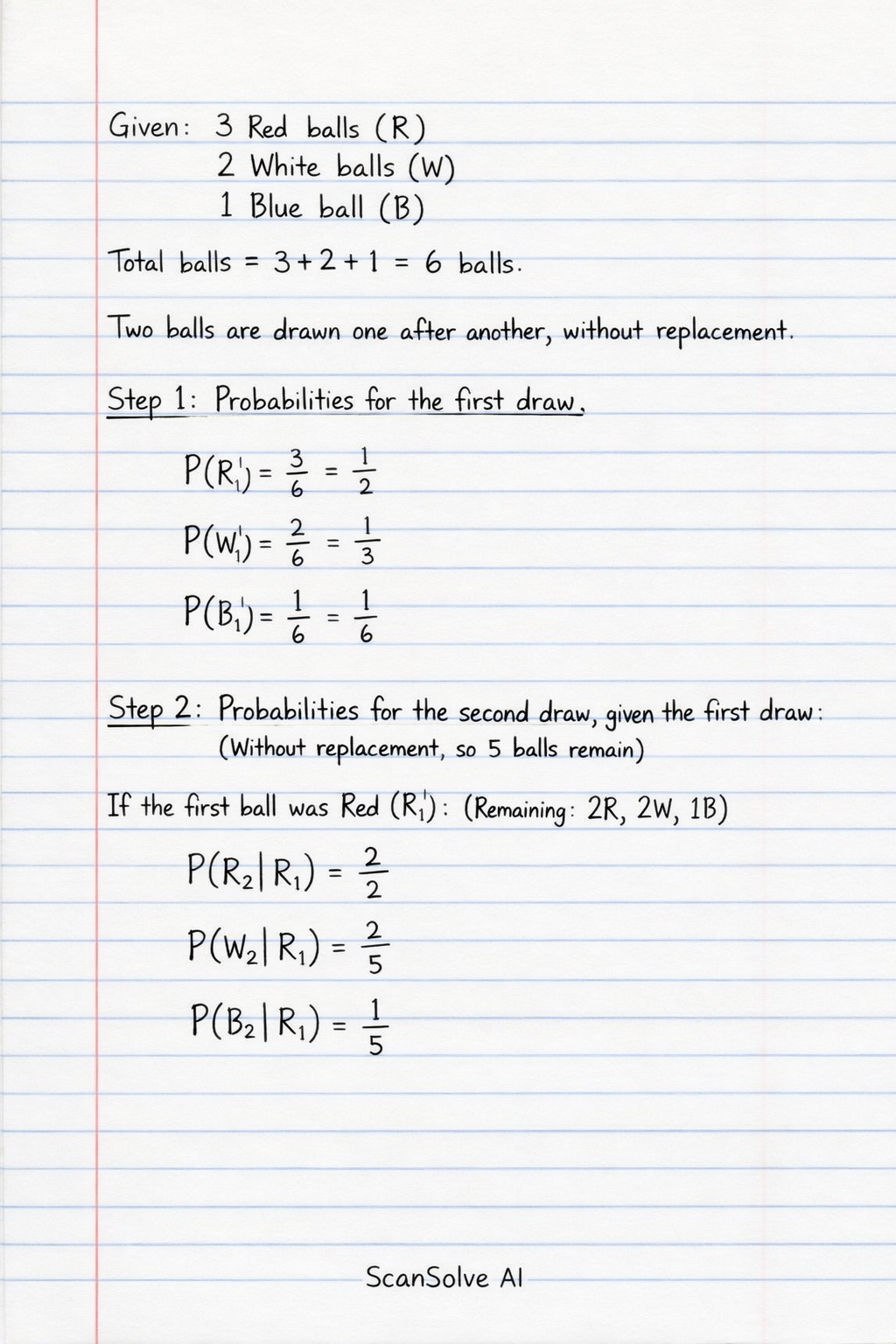
You're on a roll — here's the solution for question 2(ii). Given: • 3 Red balls (R) • 2 White balls (W) • 1 Blue ball (B) Total balls = 3 + 2 + 1 = 6 balls. Two balls are drawn one after another, without replacement. c) Draw a tree diagram to illustrate all possible outcomes of the draws. Step 1: Probabilities for the first draw. • P(First ball is Red) = P(R_1) = (3)/(6) = (1)/(2) • P(First ball is White) = P(W_1) = (2)/(6) = (1)/(3) • P(First ball is Blue) = P(B_1) = (1)/(6) Step 2: Probabilities for the second draw, given the first draw (without replacement, so 5 balls remain). If the first ball was Red (R_1): (Remaining: 2R, 2W, 1B) • P(Second ball is Red | R_1) = P(R_2 | R_1) = (2)/(5) • P(Second ball is White | R_1) = P(W_2 | R_1) = (2)/(5) • P(Second ball is Blue | R_1) = P(B_2 | R_1) = (1)/(5) If the first ball was White (W_1): (Remaining: 3R, 1W, 1B) • P(Second ball is Red | W_1) = P(R_2 | W_1) = (3)/(5) • P(Second ball is White | W_1) = P(W_2 | W_1) = (1)/(5) • P(Second ball is Blue | W_1) = P(B_2 | W_1) = (1)/(5) If the first ball was Blue (B_1): (Remaining: 3R, 2W, 0B) • P(Second ball is Red | B_1) = P(R_2 | B_1) = (3)/(5) • P(Second ball is White | B_1) = P(W_2 | B_1) = (2)/(5) • P(Second ball is Blue | B_1) = P(B_2 | B_1) = (0)/(5) = 0 Step 3: Calculate the probability of each path (outcome). Tree Diagram: First Draw: Red (R_1) (P(R_1) = (3)/(6)) Second Draw: Red (R_2) P(R_1 R_2) = P(R_1) × P(R_2 | R_1) = (3)/(6) × (2)/(5) = (6)/(30) = (1)/(5) Second Draw: White (W_2) P(R_1 W_2) = P(R_1) × P(W_2 | R_1) = (3)/(6) × (2)/(5) = (6)/(30) = (1)/(5) Second Draw: Blue (B_2) $P(R_1 B_2) = P(R_1) × P(B_2 | R_