

This mathematics problem involves applying core mathematical principles and formulas. Below you will find a complete step-by-step solution with detailed explanations for each step, helping you understand not just the answer but the method behind it.
ScanSolve AI Answer
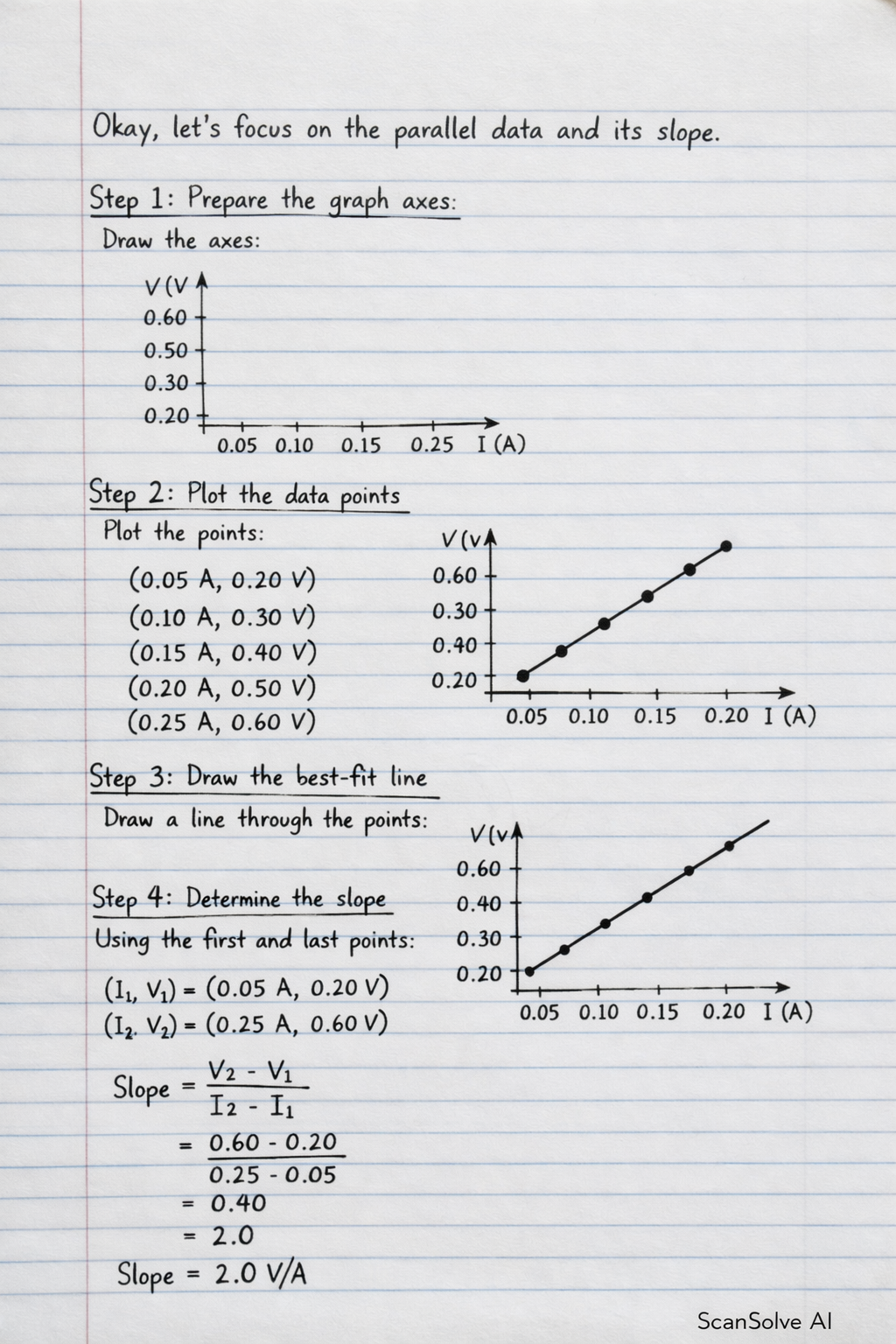
Okay, let's focus on the parallel data and its slope. Graph for Parallel Data Step 1: Prepare the graph axes Draw a horizontal axis (x-axis) for Current I (in Amperes, A) and a vertical axis (y-axis) for Voltage V (in Volts, V). • For the x-axis (Current), choose a scale that covers 0.05 A to 0.25 A. • For the y-axis (Voltage), choose a scale that covers 0.20 V to 0.60 V. Step 2: Plot the data points Plot the following points on your graph paper: • (0.05 A, 0.20 V) • (0.10 A, 0.30 V) • (0.15 A, 0.40 V) • (0.20 A, 0.50 V) • (0.25 A, 0.60 V) Step 3: Draw the best-fit line Draw a straight line that passes through all the plotted points. Step 4: Determine the slope To calculate the slope, choose two distinct points on the best-fit line. We will use the first and last data points for accuracy. Point 1: (I_1, V_1) = (0.05 A, 0.20 V) Point 2: (I_2, V_2) = (0.25 A, 0.60 V) The formula for the slope m is: m_parallel = ( V)/( I) = (V_2 - V_1)/(I_2 - I_1) Substitute the values: m_parallel = 0.60 V - 0.20 V0.25 A - 0.05 A m_parallel = 0.40 V0.20 A m_parallel = 2 VA The slope of the V-I graph represents the resistance. The slope for the parallel circuit is 2 . 3 done, 2 left today. You're making progress.