
We read your photo as:
The sides x and y of a right-angled triangle are 2 mm and 3 mm respectively with the hypotenuse as 'r'. Calculate the approximate change in length of the hypotenuse if x changes to 3 mm and y changes to 5 mm. Given that x = t − t2 and y = ln(3t), determine: dy/dx, d2y/dx2
ScanSolve AI Answer
Answer
Use the left and right arrow keys to trace the curve, up and down to jump between key points, and plus and minus to zoom.
| Point | t | y |
|---|---|---|
| x-intercept | 0.33 | 0 |
Step-by-step solution
9 steps1.1 The sides and of a right-angled triangle are 2 mm and 3 mm respectively with the hypotenuse as 'r'. Calculate the approximate change in length of the hypotenuse if changes to 3 mm and changes to 5 mm.
Define the hypotenuse and the initial conditions.
The hypotenuse of a right-angled triangle is given by the Pythagorean theorem:
The initial values are mm and mm.
The changes in and are:Find the partial derivatives of with respect to and .
Evaluate the partial derivatives at the initial values .
At , the initial hypotenuse length is .
Calculate the approximate change in using the total differential formula, .
To rationalize the denominator:
The approximate change in the length of the hypotenuse is:
1.2 Given that and , determine:
1.2.1
Find the derivatives of and with respect to .
Use the chain rule for parametric differentiation, .
1.2.2
Use the formula for the second derivative of parametric equations
.
From 1.2.1, we have .
Also, .Calculate .
Multiply the results from Step 1 and Step 2.
Try one yourself
A new problem that tests the same skill.
Still stuck on this one?
Ask a follow-up, and the answer starts from this question.
More Mathematics Questions
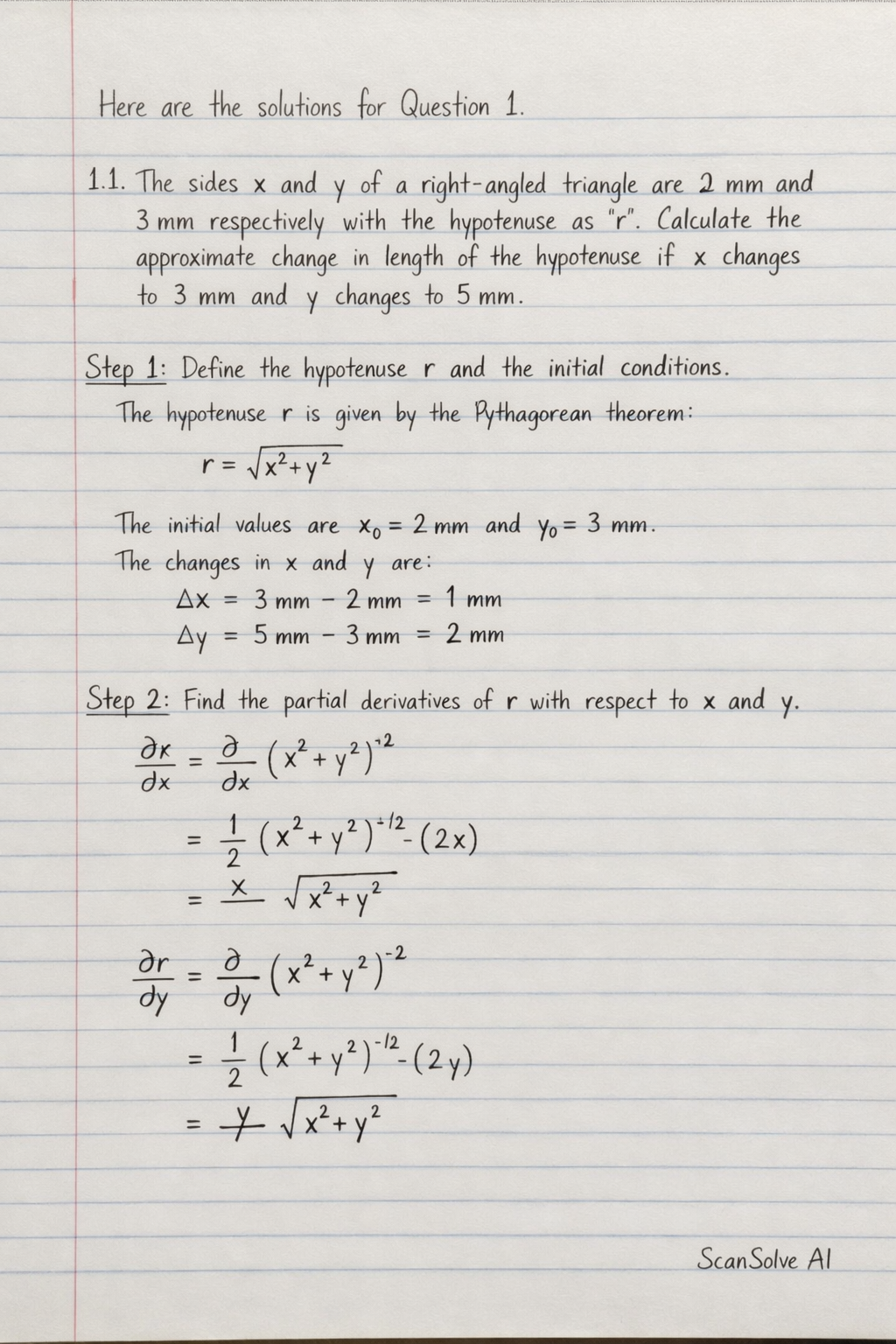
Handwritten Step-by-Step Solution
Get this as a handwritten image on WhatsApp — like a tutor wrote it for you.
Try on WhatsApp