Calculate the particular solution of dy/dx - y/(x ln x) = 1/x at (2; 0). Determine the general solution of d2y/dx2 + dy/dx - 6y = 2e^-3x.
|Mathematics
Calculate the particular solution of dy/dx - y/(x ln x) = 1/x at (2; 0). Determine the general solution of d2y/dx2 + dy/dx - 6y = 2e^-3x.
ScanSolve AI Answer
Answer
y=lnxln(ln2lnx)
Here are the solutions to the given differential equations.
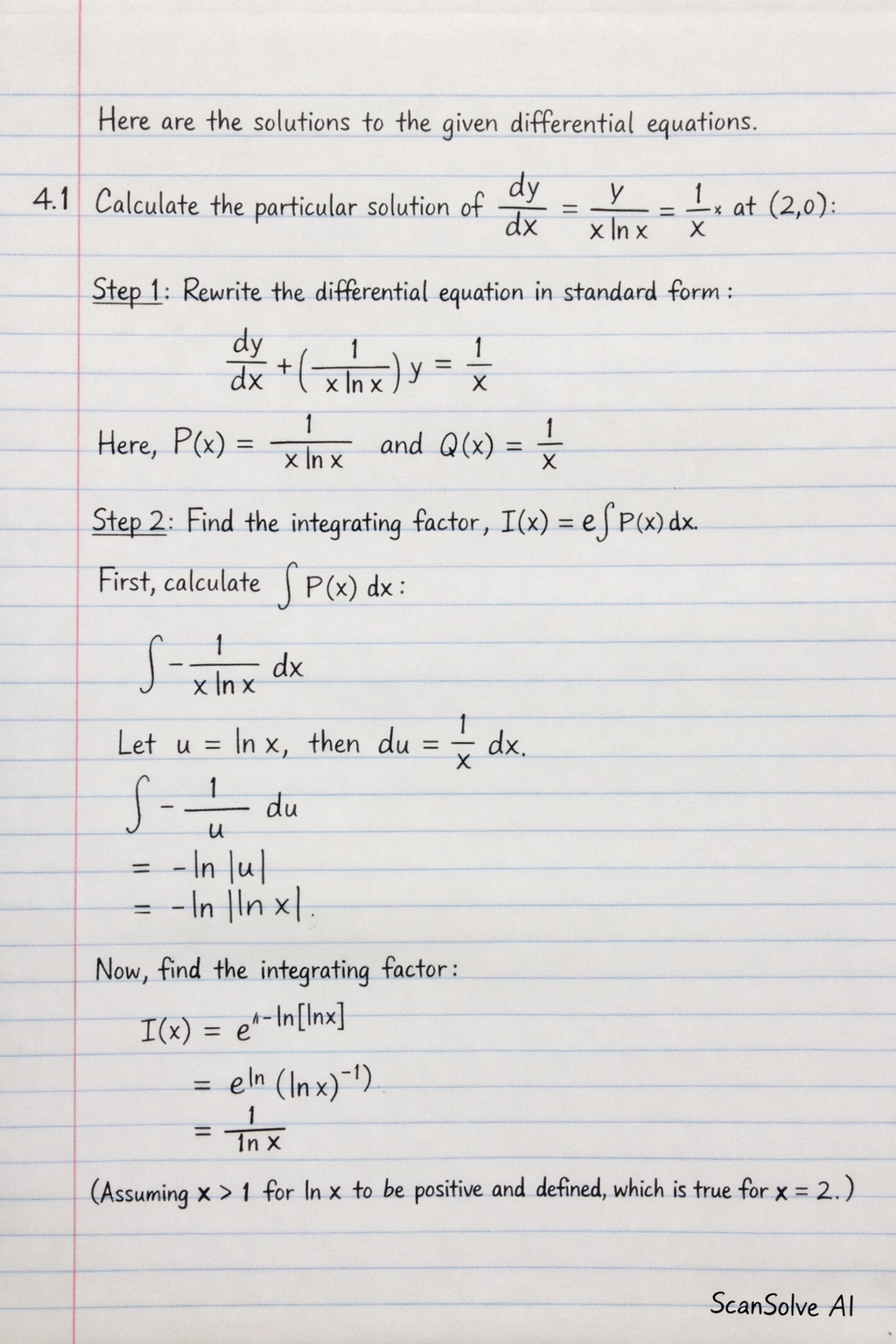
4.1 Calculate the particular solution of dxdy−xlnxy=x1 at (2,0).
Step 1: Rewrite the differential equation in the standard form for a first-order linear differential equation, dxdy+P(x)y=Q(x).
dxdy+(−xlnx1)y=x1
Here, P(x)=−xlnx1 and Q(x)=x1.
Step 2: Find the integrating factor, I(x)=e∫P(x)dx.
First, calculate ∫P(x)dx:
∫−xlnx1dx
Let u=lnx, then du=x1dx.
∫−u1du=−ln∣u∣=−ln∣lnx∣
Now, find the integrating factor:
I(x)=e−ln∣lnx∣=eln((lnx)−1)=lnx1
(Assuming x>1 for lnx to be positive and defined, which is true for x=2).
Step 3: Multiply the differential equation by the integrating factor and integrate.
The left side becomes dxd(y⋅I(x)).
dxd(y⋅lnx1)=x1⋅lnx1dxd(lnxy)=xlnx1
Integrate both sides with respect to x:
∫dxd(lnxy)dx=∫xlnx1dxlnxy=ln∣lnx∣+C
The general solution is y=lnx(ln∣lnx∣+C).
Step 4: Use the initial condition (2,0) to find the particular solution.
Substitute x=2 and y=0 into the general solution:
0=ln2(ln∣ln2∣+C)
Since ln2=0, we must have:
ln∣ln2∣+C=0C=−ln∣ln2∣
Substitute the value of C back into the general solution:
y=lnx(ln∣lnx∣−ln∣ln2∣)
Using the logarithm property lna−lnb=ln(ba):
y=lnx(lnln2lnx)
The particular solution is:
y = \ln x \ln\left(\frac{\ln x{\ln 2}\right)}
4.2 Determine the general solution of dx2d2y+dxdy−6y=2e−3x.
Step 1: Find the complementary solution yc by solving the homogeneous equation dx2d2y+dxdy−6y=0.
The characteristic equation is:
r2+r−6=0
Factor the quadratic equation:
(r+3)(r−2)=0
The roots are r1=−3 and r2=2.
The complementary solution is:
yc=C1e−3x+C2e2x
Step 2: Find the particular solution yp using the method of undetermined coefficients.
The right-hand side is g(x)=2e−3x. Since −3 is a root of the characteristic equation (and it's a simple root), we must multiply the standard guess by x.
Let yp=Axe−3x.
Calculate the first and second derivatives of yp:
yp′=Ae−3x+Ax(−3e−3x)=Ae−3x−3Axe−3x=A(1−3x)e−3xyp′′=A(−3e−3x)+(−3Ae−3x−3Ax(−3e−3x))=−3Ae−3x−3Ae−3x+9Axe−3x=A(−6+9x)e−3x
Substitute yp, yp′, and yp′′ into the non-homogeneous differential equation:
A(−6+9x)e−3x+A(1−3x)e−3x−6(Axe−3x)=2e−3x
Divide by e−3x:
A(−6+9x)+A(1−3x)−6Ax=2−6A+9Ax+A−3Ax−6Ax=2
Combine like terms:
(−6A+A)+(9Ax−3Ax−6Ax)=2−5A+0x=2−5A=2A=−52
So, the particular solution is:
yp=−52xe−3x
Step 3: Write the general solution y=yc+yp.
y=C1e−3x+C2e2x−52xe−3x
The general solution is:
y=C1e−3x+C2e2x−52xe−3x
Send me the next one 📸
Was this helpful?
Need help with your own homework?
Get instant step-by-step solutions to any question. Free to start.
This mathematics problem involves applying core mathematical principles and formulas. Below you will find a complete step-by-step solution with detailed explanations for each step, helping you understand not just the answer but the method behind it.
ScanSolve AI Answer
Here are the solutions to the given differential equations. 4.1 Calculate the particular solution of (dy)/(dx) - (y)/(x x) = (1)/(x) at (2, 0). Step 1: Rewrite the differential equation in the standard form for a first-order linear differential equation, (dy)/(dx) + P(x)y = Q(x). (dy)/(dx) + (-(1)/(x x))y = (1)/(x) Here, P(x) = -(1)/(x x) and Q(x) = (1)/(x). Step 2: Find the integrating factor, I(x) = e^ P(x) dx. First, calculate P(x) dx: -(1)/(x x) dx Let u = x, then du = (1)/(x) dx. -(1)/(u) du = -|u| = -| x| Now, find the integrating factor: I(x) = e^-| x| = e^(( x)^-1) = (1)/( x) (Assuming x>1 for x to be positive and defined, which is true for x=2). Step 3: Multiply the differential equation by the integrating factor and integrate. The left side becomes (d)/(dx)(y · I(x)). (d)/(dx)(y · (1)/( x)) = (1)/(x) · (1)/( x) (d)/(dx)((y)/( x)) = (1)/(x x) Integrate both sides with respect to x: (d)/(dx)((y)/( x)) dx = (1)/(x x) dx (y)/( x) = | x| + C The general solution is y = x (| x| + C). Step 4: Use the initial condition (2, 0) to find the particular solution. Substitute x=2 and y=0 into the general solution: 0 = 2 (| 2| + C) Since 2 ≠ 0, we must have: | 2| + C = 0 C = -| 2| Substitute the value of C back into the general solution: y = x (| x| - | 2|) Using the logarithm property a - b = ((a)/(b)): y = x ( | ( x)/( 2) | ) The particular solution is: y = x (( x)/( 2)) 4.2 Determine the general solution of (d^2 y)/(dx^2) + (dy)/(dx) - 6y = 2e^-3x. Step 1: Find the complementary solution y_c by solving the homogeneous equation (d^2 y)/(dx^2) + (dy)/(dx) - 6y = 0. The characteristic equation is: r^2 + r - 6 = 0 Factor the quadratic equation: (r+3)(r-2) = 0 The roots are r_1 = -3 and r_2 = 2. The complementary solution is: y_c = C_1 e^-3x + C_2 e^2x Step 2: Find the particular solution y_p using the method of undetermined coefficients. The right-hand side is g(x) = 2e^-3x. Since -3 is a root of the characteristic equation (and it's a simple root), we must multiply the standard guess by x. Let y_p = Ax e^-3x. Calculate the first and second derivatives of y_p: y_p' = A e^-3x + Ax(-3e^-3x) = A e^-3x - 3Ax e^-3x = A(1-3x)e^-3x y_p'' = A(-3e^-3x) + (-3A e^-3x - 3Ax(-3e^-3x)) = -3A e^-3x - 3A e^-3x + 9Ax e^-3x = A(-6+9x)e^-3x Substitute y_p, y_p', and y_p'' into the non-homogeneous differential equation: A(-6+9x)e^-3x + A(1-3x)e^-3x - 6(Ax e^-3x) = 2e^-3x Divide by e^-3x: A(-6+9x) + A(1-3x) - 6Ax = 2 -6A + 9Ax + A - 3Ax - 6Ax = 2 Combine like terms: (-6A + A) + (9Ax - 3Ax - 6Ax) = 2 -5A + 0x = 2 -5A = 2 A = -(2)/(5) So, the particular solution is: y_p = -(2)/(5) x e^-3x Step 3: Write the general solution y = y_c + y_p. y = C_1 e^-3x + C_2 e^2x - (2)/(5) x e^-3x The general solution is: y = C_1 e^-3x + C_2 e^2x - (2)/(5) x e^-3x Send me the next one 📸