
We read your photo as:
Draw the angle bisector of A.
ScanSolve AI Answer
Answer
Step-by-step solution
9 stepsPart a· 4 steps
**Proof
Let be a triangle such that . We need to prove that the sides opposite to these angles are congruent, i.e., .
Draw the angle bisector of .
Draw a line segment from vertex to side such that bisects . This means .
Consider the two triangles formed.
Now we have two triangles: and .
Apply the Angle-Angle-Side (AAS) congruence criterion.
In and :
- (Given)
- (By construction, is the angle bisector of )
- (Common side to both triangles)
Therefore, by the AAS congruence criterion, .
Conclude based on CPCTC.
Since the two triangles are congruent, their corresponding parts are congruent (CPCTC).
Thus, the side in corresponds to the side in .
Hence, .This proves that if two angles of a triangle are congruent, then the sides opposite to them are also congruent.
Part b
Given the two polynomials
And their HCF is . We need to find the LCM.
Factorize the first polynomial .
We look for two numbers that multiply to 24 and add up to -11. These numbers are -3 and -8.
Factorize the second polynomial .
The polynomial is a perfect square trinomial, which can be factored as .
Use the relationship between HCF, LCM, and the polynomials.
The product of two polynomials is equal to the product of their HCF and LCM:
Where is the LCM. We can rearrange this to find :
Substitute the factored forms and the given HCF into the formula.
Simplify the expression to find the LCM.
Cancel one term from the numerator and the denominator.
We can expand this expression:
The LCM of the two polynomials is or .
Try one yourself
A new problem that tests the same skill.
Still stuck on this one?
Ask a follow-up, and the answer starts from this question.
More Mathematics Questions
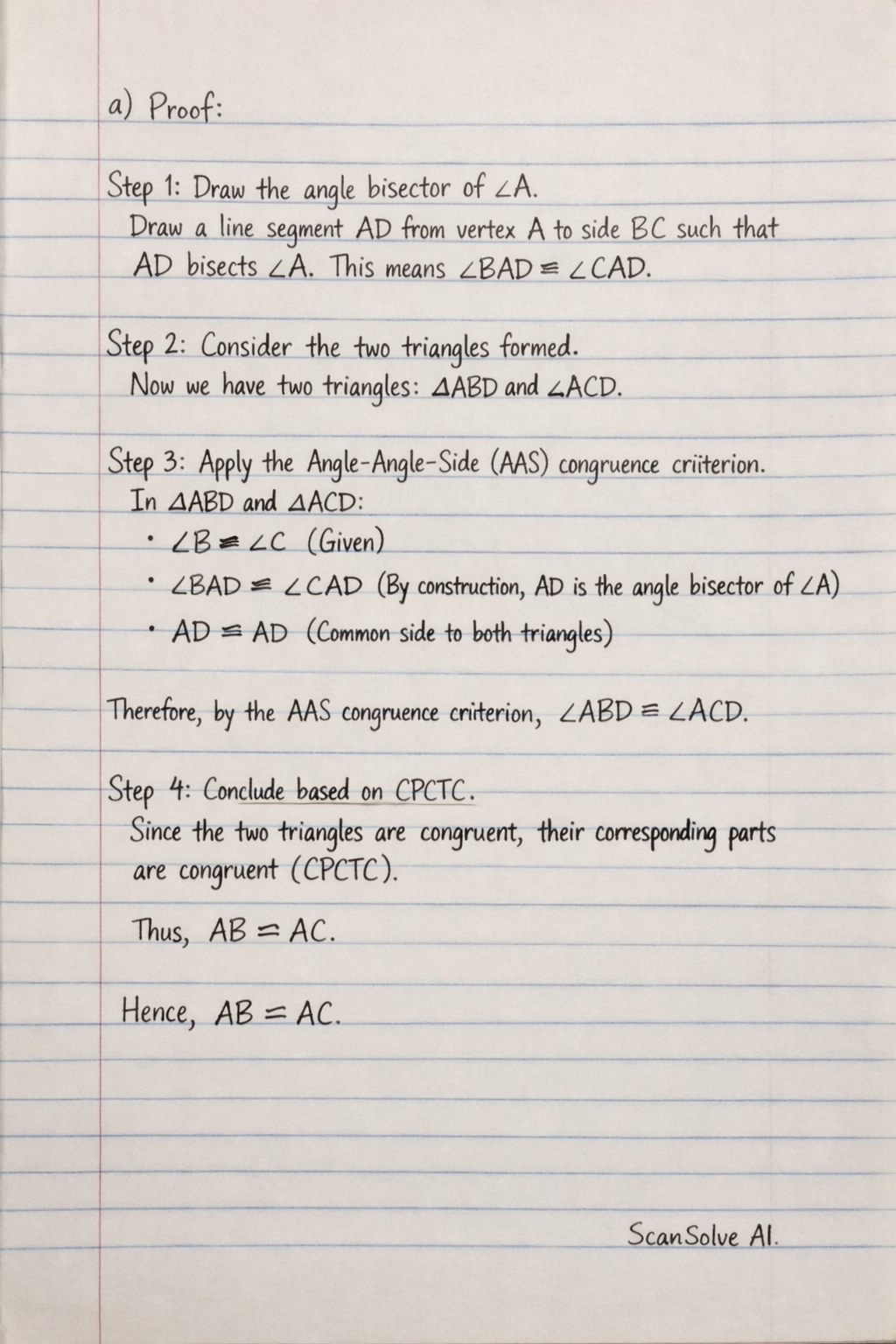
Handwritten Step-by-Step Solution
Get this as a handwritten image on WhatsApp — like a tutor wrote it for you.
Try on WhatsApp