We read your photo as:

Solve (x+2)dy/dx − 2y = (x+2)⁻¹

Mathematics

ScanSolve AI Answer

Answer

y=C(x+2)2−13(x+2)y = C(x+2)^2 - \frac{1}{3(x+2)}

Step-by-step solution

5 steps

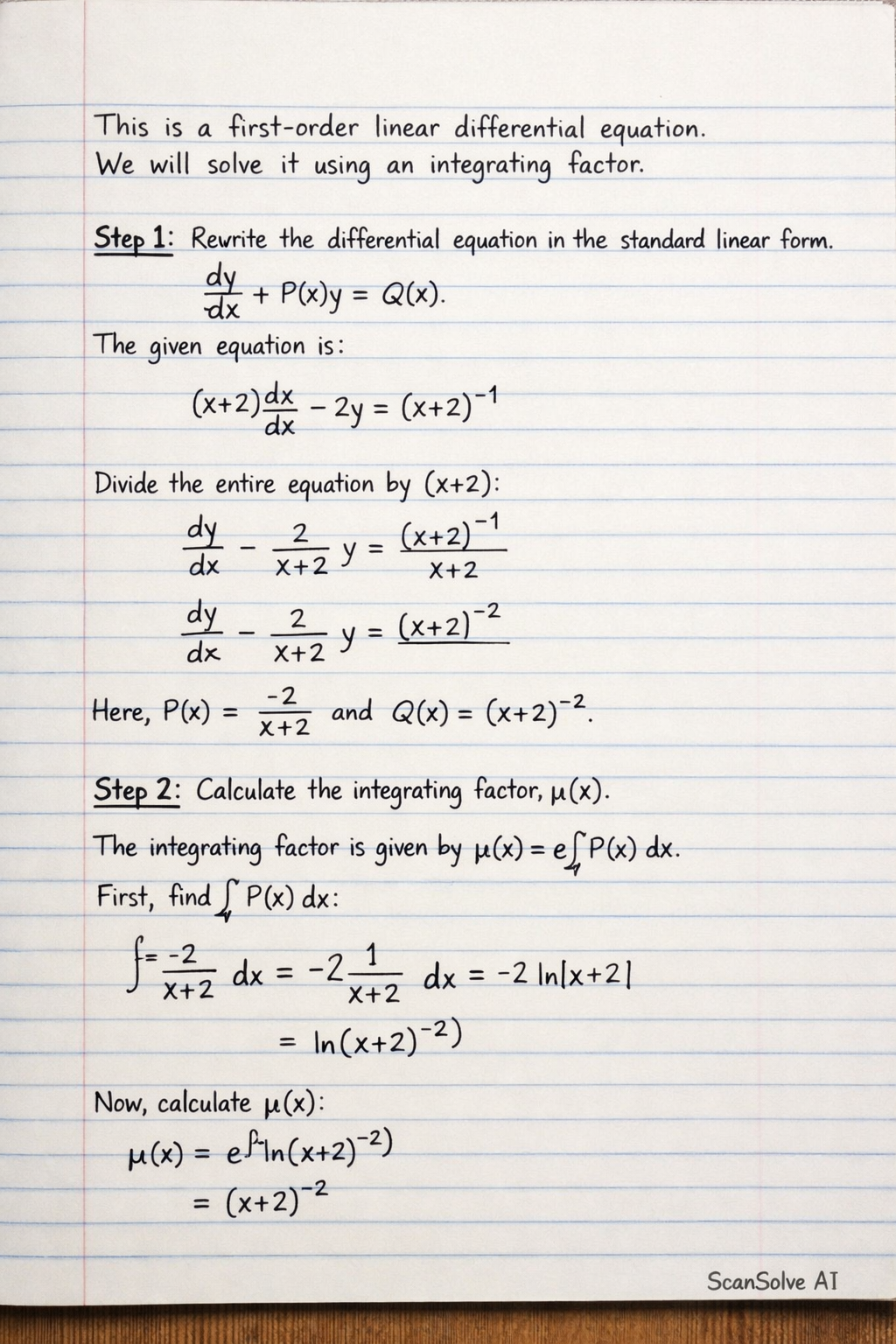
This is a first-order linear differential equation. We will solve it using an integrating factor.

  1. Rewrite the differential equation in the standard linear form dydx+P(x)y=Q(x)\frac{dy}{dx} + P(x)y = Q(x).

    The given equation is:

    (x+2)dydx−2y=(x+2)−1(x+2)\frac{dy}{dx} - 2y = (x+2)^{-1}

    Divide the entire equation by (x+2)(x+2):

    dydx−2x+2y=(x+2)−1x+2\frac{dy}{dx} - \frac{2}{x+2}y = \frac{(x+2)^{-1}}{x+2} dydx−2x+2y=(x+2)−2\frac{dy}{dx} - \frac{2}{x+2}y = (x+2)^{-2}

    Here, P(x)=−2x+2P(x) = -\frac{2}{x+2} and Q(x)=(x+2)−2Q(x) = (x+2)^{-2}.

  2. Calculate the integrating factor, μ(x)\mu(x).

    The integrating factor is given by μ(x)=e∫P(x) dx\mu(x) = e^{\int P(x) \, dx}.
    First, find ∫P(x) dx\int P(x) \, dx:

    ∫−2x+2 dx=−2∫1x+2 dx=−2ln⁡∣x+2∣=ln⁡((x+2)−2)\int -\frac{2}{x+2} \, dx = -2 \int \frac{1}{x+2} \, dx = -2 \ln|x+2| = \ln((x+2)^{-2})

    Now, calculate μ(x)\mu(x):

    μ(x)=eln⁡((x+2)−2)=(x+2)−2\mu(x) = e^{\ln((x+2)^{-2})} = (x+2)^{-2}
  3. Multiply the standard form equation by the integrating factor.

    Multiplying dydx−2x+2y=(x+2)−2\frac{dy}{dx} - \frac{2}{x+2}y = (x+2)^{-2} by (x+2)−2(x+2)^{-2}:

    (x+2)−2dydx−2(x+2)−3y=(x+2)−4(x+2)^{-2} \frac{dy}{dx} - 2(x+2)^{-3}y = (x+2)^{-4}

    The left side of this equation is the derivative of the product μ(x)y\mu(x)y:

    ddx((x+2)−2y)=(x+2)−4\frac{d}{dx} \left( (x+2)^{-2} y \right) = (x+2)^{-4}
  4. Integrate both sides with respect to xx.

    ∫ddx((x+2)−2y) dx=∫(x+2)−4 dx\int \frac{d}{dx} \left( (x+2)^{-2} y \right) \, dx = \int (x+2)^{-4} \, dx (x+2)−2y=(x+2)−3−3+C(x+2)^{-2} y = \frac{(x+2)^{-3}}{-3} + C (x+2)−2y=−13(x+2)3+C(x+2)^{-2} y = -\frac{1}{3(x+2)^3} + C
  5. Solve for yy.

    Multiply both sides by (x+2)2(x+2)^2:

    y=(x+2)2(−13(x+2)3+C)y = (x+2)^2 \left( -\frac{1}{3(x+2)^3} + C \right) y=−(x+2)23(x+2)3+C(x+2)2y = -\frac{(x+2)^2}{3(x+2)^3} + C(x+2)^2 y=−13(x+2)+C(x+2)2y = -\frac{1}{3(x+2)} + C(x+2)^2

    The general solution is:

    y=C(x+2)2−13(x+2)y = C(x+2)^2 - \frac{1}{3(x+2)}
Was this helpful?

Try one yourself

A new problem that tests the same skill.

Still stuck on this one?

Ask a follow-up, and the answer starts from this question.

Got a different question?Ask your own question
Handwritten step-by-step solution preview

Handwritten Step-by-Step Solution

Get this as a handwritten image on WhatsApp — like a tutor wrote it for you.

Try on WhatsApp