We read your photo as:

Draw the axes in the range −5≤x≤4 and −6≤y≤7 using a scale of 2cm to represent 1 unit on both axes. Draw and label triangle ABC with coordinates (1,1), (1,3) and (2,3) respectively.

Mathematics

ScanSolve AI Answer

Step-by-step solution

3 steps

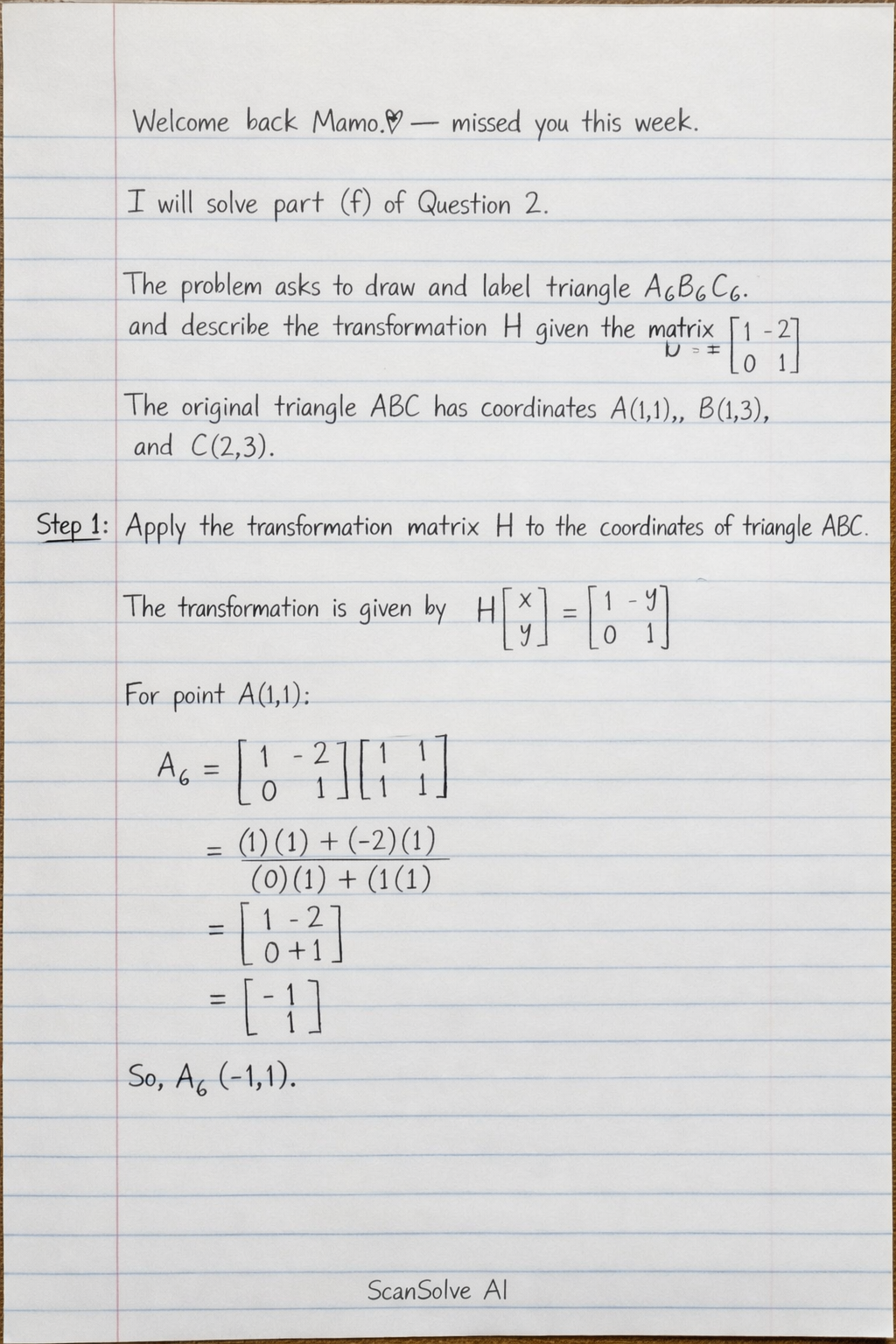
I will solve part (f) of Question 2.

The problem asks to draw and label triangle A6B6C6A_6B_6C_6 and describe the transformation HH given the matrix H=(1−201)H = \begin{pmatrix} 1 & -2 \\ 0 & 1 \end{pmatrix}.
The original triangle ABCABC has coordinates A(1,1)A(1,1), B(1,3)B(1,3), and C(2,3)C(2,3).

  1. Apply the transformation matrix HH to the coordinates of triangle ABCABC.

    The transformation is given by H(xy)=(1−201)(xy)H \begin{pmatrix} x \\ y \end{pmatrix} = \begin{pmatrix} 1 & -2 \\ 0 & 1 \end{pmatrix} \begin{pmatrix} x \\ y \end{pmatrix}.

    For point A(1,1)A(1,1):

    A6=(1−201)(11)=((1)(1)+(−2)(1)(0)(1)+(1)(1))=(1−20+1)=(−11)A_6 = \begin{pmatrix} 1 & -2 \\ 0 & 1 \end{pmatrix} \begin{pmatrix} 1 \\ 1 \end{pmatrix} = \begin{pmatrix} (1)(1) + (-2)(1) \\ (0)(1) + (1)(1) \end{pmatrix} = \begin{pmatrix} 1 - 2 \\ 0 + 1 \end{pmatrix} = \begin{pmatrix} -1 \\ 1 \end{pmatrix}

    So, A6(−1,1)A_6(-1,1).

    For point B(1,3)B(1,3):

    B6=(1−201)(13)=((1)(1)+(−2)(3)(0)(1)+(1)(3))=(1−60+3)=(−53)B_6 = \begin{pmatrix} 1 & -2 \\ 0 & 1 \end{pmatrix} \begin{pmatrix} 1 \\ 3 \end{pmatrix} = \begin{pmatrix} (1)(1) + (-2)(3) \\ (0)(1) + (1)(3) \end{pmatrix} = \begin{pmatrix} 1 - 6 \\ 0 + 3 \end{pmatrix} = \begin{pmatrix} -5 \\ 3 \end{pmatrix}

    So, B6(−5,3)B_6(-5,3).

    For point C(2,3)C(2,3):

    C6=(1−201)(23)=((1)(2)+(−2)(3)(0)(2)+(1)(3))=(2−60+3)=(−43)C_6 = \begin{pmatrix} 1 & -2 \\ 0 & 1 \end{pmatrix} \begin{pmatrix} 2 \\ 3 \end{pmatrix} = \begin{pmatrix} (1)(2) + (-2)(3) \\ (0)(2) + (1)(3) \end{pmatrix} = \begin{pmatrix} 2 - 6 \\ 0 + 3 \end{pmatrix} = \begin{pmatrix} -4 \\ 3 \end{pmatrix}

    So, C6(−4,3)C_6(-4,3).

  2. State the coordinates of the transformed triangle A6B6C6A_6B_6C_6.

    The coordinates of triangle A6B6C6A_6B_6C_6 are A6(−1,1)A_6(-1,1), B6(−5,3)B_6(-5,3), and C6(−4,3)C_6(-4,3).

    (i) To draw and label triangle A6B6C6A_6B_6C_6, plot these points on the coordinate graph and connect them.

  3. Describe fully the transformation HH.

    The matrix H=(1−201)H = \begin{pmatrix} 1 & -2 \\ 0 & 1 \end{pmatrix} is a shear matrix.
    A general shear matrix is of the form (1k01)\begin{pmatrix} 1 & k \\ 0 & 1 \end{pmatrix} for a shear parallel to the x-axis, or (10k1)\begin{pmatrix} 1 & 0 \\ k & 1 \end{pmatrix} for a shear parallel to the y-axis.
    In this case, the matrix is (1−201)\begin{pmatrix} 1 & -2 \\ 0 & 1 \end{pmatrix}, which corresponds to a shear parallel to the x-axis.
    The line y=0y=0 (the x-axis) is invariant under this transformation, as for any point (x,0)(x,0), (1−201)(x0)=(x0)\begin{pmatrix} 1 & -2 \\ 0 & 1 \end{pmatrix} \begin{pmatrix} x \\ 0 \end{pmatrix} = \begin{pmatrix} x \\ 0 \end{pmatrix}.
    The shear factor is k=−2k = -2.

    The transformation HH is a shear.
    The shear factor is −2-2.
    The invariant line is the x-axis (or y=0y=0).

    The final answer is f) (i) A6(−1,1),B6(−5,3),C6(−4,3) (Plot these points to draw the triangle.) (ii) Shear, shear factor -2, invariant line y=0\boxed{\text{f) (i) } A_6(-1,1), B_6(-5,3), C_6(-4,3) \text{ (Plot these points to draw the triangle.) (ii) Shear, shear factor -2, invariant line } y=0}.

Was this helpful?

Still stuck on this one?

Ask a follow-up, and the answer starts from this question.

Got a different question?Ask your own question
Handwritten step-by-step solution preview

Handwritten Step-by-Step Solution

Get this as a handwritten image on WhatsApp — like a tutor wrote it for you.

Try on WhatsApp