

This mathematics problem involves applying core mathematical principles and formulas. Below you will find a complete step-by-step solution with detailed explanations for each step, helping you understand not just the answer but the method behind it.
ScanSolve AI Answer
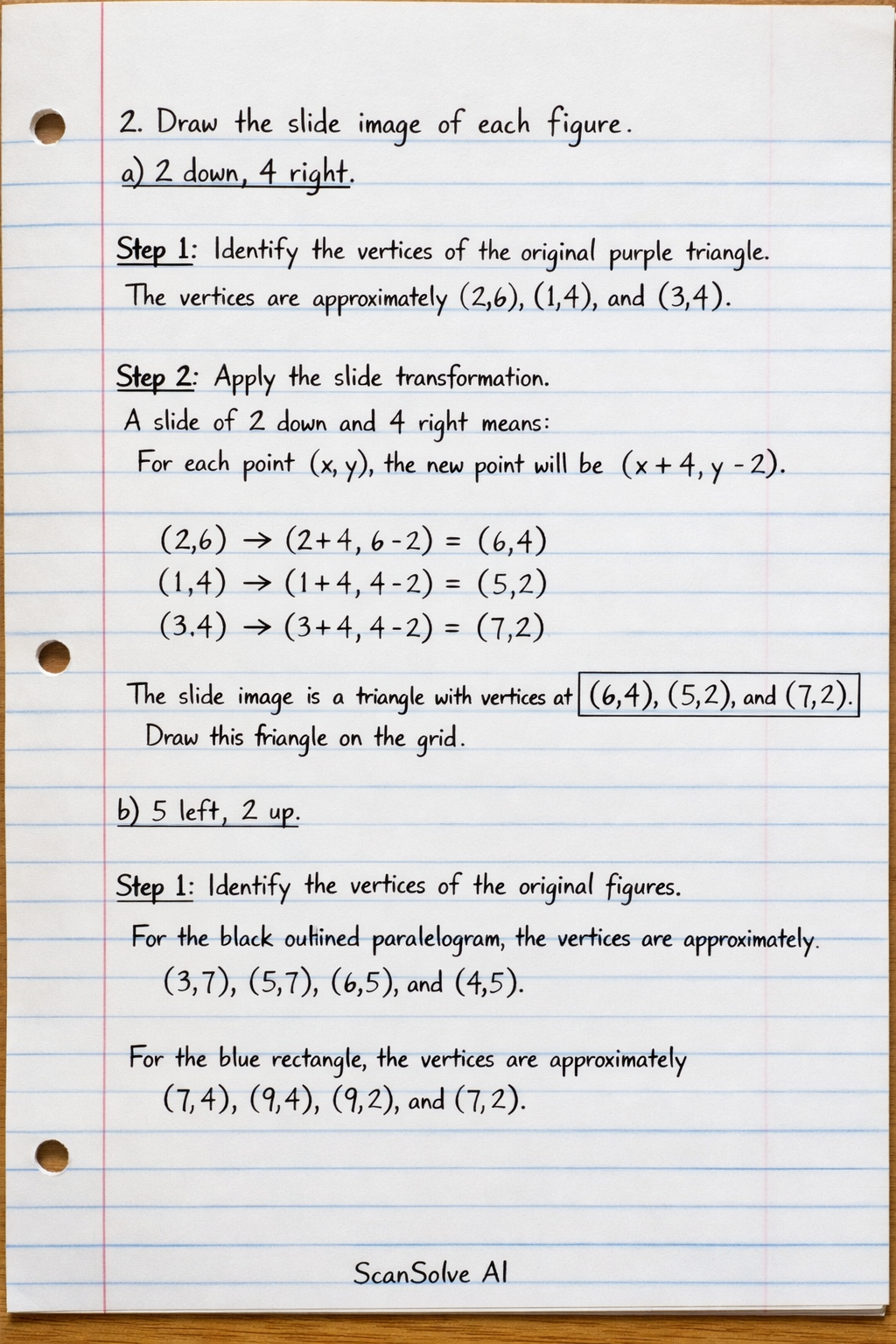
Here are the steps to find the slide images for each figure and set of points. 2. Draw the slide image of each figure. a) 2 down, 4 right Step 1: Identify the vertices of the original purple triangle. The vertices are approximately (2,6), (1,4), and (3,4). Step 2: Apply the slide transformation. A slide of 2 down and 4 right means that for each point (x,y), the new point will be (x+4, y-2). (2,6) & (2+4, 6-2) = (6,4) \\ (1,4) & (1+4, 4-2) = (5,2) \\ (3,4) & (3+4, 4-2) = (7,2) The slide image is a triangle with vertices at (6,4), (5,2), and (7,2). You should draw this triangle on the grid. b) 5 left, 2 up Step 1: Identify the vertices of the original figures. For the black outlined parallelogram, the vertices are approximately (3,7), (5,7), (6,5), and (4,5). For the blue rectangle, the vertices are approximately (7,4), (9,4), (9,2), and (7,2). Step 2: Apply the slide transformation to the parallelogram. A slide of 5 left and 2 up means that for each point (x,y), the new point will be (x-5, y+2). (3,7) & (3-5, 7+2) = (-2,9) \\ (5,7) & (5-5, 7+2) = (0,9) \\ (6,5) & (6-5, 5+2) = (1,7) \\ (4,5) & (4-5, 5+2) = (-1,7) The slide image of the parallelogram has vertices at (-2,9), (0,9), (1,7), and (-1,7). Step 3: Apply the slide transformation to the blue rectangle. (7,4) & (7-5, 4+2) = (2,6) \\ (9,4) & (9-5, 4+2) = (4,6) \\ (9,2) & (9-5, 2+2) = (4,4) \\ (7,2) & (7-5, 2+2) = (2,4) The slide image of the blue rectangle has vertices at (2,6), (4,6), (4,4), and (2,4). You should draw both slide images on the grid. 3. Plot the given points, then connect the points in order. Draw each slide, then give the coordinates of the slide image. a) Points: (2,4), (2,2), (4,2). Slide 4 right, 4 up. Step 1: Plot the original points and connect them. The original points are A=(2,4), B=(2,2), and C=(4,2). Connecting them forms a right-angled triangle. Step 2: Apply the slide transformation. A slide of 4 right and 4 up means that for each point (x,y), the new point will be (x+4, y+4). (2,4) & (2+4, 4+4) = (6,8) \\ (2,2) & (2+4, 2+4) = (6,6) \\ (4,2) & (4+4, 2+4) = (8,6) The coordinates of the slide image are (6,8), (6,6), and (8,6). You should plot these new points and connect them to draw the slide image. b) Points: (9,9), (6,8), (6,5), (9,5). Slide 3 down and 2 left. Step 1: Plot the original points and connect them. The original points are P=(9,9), Q=(6,8), R=(6,5), and S=(9,5). Connecting them forms a quadrilateral. Step 2: Apply the slide transformation. A slide of 3 down and 2 left means that for each point (x,y), the new point will be (x-2, y-3). (9,9) & (9-2, 9-3) = (7,6) \\ (6,8) & (6-2, 8-3) = (4,5) \\ (6,5) & (6-2, 5-3) = (4,2) \\ (9,5) & (9-2, 5-3) = (7,2) The coordinates of the slide image are (7,6), (4,5), (4,2), and (7,2). You should plot these new points and connect them to draw the slide image. Send me the next one 📸