
We read your photo as:
Determine the values of a to e in order giving, reasons for all your statements.
ScanSolve AI Answer
Answers
2 partsStep-by-step solution
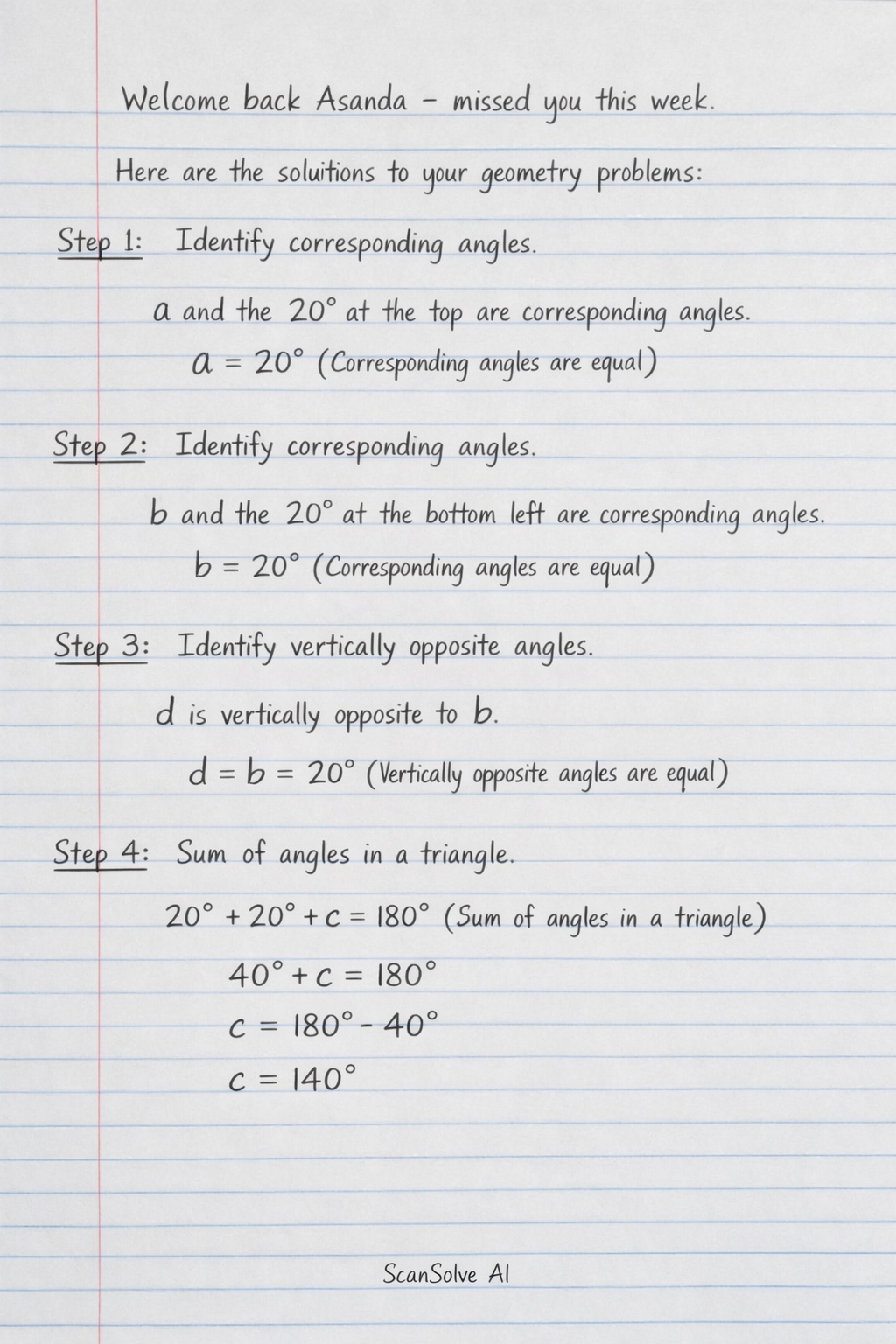
8 stepsHere are the solutions to your geometry problems:
1. Determine the values of to in order giving reasons for all your statements.
Step 1: Identify corresponding angles.
The angle and the angle at the top vertex of the triangle are corresponding angles.
Step 2: Identify corresponding angles.
The angle and the angle at the bottom left vertex of the triangle are corresponding angles.
Step 3: Identify vertically opposite angles.
The angle is vertically opposite to angle .
Step 4: Sum of angles in a triangle.
The interior angles of the triangle are (top), (bottom left), and (bottom right).
Step 5: Identify alternate interior angles.
The angle and angle are alternate interior angles.
The values are:
2. Determine the value of and in the following diagrams, showing all working and giving reasons for each statement that you make.
Part a· 2 steps
Find using alternate interior angles.
The angle and the angle are alternate interior angles.
Find using consecutive interior angles.
The angle and the angle are consecutive interior angles (also known as co-interior angles).
The values are:
Part b
Identify properties of the isosceles triangle.
The two sides marked with dashes are equal, so the triangle is isosceles. The angles opposite these sides are equal. Let the angle at the bottom right vertex inside the triangle be .
Sum of angles in the triangle.
The sum of angles in a triangle is .
Substitute :
So, .
Find using the exterior angle property.
The exterior angle is equal to the sum of the two opposite interior angles ( and ).
Substitute :
The values are:
3. Determine the value of and in the following diagram, showing all working and giving reasons for each statement that you make.
Find using alternate interior angles.
The line segment AD is parallel to the line segment BE (indicated by arrows). The transversal is AB.
The angle and the angle are alternate interior angles.Find using alternate interior angles.
The line segment AD is parallel to the line segment BE. The transversal is DE.
The angle and the angle are alternate interior angles.Find using the sum of angles in triangle BCE.
The angles in triangle BCE are , , and the angle at C.
The angle at C (angle BCE) and angle are vertically opposite angles.
So, angle BCE = .
Now, sum of angles in triangle BCE:The values are:
Try one yourself
A new problem that tests the same skill.
Still stuck on this one?
Ask a follow-up, and the answer starts from this question.
More Mathematics Questions
Handwritten Step-by-Step Solution
Get this as a handwritten image on WhatsApp — like a tutor wrote it for you.
Try on WhatsApp