Find dy/dx by using chain rule Find dy/dx by using produce rule Find dy/dx by using Quotient. rule.
|Mathematics
Find dy/dx by using chain rule Find dy/dx by using produce rule Find dy/dx by using Quotient. rule.
ScanSolve AI Answer
Answer
2secxtanx
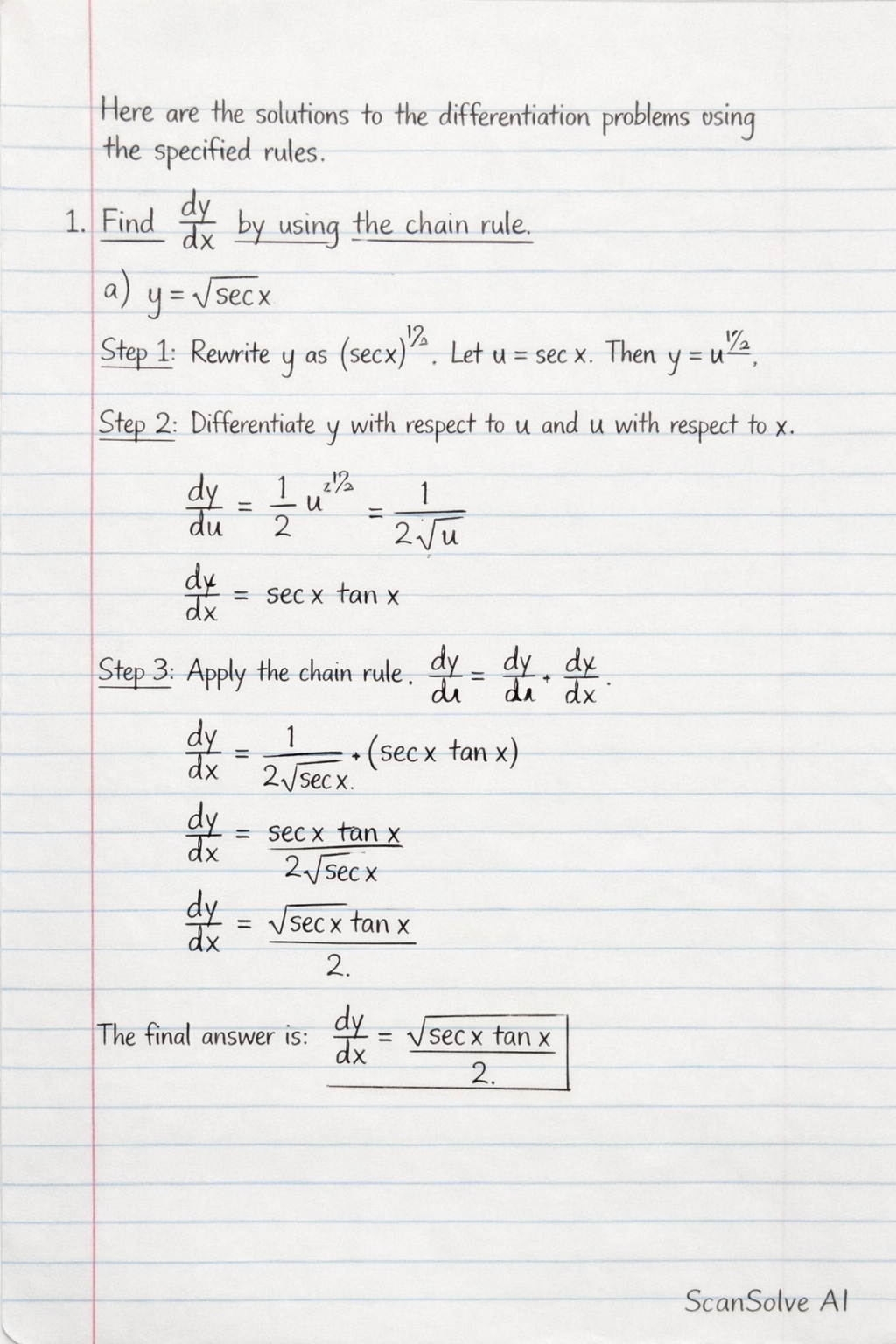
Here are the solutions to the differentiation problems using the specified rules.
1. Find dxdy by using the chain rule
a) y=secx
Step 1: Rewrite y as (secx)1/2. Let u=secx. Then y=u1/2.
Step 2: Differentiate y with respect to u and u with respect to x.
dudy=21u−1/2=2u1dxdu=secxtanx
Step 3: Apply the chain rule dxdy=dudy⋅dxdu.
dxdy=2secx1⋅(secxtanx)=2secxsecxtanxdxdy=2secxtanx
The final answer is 2secxtanx.
b) y=4x2−3x
Step 1: Rewrite y as (4x2−3x)1/2. Let u=4x2−3x. Then y=u1/2.
Step 2: Differentiate y with respect to u and u with respect to x.
dudy=21u−1/2=2u1dxdu=8x−3
Step 3: Apply the chain rule dxdy=dudy⋅dxdu.
dxdy=24x2−3x1⋅(8x−3)
The final answer is 24x2−3x8x−3.
c) y=cos3x1
Step 1: Rewrite y as (cosx)−3. Let u=cosx. Then y=u−3.
Step 2: Differentiate y with respect to u and u with respect to x.
dudy=−3u−4=−u43dxdu=−sinx
Step 3: Apply the chain rule dxdy=dudy⋅dxdu.
dxdy=−(cosx)43⋅(−sinx)=cos4x3sinxdxdy=3⋅cosxsinx⋅cos3x1=3tanxsec3x
The final answer is 3tanxsec3x.
d) y=tan3x
Step 1: Rewrite y as (tan3x)1/2. Let u=tan3x. Then y=u1/2.
Step 2: Differentiate y with respect to u.
dudy=21u−1/2=2u1
Step 3: Differentiate u=tan3x with respect to x using the chain rule again. Let v=3x. Then u=tanv.
dvdu=sec2v=sec23xdxdv=3dxdu=dvdu⋅dxdv=sec23x⋅3=3sec23x
Step 4: Apply the chain rule dxdy=dudy⋅dxdu.
dxdy=2tan3x1⋅(3sec23x)=2tan3x3sec23x
The final answer is 2tan3x3sec23x.
2. Find dxdy by using the product rule
The product rule states that if y=u(x)v(x), then dxdy=u′(x)v(x)+u(x)v′(x).
a) y=34xx7
Step 1: Identify u(x) and v(x).
Let u=34x and v=x7.
Step 2: Find u′(x) and v′(x).
u′=dxd(34x)=34xln3⋅4=4⋅34xln3v′=dxd(x7)=7x6
Step 3: Apply the product rule.
dxdy=(4⋅34xln3)x7+34x(7x6)
Step 4: Factor out common terms.
dxdy=34xx6(4xln3+7)
The final answer is 34xx6(4xln3+7).
b) y=lnx⋅secx
Step 1: Identify u(x) and v(x).
Let u=lnx and v=secx.
Step 2: Find u′(x) and v′(x).
u′=dxd(lnx)=x1v′=dxd(secx)=secxtanx
Step 3: Apply the product rule.
dxdy=(x1)secx+(lnx)(secxtanx)
Step 4: Factor out common terms.
dxdy=secx(x1+lnxtanx)
The final answer is secx(x1+lnxtanx).
c) y=e3x⋅logx
Step 1: Identify u(x) and v(x). Assume logx=lnx (natural logarithm).
Let u=e3x and v=lnx.
Step 2: Find u′(x) and v′(x).
u′=dxd(e3x)=e3x⋅3=3e3xv′=dxd(lnx)=x1
Step 3: Apply the product rule.
dxdy=(3e3x)lnx+e3x(x1)
Step 4: Factor out common terms.
dxdy=e3x(3lnx+x1)
The final answer is e3x(3lnx+x1).
d) y=4x31⋅tanx
Step 1: Identify u(x) and v(x). Rewrite u(x) as 41x−3.
Let u=41x−3 and v=tanx.
Step 2: Find u′(x) and v′(x).
u′=dxd(41x−3)=41(−3)x−4=−4x43v′=dxd(tanx)=sec2x
Step 3: Apply the product rule.
dxdy=(−4x43)tanx+(4x31)sec2x
Step 4: Combine terms with a common denominator.
dxdy=4x4−3tanx+4x4xsec2x=4x4xsec2x−3tanx
The final answer is 4x4xsec2x−3tanx.
3. Find dxdy by using the quotient rule
The quotient rule states that if y=v(x)u(x), then dxdy=(v(x))2u′(x)v(x)−u(x)v′(x).
a) y=lnxx8
Step 1: Identify u(x) and v(x).
Let u=x8 and v=lnx.
Step 2: Find u′(x) and v′(x).
u′=dxd(x8)=8x7v′=dxd(lnx)=x1
Step 3: Apply the quotient rule.
dxdy=(lnx)2(8x7)(lnx)−(x8)(x1)
Step 4: Simplify the expression.
dxdy=(lnx)28x7lnx−x7=(lnx)2x7(8lnx−1)
The final answer is (lnx)2x7(8lnx−1).
b) y=x4sinx
Step 1: Identify u(x) and v(x).
Let u=sinx and v=x4.
Step 2: Find u′(x) and v′(x).
u′=dxd(sinx)=cosxv′=dxd(x4)=4x3
Step 3: Apply the quotient rule.
dxdy=(x4)2(cosx)(x4)−(sinx)(4x3)
Step 4: Simplify the expression.
dxdy=x8x4cosx−4x3sinx=x8x3(xcosx−4sinx)=x5xcosx−4sinx
The final answer is x5xcosx−4sinx.
c) y=x23−2x
Step 1: Identify u(x) and v(x).
Let u=3−2x and v=x2.
Step 2: Find u′(x) and v′(x).
u′=dxd(3−2x)=3−2xln3⋅(−2)=−2⋅3−2xln3v′=dxd(x2)=2x
Step 3: Apply the quotient rule.
dxdy=(x2)2(−2⋅3−2xln3)(x2)−(3−2x)(2x)
Step 4: Simplify the expression.
dxdy=x4−2x2⋅3−2xln3−2x⋅3−2x=x42x⋅3−2x(−xln3−1)dxdy=x32⋅3−2x(−xln3−1)=x3−2⋅3−2x(xln3+1)
The final answer is x3−2⋅3−2x(xln3+1).
d) y=x7secx
Step 1: Identify u(x) and v(x).
Let u=secx and v=x7.
Step 2: Find u′(x) and v′(x).
u′=dxd(secx)=secxtanxv′=dxd(x7)=7x6
Step 3: Apply the quotient rule.
dxdy=(x7)2(secxtanx)(x7)−(secx)(7x6)
Step 4: Simplify the expression.
dxdy=x14x7secxtanx−7x6secx=x14x6secx(xtanx−7)dxdy=x8secx(xtanx−7)
The final answer is x8secx(xtanx−7).
Send me the next one 📸
Was this helpful?
Need help with your own homework?
Get instant step-by-step solutions to any question. Free to start.
This mathematics problem involves applying core mathematical principles and formulas. Below you will find a complete step-by-step solution with detailed explanations for each step, helping you understand not just the answer but the method behind it.
ScanSolve AI Answer
Here are the solutions to the differentiation problems using the specified rules. 1. Find (dy)/(dx) by using the chain rule a) y = sqrt( x) Step 1: Rewrite y as ( x)^1/2. Let u = x. Then y = u^1/2. Step 2: Differentiate y with respect to u and u with respect to x. (dy)/(du) = (1)/(2)u^-1/2 = (1)/(2sqrt(u)) (du)/(dx) = x x Step 3: Apply the chain rule (dy)/(dx) = (dy)/(du) · (du)/(dx). (dy)/(dx) = (1)/(2sqrt( x)) · ( x x) = ( x x)/(2sqrt( x)) (dy)/(dx) = sqrt( x) x2 The final answer is sqrt( x) x2. b) y = sqrt(4x^2 - 3x) Step 1: Rewrite y as (4x^2 - 3x)^1/2. Let u = 4x^2 - 3x. Then y = u^1/2. Step 2: Differentiate y with respect to u and u with respect to x. (dy)/(du) = (1)/(2)u^-1/2 = (1)/(2sqrt(u)) (du)/(dx) = 8x - 3 Step 3: Apply the chain rule (dy)/(dx) = (dy)/(du) · (du)/(dx). (dy)/(dx) = (1)/(2sqrt(4x^2 - 3x)) · (8x - 3) The final answer is (8x - 3)/(2sqrt(4x^2 - 3x)). c) y = (1)/(^3 x) Step 1: Rewrite y as ( x)^-3. Let u = x. Then y = u^-3. Step 2: Differentiate y with respect to u and u with respect to x. (dy)/(du) = -3u^-4 = -(3)/(u^4) (du)/(dx) = - x Step 3: Apply the chain rule (dy)/(dx) = (dy)/(du) · (du)/(dx). (dy)/(dx) = -(3)/(( x)^4) · (- x) = (3 x)/(^4 x) (dy)/(dx) = 3 · ( x)/( x) · (1)/(^3 x) = 3 x ^3 x The final answer is 3 x ^3 x. d) y = sqrt( 3x) Step 1: Rewrite y as ( 3x)^1/2. Let u = 3x. Then y = u^1/2. Step 2: Differentiate y with respect to u. (dy)/(du) = (1)/(2)u^-1/2 = (1)/(2sqrt(u)) Step 3: Differentiate u = 3x with respect to x using the chain rule again. Let v = 3x. Then u = v. (du)/(dv) = ^2 v = ^2 3x (dv)/(dx) = 3 (du)/(dx) = (du)/(dv) · (dv)/(dx) = ^2 3x · 3 = 3^2 3x Step 4: Apply the chain rule (dy)/(dx) = (dy)/(du) · (du)/(dx). (dy)/(dx) = (1)/(2sqrt( 3x)) · (3^2 3x) = (3^2 3x)/(2sqrt( 3x)) The final answer is (3^2 3x)/(2sqrt( 3x)). 2. Find (dy)/(dx) by using the product rule The product rule states that if y = u(x)v(x), then (dy)/(dx) = u'(x)v(x) + u(x)v'(x). a) y = 3^4x x^7 Step 1: Identify u(x) and v(x). Let u = 3^4x and v = x^7. Step 2: Find u'(x) and v'(x). u' = (d)/(dx)(3^4x) = 3^4x 3 · 4 = 4 · 3^4x 3 v' = (d)/(dx)(x^7) = 7x^6 Step 3: Apply the product rule. (dy)/(dx) = (4 · 3^4x 3) x^7 + 3^4x (7x^6) Step 4: Factor out common terms. (dy)/(dx) = 3^4x x^6 (4x 3 + 7) The final answer is 3^4x x^6 (4x 3 + 7). b) y = x · x Step 1: Identify u(x) and v(x). Let u = x and v = x. Step 2: Find u'(x) and v'(x). u' = (d)/(dx)( x) = (1)/(x) v' = (d)/(dx)( x) = x x Step 3: Apply the product rule. (dy)/(dx) = ((1)/(x)) x + ( x) ( x x) Step 4: Factor out common terms. (dy)/(dx) = x ((1)/(x) + x x) The final answer is x ((1)/(x) + x x). c) y = e^3x · x Step 1: Identify u(x) and v(x). Assume x = x (natural logarithm). Let u = e^3x and v = x. Step 2: Find u'(x) and v'(x). u' = (d)/(dx)(e^3x) = e^3x · 3 = 3e^3x v' = (d)/(dx)( x) = (1)/(x) Step 3: Apply the product rule. (dy)/(dx) = (3e^3x) x + e^3x ((1)/(x)) Step 4: Factor out common terms. (dy)/(dx) = e^3x (3 x + (1)/(x)) The final answer is e^3x (3 x + (1)/(x)). d) y = (1)/(4x^3) · x Step 1: Identify u(x) and v(x). Rewrite u(x) as (1)/(4)x^-3. Let u = (1)/(4)x^-3 and v = x. Step 2: Find u'(x) and v'(x). u' = (d)/(dx)((1)/(4)x^-3) = (1)/(4)(-3)x^-4 = -(3)/(4x^4) v' = (d)/(dx)( x) = ^2 x Step 3: Apply the product rule. (dy)/(dx) = (-(3)/(4x^4)) x + ((1)/(4x^3)) ^2 x Step 4: Combine terms with a common denominator. (dy)/(dx) = (-3 x)/(4x^4) + (x ^2 x)/(4x^4) = (x ^2 x - 3 x)/(4x^4) The final answer is (x ^2 x - 3 x)/(4x^4). 3. Find (dy)/(dx) by using the quotient rule The quotient rule states that if y = (u(x))/(v(x)), then (dy)/(dx) = (u'(x)v(x) - u(x)v'(x))/((v(x))^2). a) y = (x^8)/( x) Step 1: Identify u(x) and v(x). Let u = x^8 and v = x. Step 2: Find u'(x) and v'(x). u' = (d)/(dx)(x^8) = 8x^7 v' = (d)/(dx)( x) = (1)/(x) Step 3: Apply the quotient rule. (dy)/(dx) = ((8x^7)( x) - (x^8)(1)/(x))( x)^2 Step 4: Simplify the expression. (dy)/(dx) = (8x^7 x - x^7)/(( x)^2) = (x^7(8 x - 1))/(( x)^2) The final answer is (x^7(8 x - 1))/(( x)^2). b) y = ( x)/(x^4) Step 1: Identify u(x) and v(x). Let u = x and v = x^4. Step 2: Find u'(x) and v'(x). u' = (d)/(dx)( x) = x v' = (d)/(dx)(x^4) = 4x^3 Step 3: Apply the quotient rule. (dy)/(dx) = (( x)(x^4) - ( x)(4x^3))/((x^4)^2) Step 4: Simplify the expression. (dy)/(dx) = (x^4 x - 4x^3 x)/(x^8) = (x^3(x x - 4 x))/(x^8) = (x x - 4 x)/(x^5) The final answer is (x x - 4 x)/(x^5). c) y = 3^-2xx^2 Step 1: Identify u(x) and v(x). Let u = 3^-2x and v = x^2. Step 2: Find u'(x) and v'(x). u' = (d)/(dx)(3^-2x) = 3^-2x 3 · (-2) = -2 · 3^-2x 3 v' = (d)/(dx)(x^2) = 2x Step 3: Apply the quotient rule. (dy)/(dx) = (-2 · 3^-2x 3)(x^2) - (3^-2x)(2x)(x^2)^2 Step 4: Simplify the expression. (dy)/(dx) = -2x^2 · 3^-2x 3 - 2x · 3^-2xx^4 = 2x · 3^-2x(-x 3 - 1)x^4 (dy)/(dx) = 2 · 3^-2x(-x 3 - 1)x^3 = -2 · 3^-2x(x 3 + 1)x^3 The final answer is -2 · 3^-2x(x 3 + 1)x^3. d) y = ( x)/(x^7) Step 1: Identify u(x) and v(x). Let u = x and v = x^7. Step 2: Find u'(x) and v'(x). u' = (d)/(dx)( x) = x x v' = (d)/(dx)(x^7) = 7x^6 Step 3: Apply the quotient rule. (dy)/(dx) = (( x x)(x^7) - ( x)(7x^6))/((x^7)^2) Step 4: Simplify the expression. (dy)/(dx) = (x^7 x x - 7x^6 x)/(x^14) = (x^6 x (x x - 7))/(x^14) (dy)/(dx) = ( x (x x - 7))/(x^8) The final answer is ( x (x x - 7))/(x^8). Send me the next one 📸