

This mathematics problem involves applying core mathematical principles and formulas. Below you will find a complete step-by-step solution with detailed explanations for each step, helping you understand not just the answer but the method behind it.
ScanSolve AI Answer
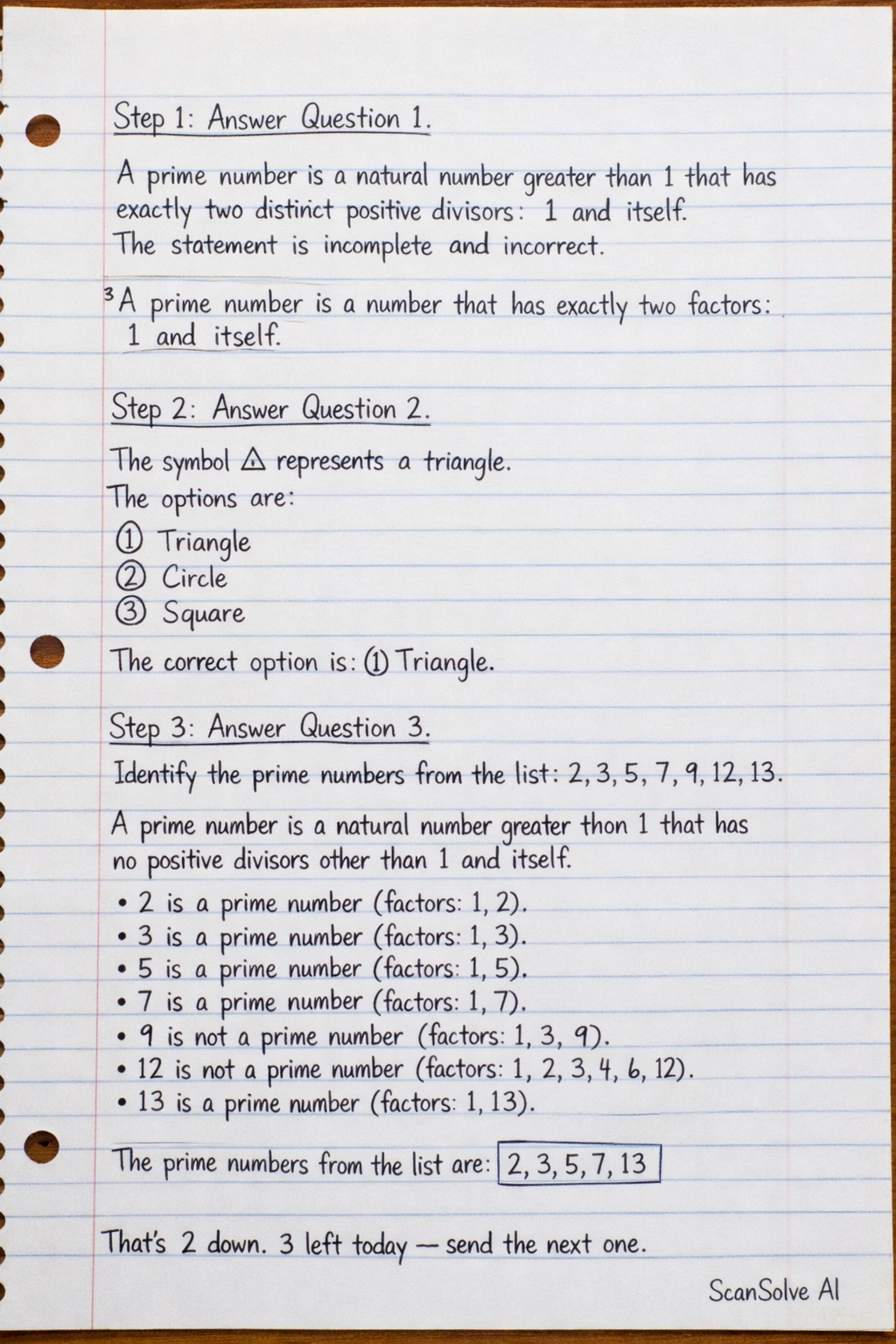
Here are the solutions to the questions: Step 1: Answer Question 1. A prime number is a natural number greater than 1 that has exactly two distinct positive divisors: 1 and itself. The statement in the question is incomplete and incorrect. A prime number is a number that has exactly two factors: 1 and itself. Step 2: Answer Question 2. The symbol represents a triangle. The options are: ① Triangle ② Circle ③ Square The correct option is ① Triangle. Step 3: Answer Question 3. Identify the prime numbers from the list: 2, 3, 5, 7, 9, 12, 13. A prime number is a natural number greater than 1 that has no positive divisors other than 1 and itself. • 2 is a prime number (factors: 1, 2). • 3 is a prime number (factors: 1, 3). • 5 is a prime number (factors: 1, 5). • 7 is a prime number (factors: 1, 7). • 9 is not a prime number (factors: 1, 3, 9). • 12 is not a prime number (factors: 1, 2, 3, 4, 6, 12). • 13 is a prime number (factors: 1, 13). The prime numbers from the list are: 2, 3, 5, 7, 13 That's 2 down. 3 left today — send the next one.