
We read your photo as:
Solve the equation (11−3x)2 = 4(x+4)(x−1)
ScanSolve AI Answer
Step-by-step solution
6 stepslet's solve this equation.
Expand both sides of the equation.
The given equation is .
Expand the left side using the formula :
Expand the right side . First, multiply the binomials :
Now, multiply by 4:
Set the expanded left side equal to the expanded right side.
Rearrange the equation into the standard quadratic form .
Subtract , , and from both sides to move all terms to one side:
Solve the quadratic equation using the quadratic formula .
Here, , , and .
Calculate the discriminant :
Now, substitute the values into the quadratic formula:
Simplify the square root.
Factorize 3344 to find any perfect square factors:
So, .
Substitute this back into the expression for :
Simplify the fraction by dividing the numerator and denominator by 2.
The solutions for are:
The solutions are
\boxed{\text{x = \frac{39 \pm 2\sqrt{209}}{5}}}.
Still stuck on this one?
Ask a follow-up, and the answer starts from this question.
More Mathematics Questions
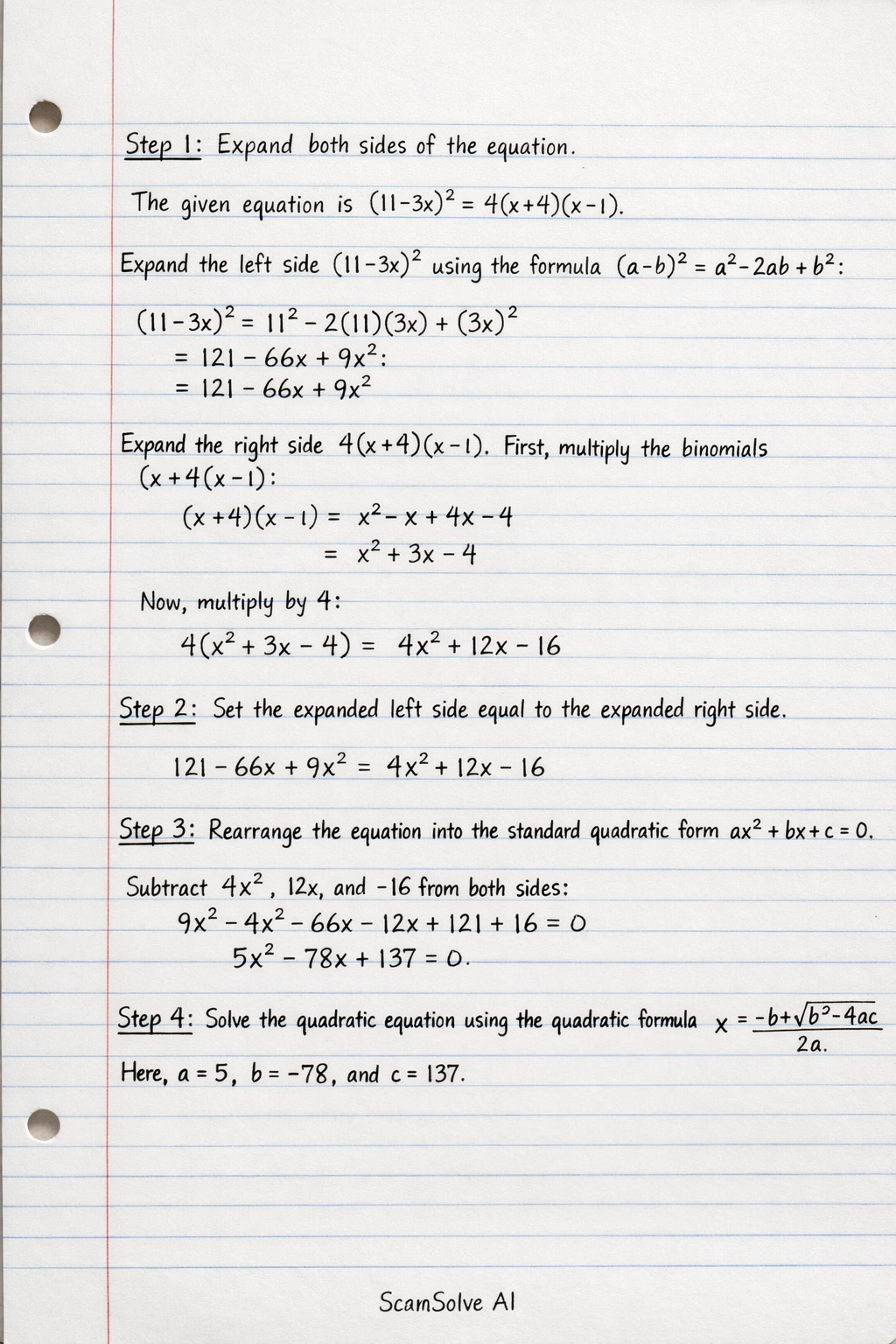
Handwritten Step-by-Step Solution
Get this as a handwritten image on WhatsApp — like a tutor wrote it for you.
Try on WhatsApp