
We read your photo as:
Find the equation of the tangent to the circle x2 + y2 − 4x − 2y − 13 = 0 at the point P(5,4), given that TNP is a diameter.
ScanSolve AI Answer
Step-by-step solution
4 stepsWrite the equation of the circle in the form .
The given equation of the circle is .
To convert this to the standard form, we complete the square for the and terms.Group the terms and terms:
Complete the square for by adding .
Complete the square for by adding .
Add these values to both sides of the equation:The equation of the circle in the required form is:
Write down the coordinates of N and the length of NT.
From the standard form of the circle's equation , the center is and the radius is .
From :
The coordinates of the centre N are .
The radius squared is .
The length of the radius NT is .
Simplify : .
The coordinates of N are and the length of NT is .Determine the equation of the tangent QT in the form .
We are given that TNP is a diameter and P is . N is the center .
Since N is the midpoint of the diameter TP, we can find the coordinates of T using the midpoint formula:
Let .So, the coordinates of T are .
The tangent QT is perpendicular to the radius NT at the point of tangency T.
First, calculate the gradient of the radius NT ():
and .Since QT is perpendicular to NT, the gradient of the tangent QT () is the negative reciprocal of :
Now, use the point-slope form of a linear equation with point T and :
The equation of the tangent QT is .
Determine the coordinates of S.
The circle with centre touches the circle with centre N externally at T.
QT is a tangent to both circles. This means that the radius ST is also perpendicular to QT at T.
Since NT is perpendicular to QT and ST is perpendicular to QT at the same point T, the points N, T, and S must be collinear.
Also, since the circles touch externally at T, T lies between N and S.
We are given NS = 3NT.
We know NT is the radius of the first circle, .
So, .
Since N, T, S are collinear and T is between N and S, the distance .
Therefore, .
This means that T divides the line segment NS in the ratio .
We can use the section formula or simply observe that if N was the origin, but here T is between N and S.
A more direct way is to use the fact that T is a point on the line segment NS such that .
This means that .
So, .
.Using the coordinates:
.
.
The coordinates of S are .
Still stuck on this one?
Ask a follow-up, and the answer starts from this question.
More Mathematics Questions
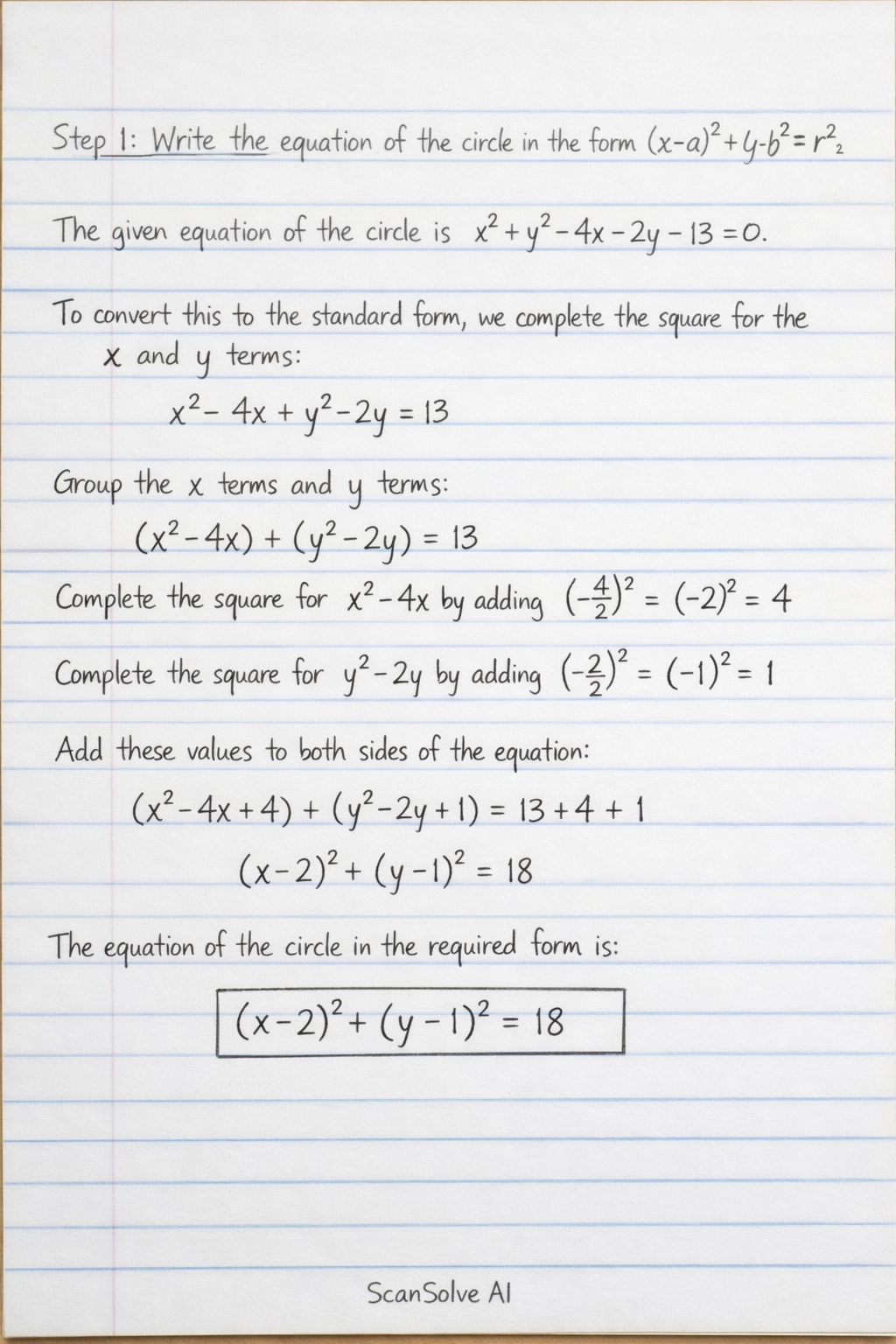
Handwritten Step-by-Step Solution
Get this as a handwritten image on WhatsApp — like a tutor wrote it for you.
Try on WhatsApp