
We read your photo as:
Find the equation of the tangent to the curve x2 − xy − y2 + 4 = 0 at K(2,4). The sum Sn of the first n terms of a linear sequence (A.P.) is given by Sn = n2 − 8n. If the n^th term of the sequence is
ScanSolve AI Answer
This answer stops before the end.
It was cut off when it was first written. Ask ScanSolve this question again for the full working.
here are the solutions to the math problems:
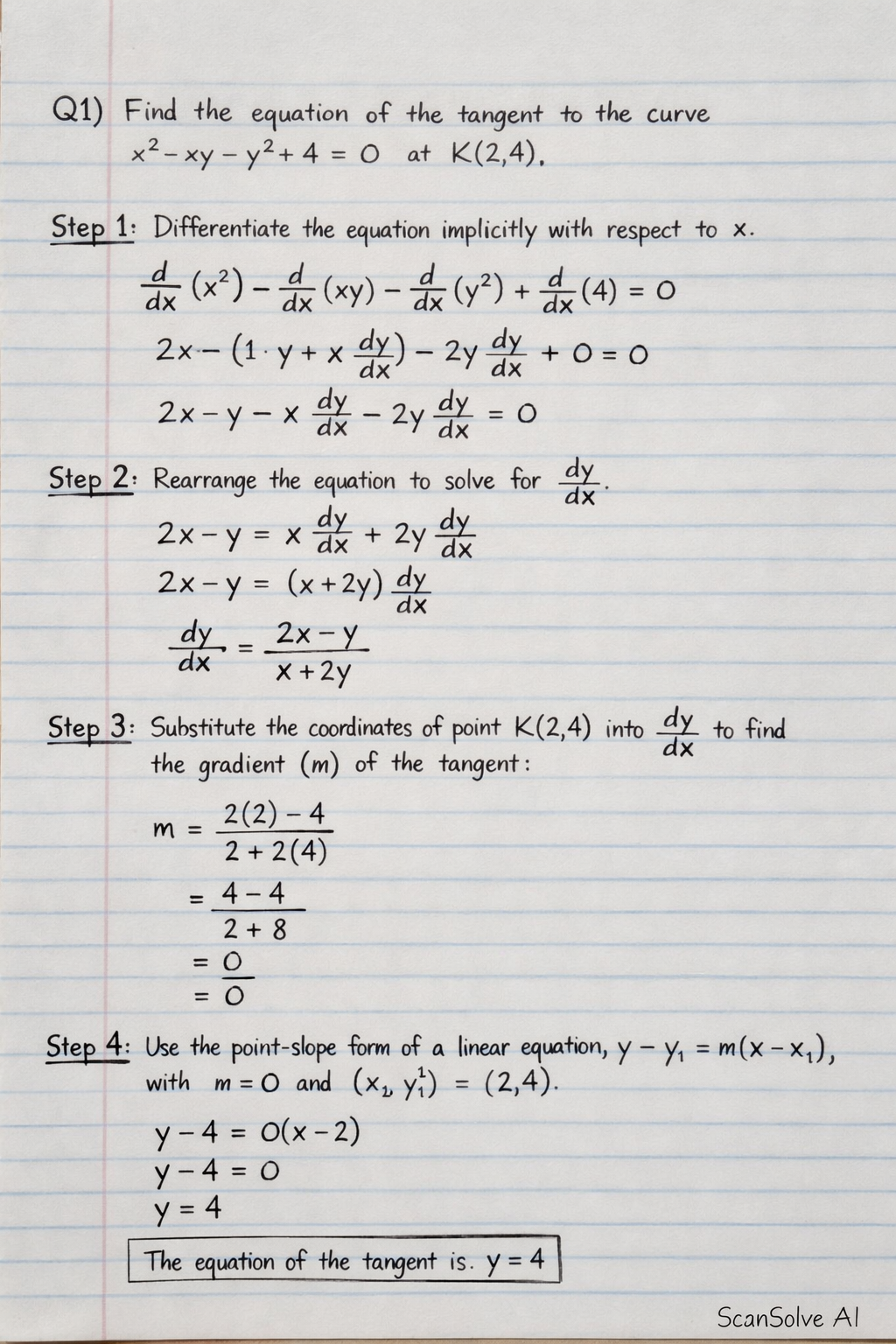
Q1) Find the equation of the tangent to the curve at .
Step 1: Differentiate the equation implicitly with respect to .
Step 2: Rearrange the equation to solve for .
Step 3: Substitute the coordinates of point into to find the gradient () of the tangent.
Step 4: Use the point-slope form of a linear equation, , with and .
The equation of the tangent is .
Q2) The sum of the first terms of a linear sequence (A.P.) is given by . If the term of the sequence is greater than 30, find the least possible value of .
Step 1: Find the formula for the term, , using the relationship .
First, find :
Now, find :
Step 2: Set up the inequality given that the term is greater than 30.
Step 3: Solve the inequality for .
Step 4: Determine the least possible integer value of .
Since must be an integer and must be greater than 19.5, the least possible integer value for is 20.
The least possible value of is .
Q3) Resolve into partial fractions.
Step 1: Factorize the denominator.
We need two numbers that multiply to -24 and add to -5. These numbers are -8 and 3.
Still stuck on this one?
Ask a follow-up, and the answer starts from this question.
More Mathematics Questions
Handwritten Step-by-Step Solution
Get this as a handwritten image on WhatsApp — like a tutor wrote it for you.
Try on WhatsApp