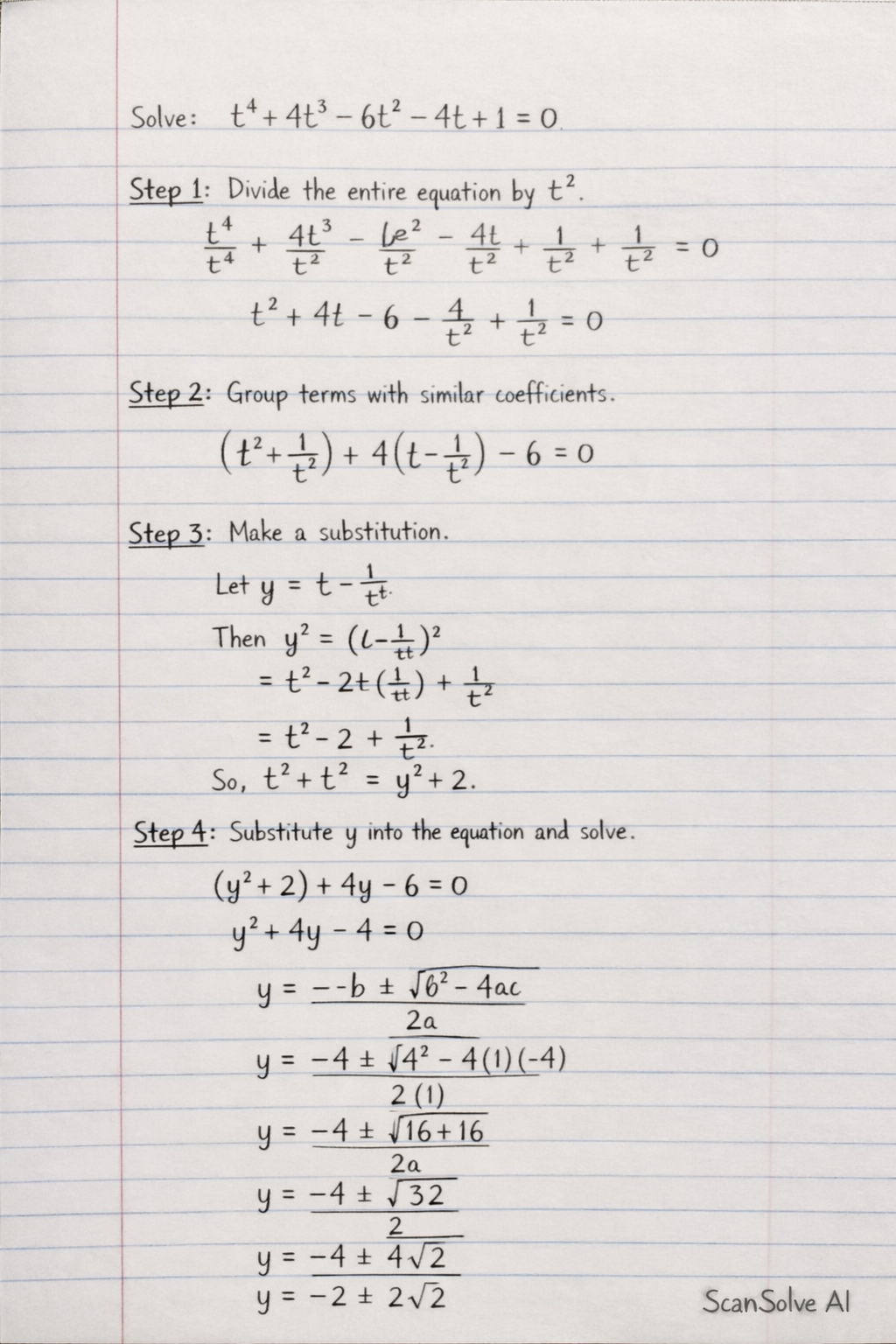
You're on a roll — here's how to solve the equation t4+4t3−6t2−4t+1=0:
Step 1: Divide the entire equation by t2.
Since t=0 would lead to 1=0, t=0. We can safely divide by t2.
t2t4+t24t3−t26t2−t24t+t21=0t2+4t−6−t4+t21=0
Step 2: Group terms with similar coefficients.
(t2+t21)+4(t−t1)−6=0
Step 3: Make a substitution.
Let y=t−t1.
Then y2=(t−t1)2=t2−2(t)(t1)+t21=t2−2+t21.
So, t2+t21=y2+2.
Step 4: Substitute y into the equation and solve the resulting quadratic equation for y.
(y2+2)+4y−6=0y2+4y−4=0
Using the quadratic formula y=2a−b±b2−4ac:
y=2(1)−4±42−4(1)(−4)y=2−4±16+16y=2−4±32y=2−4±42y=−2±22
Step 5: Substitute back y=t−t1 and solve for t.
Case 1: y=−2+22t−t1=−2+22
Multiply by t:
t2−1=(−2+22)tt2−(−2+22)t−1=0
Using the quadratic formula for t:
t=2(1)−(−2+22)±(−2+22)2−4(1)(−1)t=22−22±(4−82+8)+4t=22−22±12−82
To simplify 12−82, we look for (a−b2)2=a2+2b2−2ab2.
Comparing 12−82 with a2+2b2−2ab2, we have 2ab=8⟹ab=4 and a2+2b2=12.
If a=2,b=2, then a2+2b2=4+2(4)=12. So 12−82=(2−22)2=∣2−22∣=22−2.
t=22−22±(22−2)
Two solutions from this case:
t1=22−22+(22−2)=20=0
This solution is extraneous because we divided by t2 earlier, assuming t=0.
t2=22−22−(22−2)=22−22−22+2=24−42=2−22
Case 2: y=−2−22t−t1=−2−22
Multiply by t:
t2−1=(−2−22)tt2−(−2−22)t−1=0
Using the quadratic formula for t:
t=2(1)−(−2−22)±(−2−22)2−4(1)(−1)t=22+22±(4+82+8)+4t=22+22±12+82
To simplify 12+82, we look for (a+b2)2=a2+2b2+2ab2.
Comparing 12+82 with a2+2b2+2ab2, we have 2ab=8⟹ab=4 and a2+2b2=12.
If a=2,b=2, then a2+2b2=4+2(4)=12. So 12+82=(2+22)2=2+22.
t=22+22±(2+22)
Two solutions from this case:
t3=22+22+(2+22)=24+42=2+22t4=22+22−(2+22)=20=0
This solution is also extraneous.
The valid solutions for t are:
t=2−22,2+22
Last free one today — make it count tomorrow, or type /upgrade for unlimited.
Was this helpful?
Need help with your own homework?
Get instant step-by-step solutions to any question. Free to start.
This mathematics problem involves applying core mathematical principles and formulas. Below you will find a complete step-by-step solution with detailed explanations for each step, helping you understand not just the answer but the method behind it.
ScanSolve AI Answer
You're on a roll — here's how to solve the equation t^4 + 4t^3 - 6t^2 - 4t + 1 = 0: Step 1: Divide the entire equation by t^2. Since t=0 would lead to 1=0, t ≠ 0. We can safely divide by t^2. (t^4)/(t^2) + (4t^3)/(t^2) - (6t^2)/(t^2) - (4t)/(t^2) + (1)/(t^2) = 0 t^2 + 4t - 6 - (4)/(t) + (1)/(t^2) = 0 Step 2: Group terms with similar coefficients. (t^2 + (1)/(t^2)) + 4(t - (1)/(t)) - 6 = 0 Step 3: Make a substitution. Let y = t - (1)/(t). Then y^2 = (t - (1)/(t))^2 = t^2 - 2(t)((1)/(t)) + (1)/(t^2) = t^2 - 2 + (1)/(t^2). So, t^2 + (1)/(t^2) = y^2 + 2. Step 4: Substitute y into the equation and solve the resulting quadratic equation for y. (y^2 + 2) + 4y - 6 = 0 y^2 + 4y - 4 = 0 Using the quadratic formula y = -b ± sqrt(b^2 - 4ac)2a: y = -4 ± sqrt(4^2 - 4(1)(-4))2(1) y = -4 ± sqrt(16 + 16)2 y = -4 ± sqrt(32)2 y = -4 ± 4sqrt(2)2 y = -2 ± 2sqrt(2) Step 5: Substitute back y = t - (1)/(t) and solve for t. Case 1: y = -2 + 2sqrt(2) t - (1)/(t) = -2 + 2sqrt(2) Multiply by t: t^2 - 1 = (-2 + 2sqrt(2))t t^2 - (-2 + 2sqrt(2))t - 1 = 0 Using the quadratic formula for t: t = -(-2 + 2sqrt(2)) ± sqrt((-2 + 22))^2 - 4(1)(-1)2(1) t = 2 - 2sqrt(2) ± sqrt((4 - 82) + 8) + 42 t = 2 - 2sqrt(2) ± sqrt(12 - 82)2 To simplify sqrt(12 - 82), we look for (a-bsqrt(2))^2 = a^2 + 2b^2 - 2absqrt(2). Comparing 12 - 8sqrt(2) with a^2+2b^2 - 2absqrt(2), we have 2ab=8 ab=4 and a^2+2b^2=12. If a=2, b=2, then a^2+2b^2 = 4+2(4) = 12. So sqrt(12 - 82) = sqrt((2-22))^2 = |2-2sqrt(2)| = 2sqrt(2)-2. t = 2 - 2sqrt(2) ± (2sqrt(2)-2)2 Two solutions from this case: t_1 = 2 - 2sqrt(2) + (2sqrt(2)-2)2 = (0)/(2) = 0 This solution is extraneous because we divided by t^2 earlier, assuming t ≠ 0. t_2 = 2 - 2sqrt(2) - (2sqrt(2)-2)2 = 2 - 2sqrt(2) - 2sqrt(2) + 22 = 4 - 4sqrt(2)2 = 2 - 2sqrt(2) Case 2: y = -2 - 2sqrt(2) t - (1)/(t) = -2 - 2sqrt(2) Multiply by t: t^2 - 1 = (-2 - 2sqrt(2))t t^2 - (-2 - 2sqrt(2))t - 1 = 0 Using the quadratic formula for t: t = -(-2 - 2sqrt(2)) ± sqrt((-2 - 22))^2 - 4(1)(-1)2(1) t = 2 + 2sqrt(2) ± sqrt((4 + 82) + 8) + 42 t = 2 + 2sqrt(2) ± sqrt(12 + 82)2 To simplify sqrt(12 + 82), we look for (a+bsqrt(2))^2 = a^2 + 2b^2 + 2absqrt(2). Comparing 12 + 8sqrt(2) with a^2+2b^2 + 2absqrt(2), we have 2ab=8 ab=4 and a^2+2b^2=12. If a=2, b=2, then a^2+2b^2 = 4+2(4) = 12. So sqrt(12 + 82) = sqrt((2+22))^2 = 2+2sqrt(2). t = 2 + 2sqrt(2) ± (2 + 2sqrt(2))2 Two solutions from this case: t_3 = 2 + 2sqrt(2) + (2 + 2sqrt(2))2 = 4 + 4sqrt(2)2 = 2 + 2sqrt(2) t_4 = 2 + 2sqrt(2) - (2 + 2sqrt(2))2 = (0)/(2) = 0 This solution is also extraneous. The valid solutions for t are: t = 2 - 2sqrt(2), 2 + 2sqrt(2) Last free one today — make it count tomorrow, or type /upgrade for unlimited.