Solve the equations for x and y. Find the eigenvalues and eigenvectors for the given matrix A.
|Mathematics
Solve the equations for x and y. Find the eigenvalues and eigenvectors for the given matrix A.
ScanSolve AI Answer
Answer
x = -7, y = 9
here are the solutions to questions 8a and 8b.
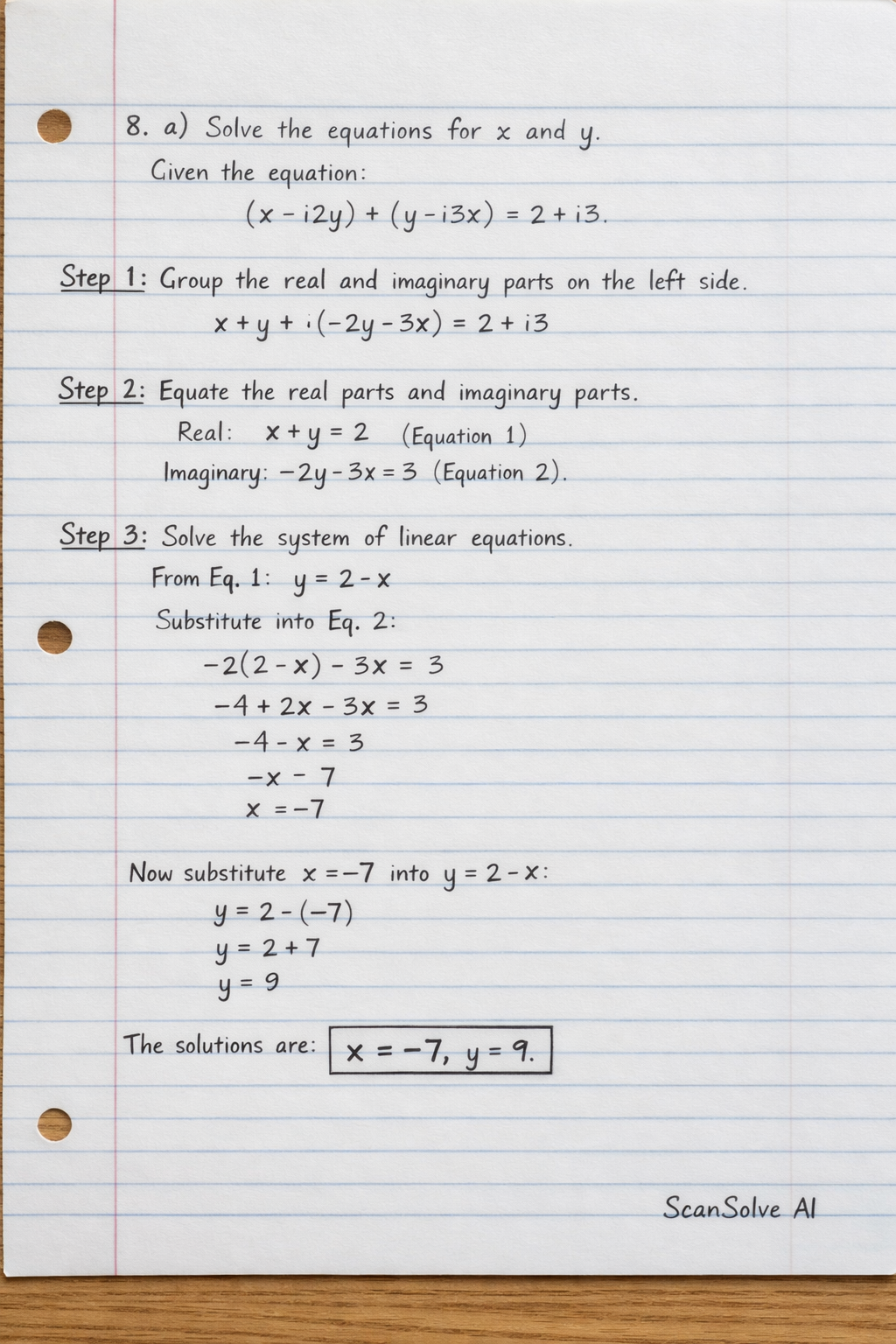
8. a) Solve the equations for x and y.
Given the equation:
(x−i2y)+(y−i3x)=2+i3
Step 1: Group the real and imaginary parts on the left side of the equation.
The real parts are x and y.
The imaginary parts are −2y (from −i2y) and −3x (from −i3x).
So, the equation becomes:
(x+y)+i(−2y−3x)=2+i3
Step 2: Equate the real parts and the imaginary parts from both sides of the equation.
Equating the real parts:
x+y=2(Equation 1)
Equating the imaginary parts:
−2y−3x=3(Equation 2)
Step 3: Solve the system of linear equations.
From Equation 1, express y in terms of x:
y=2−x
Substitute this expression for y into Equation 2:
−2(2−x)−3x=3−4+2x−3x=3−4−x=3−x=3+4−x=7x=−7
Now substitute the value of x back into the expression for y:
y=2−(−7)y=2+7y=9
The solutions are x=−7,y=9.
8. b) Find the eigenvalues and eigenvectors for the given matrix A.
Given the matrix:
A=21−1231−221
Step 1: Find the eigenvalues by solving the characteristic equation det(A−λI)=0.
A−λI=2−λ1−123−λ1−221−λ
Calculate the determinant:
det(A−λI)=(2−λ)[(3−λ)(1−λ)−(2)(1)]−2[(1)(1−λ)−(2)(−1)]+(−2)[(1)(1)−(3−λ)(−1)]=(2−λ)[λ2−4λ+3−2]−2[1−λ+2]−2[1+3−λ]=(2−λ)[λ2−4λ+1]−2[3−λ]−2[4−λ]=(2λ2−8λ+2−λ3+4λ2−λ)−(6−2λ)−(8−2λ)=−λ3+6λ2−5λ−12
Set the determinant to zero:
−λ3+6λ2−5λ−12=0λ3−6λ2+5λ+12=0
By testing integer factors of 12, we find that λ=−1 is a root:
(−1)3−6(−1)2+5(−1)+12=−1−6−5+12=0.
So, (λ+1) is a factor. Dividing the polynomial by (λ+1) gives λ2−7λ+12.
Factoring the quadratic equation λ2−7λ+12=0:
(λ−3)(λ−4)=0
The eigenvalues are λ1=−1,λ2=3,λ3=4.
Step 2: Find the eigenvectors for each eigenvalue.
For λ1=−1:
Solve (A−(−1)I)v=0⟹(A+I)v=0:
31−1241−222v1v2v3=000
From the second and third rows, we can perform row operations:
R2→3R2−R1: 3(1)v1+3(4)v2+3(2)v3−(3v1+2v2−2v3)=0⟹10v2+8v3=0⟹5v2+4v3=0.
R3→3R3+R1: 3(−1)v1+3(1)v2+3(2)v3+(3v1+2v2−2v3)=0⟹5v2+4v3=0.
Let v2=4k. Then 5(4k)+4v3=0⟹20k+4v3=0⟹v3=−5k.
Substitute v2 and v3 into the first equation: 3v1+2(4k)−2(−5k)=0⟹3v1+8k+10k=0⟹3v1+18k=0⟹v1=−6k.
Choosing k=1, the eigenvector is v1=−64−5.
For λ2=3:
Solve (A−3I)v=0:
−11−1201−22−2v1v2v3=000
From the second equation: v1+2v3=0⟹v1=−2v3.
Substitute v1 into the first equation: −(−2v3)+2v2−2v3=0⟹2v3+2v2−2v3=0⟹2v2=0⟹v2=0.
Let v3=k. Then v1=−2k and v2=0.
Choosing k=1, the eigenvector is v2=−201.
For λ3=4:
Solve (A−4I)v=0:
−21−12−11−22−3v1v2v3=000
From the first equation, divide by -2: v1−v2+v3=0⟹v1=v2−v3.
Substitute v1 into the second equation: (v2−v3)−v2+2v3=0⟹v3=0.
Substitute v3=0 into v1=v2−v3: v1=v2−0⟹v1=v2.
Let v2=k. Then v1=k and v3=0.
Choosing k=1, the eigenvector is v3=110.
Drop the next question.
Was this helpful?
Need help with your own homework?
Get instant step-by-step solutions to any question. Free to start.
This mathematics problem involves applying core mathematical principles and formulas. Below you will find a complete step-by-step solution with detailed explanations for each step, helping you understand not just the answer but the method behind it.
ScanSolve AI Answer
here are the solutions to questions 8a and 8b. 8. a) Solve the equations for x and y. Given the equation: (x - i2y) + (y - i3x) = 2 + i3 Step 1: Group the real and imaginary parts on the left side of the equation. The real parts are x and y. The imaginary parts are -2y (from -i2y) and -3x (from -i3x). So, the equation becomes: (x+y) + i(-2y-3x) = 2 + i3 Step 2: Equate the real parts and the imaginary parts from both sides of the equation. Equating the real parts: x + y = 2 (Equation 1) Equating the imaginary parts: -2y - 3x = 3 (Equation 2) Step 3: Solve the system of linear equations. From Equation 1, express y in terms of x: y = 2 - x Substitute this expression for y into Equation 2: -2(2 - x) - 3x = 3 -4 + 2x - 3x = 3 -4 - x = 3 -x = 3 + 4 -x = 7 x = -7 Now substitute the value of x back into the expression for y: y = 2 - (-7) y = 2 + 7 y = 9 The solutions are x = -7, y = 9. 8. b) Find the eigenvalues and eigenvectors for the given matrix A. Given the matrix: A = 2 & 2 & -2 \\ 1 & 3 & 2 \\ -1 & 1 & 1 Step 1: Find the eigenvalues by solving the characteristic equation (A - I) = 0. A - I = 2- & 2 & -2 \\ 1 & 3- & 2 \\ -1 & 1 & 1- Calculate the determinant: (A - I) = (2-)[(3-)(1-) - (2)(1)] - 2[(1)(1-) - (2)(-1)] + (-2)[(1)(1) - (3-)(-1)] = (2-)[^2 - 4 + 3 - 2] - 2[1-+2] - 2[1+3-] = (2-)[^2 - 4 + 1] - 2[3-] - 2[4-] = (2^2 - 8 + 2 - ^3 + 4^2 - ) - (6 - 2) - (8 - 2) = -^3 + 6^2 - 5 - 12 Set the determinant to zero: -^3 + 6^2 - 5 - 12 = 0 ^3 - 6^2 + 5 + 12 = 0 By testing integer factors of 12, we find that = -1 is a root: (-1)^3 - 6(-1)^2 + 5(-1) + 12 = -1 - 6 - 5 + 12 = 0. So, (+1) is a factor. Dividing the polynomial by (+1) gives ^2 - 7 + 12. Factoring the quadratic equation ^2 - 7 + 12 = 0: (-3)(-4) = 0 The eigenvalues are _1 = -1, _2 = 3, _3 = 4. Step 2: Find the eigenvectors for each eigenvalue. For _1 = -1: Solve (A - (-1)I)v = 0 (A+I)v = 0: 3 & 2 & -2 \\ 1 & 4 & 2 \\ -1 & 1 & 2 v_1 \\ v_2 \\ v_3 = 0 \\ 0 \\ 0 From the second and third rows, we can perform row operations: R_2 3R_2 - R_1: 3(1)v_1 + 3(4)v_2 + 3(2)v_3 - (3v_1 + 2v_2 - 2v_3) = 0 10v_2 + 8v_3 = 0 5v_2 + 4v_3 = 0. R_3 3R_3 + R_1: 3(-1)v_1 + 3(1)v_2 + 3(2)v_3 + (3v_1 + 2v_2 - 2v_3) = 0 5v_2 + 4v_3 = 0. Let v_2 = 4k. Then 5(4k) + 4v_3 = 0 20k + 4v_3 = 0 v_3 = -5k. Substitute v_2 and v_3 into the first equation: 3v_1 + 2(4k) - 2(-5k) = 0 3v_1 + 8k + 10k = 0 3v_1 + 18k = 0 v_1 = -6k. Choosing k=1, the eigenvector is v_1 = -6 \\ 4 \\ -5 . For _2 = 3: Solve (A - 3I)v = 0: -1 & 2 & -2 \\ 1 & 0 & 2 \\ -1 & 1 & -2 v_1 \\ v_2 \\ v_3 = 0 \\ 0 \\ 0 From the second equation: v_1 + 2v_3 = 0 v_1 = -2v_3. Substitute v_1 into the first equation: -(-2v_3) + 2v_2 - 2v_3 = 0 2v_3 + 2v_2 - 2v_3 = 0 2v_2 = 0 v_2 = 0. Let v_3 = k. Then v_1 = -2k and v_2 = 0. Choosing k=1, the eigenvector is v_2 = -2 \\ 0 \\ 1 . For _3 = 4: Solve (A - 4I)v = 0: -2 & 2 & -2 \\ 1 & -1 & 2 \\ -1 & 1 & -3 v_1 \\ v_2 \\ v_3 = 0 \\ 0 \\ 0 From the first equation, divide by -2: v_1 - v_2 + v_3 = 0 v_1 = v_2 - v_3. Substitute v_1 into the second equation: (v_2 - v_3) - v_2 + 2v_3 = 0 v_3 = 0. Substitute v_3 = 0 into v_1 = v_2 - v_3: v_1 = v_2 - 0 v_1 = v_2. Let v_2 = k. Then v_1 = k and v_3 = 0. Choosing k=1, the eigenvector is v_3 = 1 \\ 1 \\ 0 . Drop the next question.