
We read your photo as:
Example 10.1 A, B is a line segment and the line is perpendicular bisector to point P. Show that P is equidistant from A and B.
ScanSolve AI Answer
Answer
Step-by-step solution
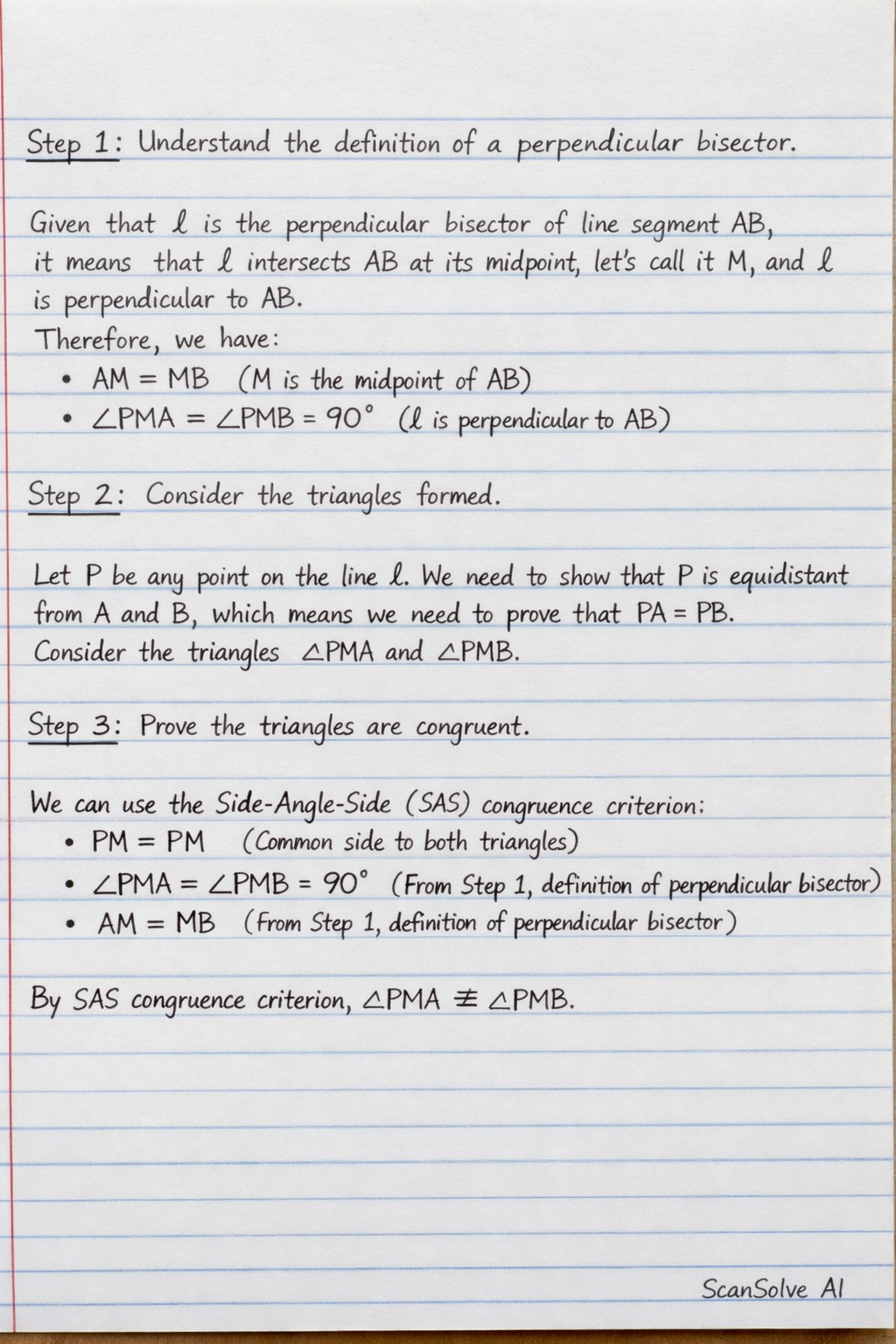
4 stepsUnderstand the definition of a perpendicular bisector.
Given that is the perpendicular bisector of line segment AB, it means that intersects AB at its midpoint, let's call it M, and is perpendicular to AB.
Therefore, we have:- AM = MB (M is the midpoint of AB)
- (l is perpendicular to AB)
Consider the triangles formed.
Let P be any point on the line . We need to show that P is equidistant from A and B, which means we need to prove that PA = PB. Consider the triangles and .
Prove the triangles are congruent.
We can use the Side-Angle-Side (SAS) congruence criterion:
- PM = PM (Common side to both triangles)
- (From Step 1, definition of perpendicular bisector)
- AM = MB (From Step 1, definition of perpendicular bisector) By SAS congruence criterion, .
Conclude that P is equidistant from A and B.
Since , their corresponding parts are equal (CPCTC - Corresponding Parts of Congruent Triangles are Congruent).
Therefore, PA = PB.
This shows that any point P on the perpendicular bisector is equidistant from points A and B.The final answer is .
Try one yourself
A new problem that tests the same skill.
Still stuck on this one?
Ask a follow-up, and the answer starts from this question.
More Mathematics Questions
Handwritten Step-by-Step Solution
Get this as a handwritten image on WhatsApp — like a tutor wrote it for you.
Try on WhatsApp