
We read your photo as:
Expand the expression (1-2x)².
ScanSolve AI Answer
Answer
Step-by-step solution
18 stepsPart 27· 2 steps
The term independent of in the expansion of is
Expand the expression .
Identify the term independent of .
The term independent of is the constant term.
In the expansion , the constant term is 1.The term independent of is .
Since 1 is not among options a) 15, b) -15, c) 32, d) -32, the correct option is e) None of the above.
Part 28· 2 steps
In the expansion of , the sum of the coefficients is
To find the sum of coefficients of a polynomial, substitute 1 for each variable.
For the expansion of , substitute and .
Sum of coefficients .Evaluate .
If , then . In binomial expansion, is typically a positive integer.
The sum of the coefficients is .
This matches option a) 0.
Part 29· 3 steps
The middle term in the expansion of is
Determine the number of terms in the expansion.
For , there are terms. Here , so there are terms.
Find the position of the middle term.
Since there are 11 terms (an odd number), there is one middle term. Its position is . So, it's the 6-th term.
Use the general term formula .
For the 6-th term, .
For , , , .The question asks for "the middle term", and the options are powers of . This implies we should identify the variable part of the middle term.
The middle term is . The variable part is .
This matches option a) .
Part 30· 3 steps
The coefficient of the term containing in the expansion of is
Use the generalized binomial theorem for
Here, and .
We need the term containing , which corresponds to the term with .
The coefficient of is .Substitute and into the term.
The term is .
Identify the coefficient of .
The coefficient of is 160.
The coefficient of the term containing is .
Since 160 is not among options a) -4, b) -8, c) 8, d) 4, the correct option is e) None of the above.
Part 31· 3 steps
What is the term independent of in the expansion of ?
Use the general term formula .
For , , , .
The term independent of is the term where the power of is 0. So, .Substitute into the general term formula.
Calculate the value.
The term independent of is .
This matches option a) 1.
Part 32· 4 steps
The coefficient of the second term in the expansion of is
Use the general term formula .
For , , , .
We need the second term, so .Substitute into the general term formula.
Calculate the values.
Identify the coefficient of the second term.
The coefficient of the second term is .
The coefficient of the second term is .
Since is not among options a) -120, b) 240, c) -240, d) 120, the correct option is e) None of the above.
Part 33· 1 step
The sum of the coefficients in the expansion of is
To find the sum of coefficients of a polynomial, substitute 1 for each variable.
For the expansion of , substitute and .
Sum of coefficients .The sum of the coefficients is .
This matches option c) .
Try one yourself
A new problem that tests the same skill.
Still stuck on this one?
Ask a follow-up, and the answer starts from this question.
More Mathematics Questions
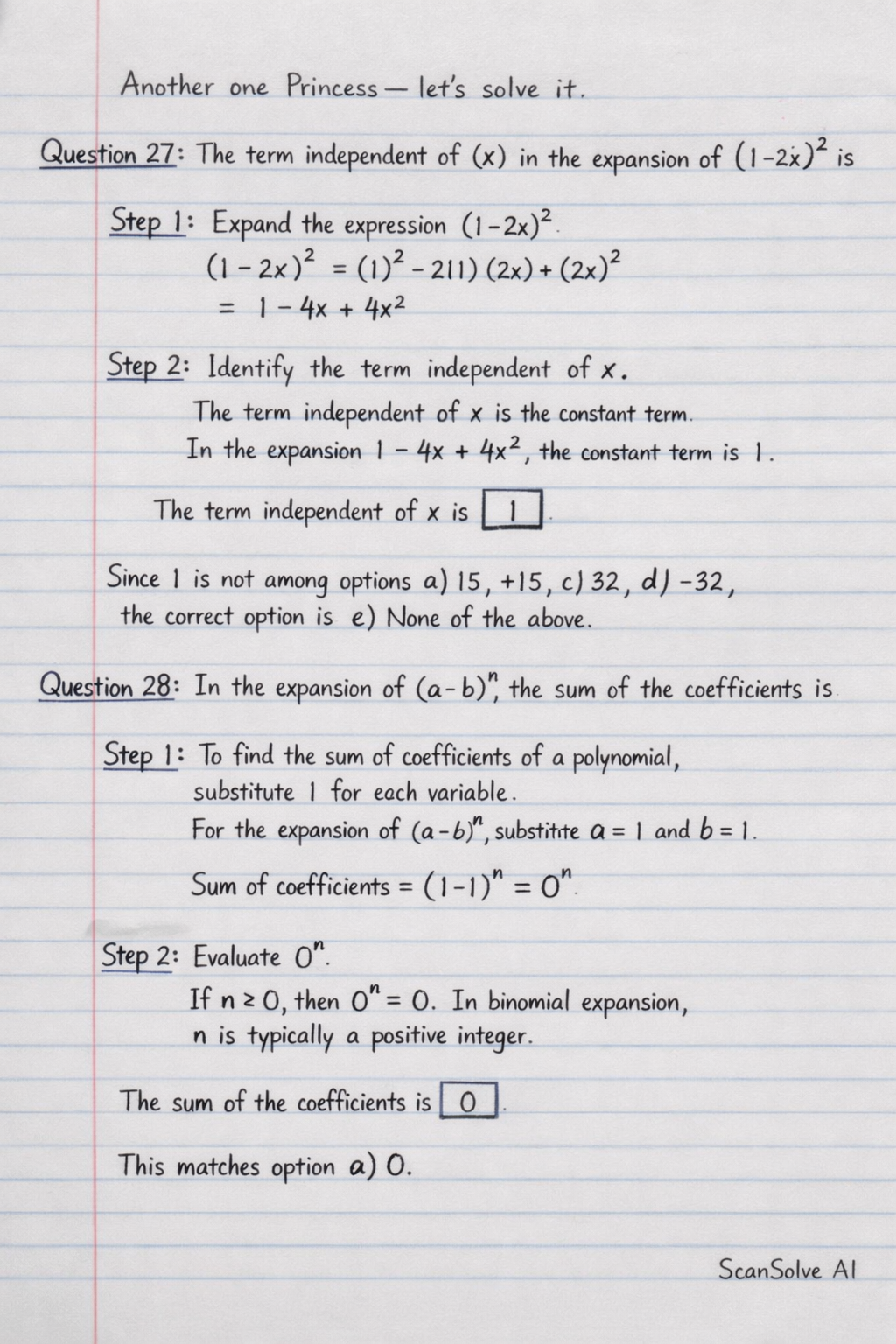
Handwritten Step-by-Step Solution
Get this as a handwritten image on WhatsApp — like a tutor wrote it for you.
Try on WhatsApp