
We read your photo as:
Expand (x- rac12)6 and use it to show that ( rac199400)6 ~= 0.01516.
ScanSolve AI Answer
This answer stops before the end.
It was cut off when it was first written. Ask ScanSolve this question again for the full working.
: Write down in its simplest form the complete expansion of . Hence, by taking in this expansion, show that , correct to five places of decimals.
Step 1: Expand using the binomial theorem.
The complete expansion is .
Step 2: Substitute into the expansion.
When , the expression becomes .
We evaluate the expansion with . Since is small, we can use the terms in ascending powers of :
Substitute :
The terms with and higher powers are very small and will not affect the fifth decimal place.
Summing these values:
Rounding to five decimal places, we get 0.01516.
Thus, .
: The ratio of the third to the fourth term in the expansion of in ascending powers of is when . Find .
Step 1: Write the general term for .
Step 2: Write the third term () and the fourth term ().
For , :
For , :
Step 3: Set up the ratio and simplify.
Still stuck on this one?
Ask a follow-up, and the answer starts from this question.
More Mathematics Questions
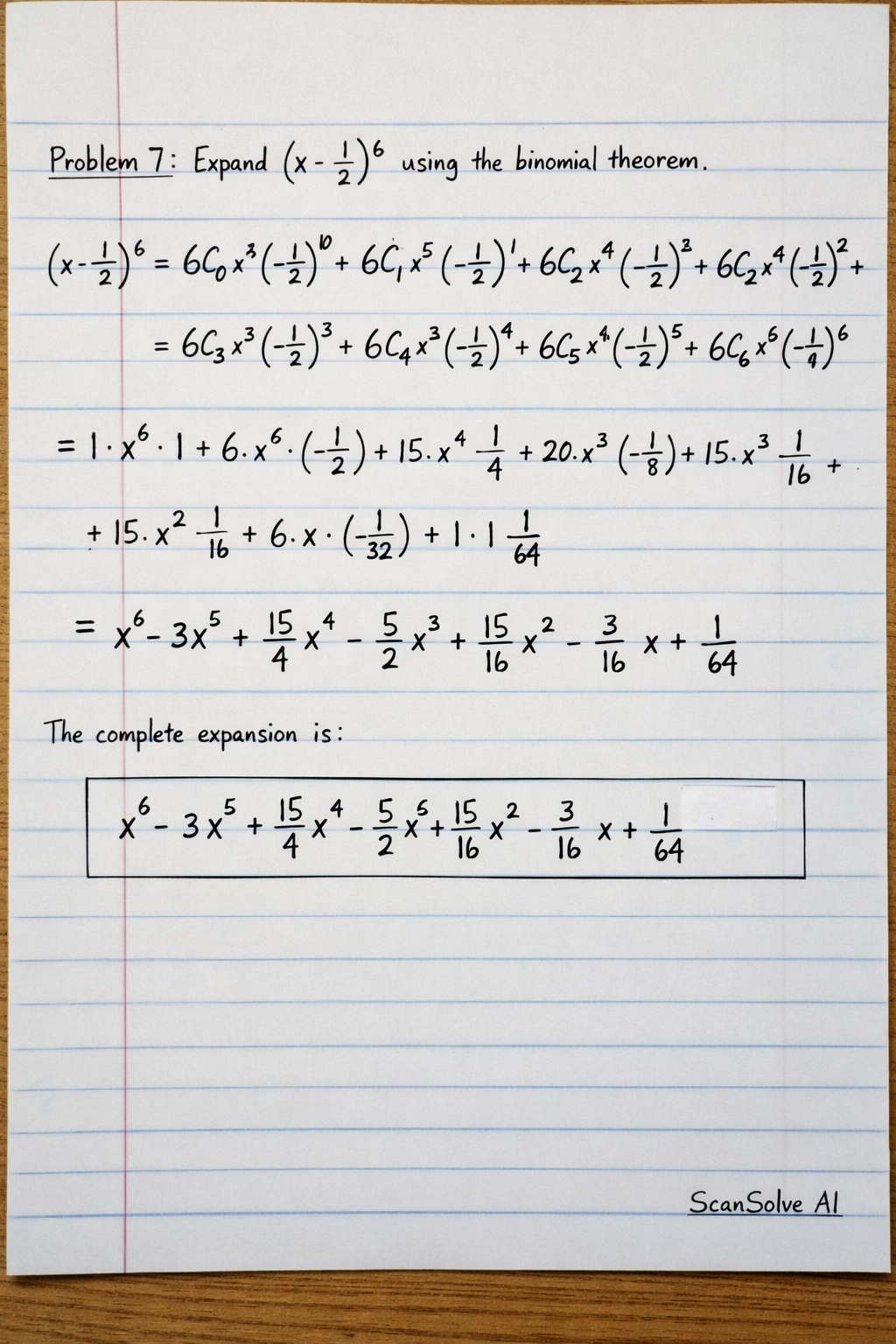
Handwritten Step-by-Step Solution
Get this as a handwritten image on WhatsApp — like a tutor wrote it for you.
Try on WhatsApp