

This mathematics problem involves applying core mathematical principles and formulas. Below you will find a complete step-by-step solution with detailed explanations for each step, helping you understand not just the answer but the method behind it.
ScanSolve AI Answer
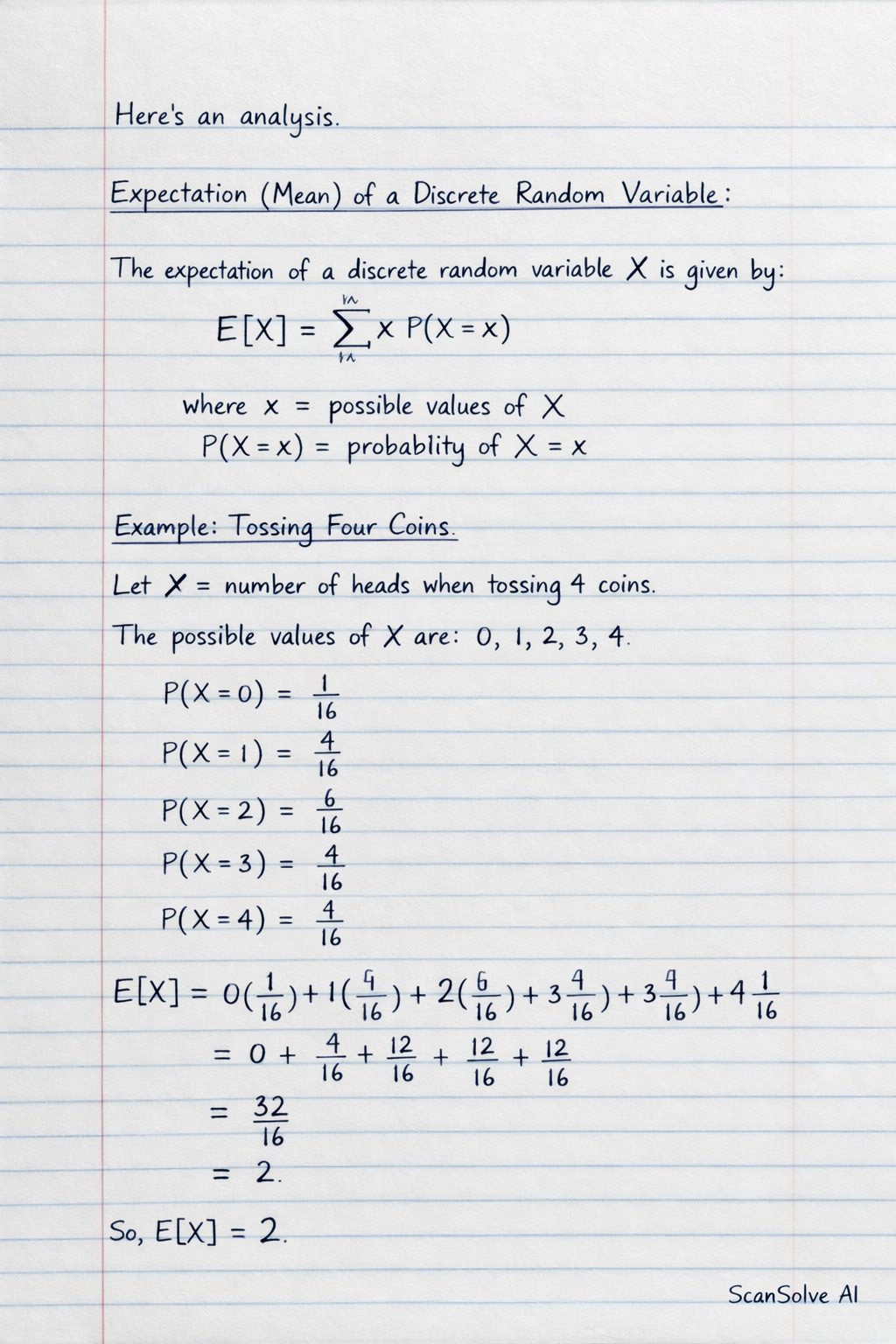
You're on a roll — Here's a breakdown of the concepts from your notes: • Expectation (Mean) of a Discrete Random Variable: The expectation, or mean, of a discrete random variable X is denoted by E[X] or . It represents the average value of the random variable over many trials. The formula for the expectation is: E[X] = _x x P(X=x) where x represents each possible value of the random variable, and P(X=x) is the probability of X taking that value. Example: Tossing Four Coins The notes mention "tossing three coins" but the probabilities are given out of 16, which corresponds to tossing four coins (2^4 = 16 possible outcomes). Let X be the number of heads when tossing four fair coins. The possible values for X are 0, 1, 2, 3, 4, with the following probabilities: P(X=0) = 1/16 P(X=1) = 4/16 P(X=2) = 6/16 P(X=3) = 4/16 P(X=4) = 1/16 Step 1: Substitute the values into the expectation formula. E[X] = 0 ((1)/(16)) + 1 ((4)/(16)) + 2 ((6)/(16)) + 3 ((4)/(16)) + 4 ((1)/(16)) Step 2: Multiply the terms. E[X] = (0)/(16) + (4)/(16) + (12)/(16) + (12)/(16) + (4)/(16) Step 3: Sum the numerators. E[X] = (0+4+12+12+4)/(16) = (32)/(16) Step 4: Simplify the fraction. E[X] = 2 • Variance of a Discrete Random Variable: The variance of a discrete random variable X, denoted by ^2 or Var(X), measures how far the values of the random variable are spread out from the mean. The formula for variance is: ^2 = E[(X-)^2] This can be expanded and simplified to a more computationally convenient form: ^2 = E[X^2] - (E[X])^2 where E[X^2] = _x x^2 P(X=x). Example: Calculating E[X^2] for Tossing Four Coins Using the same example of tossing four coins, we first calculate E[X^2]. Step 1: Substitute the values into the E[X^2] formula. E[X^2] = 0^2 ((1)/(16)) + 1^2 ((4)/(16)) + 2^2 ((6)/(16)) + 3^2 ((4)/(16)) + 4^2 ((1)/(16)) Step 2: Square the x values and multiply. E[X^2] = 0 ((1)/(16)) + 1 ((4)/(16)) + 4 ((6)/(16)) + 9 ((4)/(16)) + 16 ((1)/(16)) E[X^2] = (0)/(16) + (4)/(16) + (24)/(16) + (36)/(16) + (16)/(16) Step 3: Sum the numerators. E[X^2] = (0+4+24+36+16)/(16) = (80)/(16) Step 4: Simplify the fraction. E[X^2] = 5 Calculating the Variance Now we can calculate the variance using E[X] = 2 and E[X^2] = 5. Step 1: Use the variance formula. ^2 = E[X^2] - (E[X])^2 Step 2: Substitute the calculated values. ^2 = 5 - (2)^2 Step 3: Simplify. ^2 = 5 - 4 ^2 = 1 What's next?