
We read your photo as:
Solve the exponential equation: 5^(2(x+3)) = 7^(x+3)
Mathematics
ScanSolve AI Answer
Answer
Step-by-step solution
5 stepsThe equation from the image is:
Take the natural logarithm of both sides of the equation.
Use the logarithm property to bring the exponents down.
Move all terms to one side of the equation.
Factor out the common term .
For the product of two factors to be zero, at least one of the factors must be zero.
We have two possibilities:
Possibility 1:Possibility 2:
This simplifies to , which means . Since , this statement is false, and this factor cannot be zero.Therefore, the only valid solution is from Possibility 1.
Was this helpful?
Try one yourself
A new problem that tests the same skill.
Still stuck on this one?
Ask a follow-up, and the answer starts from this question.
Got a different question?Ask your own question
More Mathematics Questions
QSolve the exponential equation: 2(52x) − 7(5^x) = 15.QSolve the exponential equation: (5^x)2 - 6(5^x) + 5 = 0QSolve the exponential equation: 2^(2x−3) imes 2^(x+2) = 128.QSolve the equation (x+5)2 = 7(x−5) for x.QSolve the following exponential equations: 2^(2x+4)=1, 2^(4x+2)=64, 2^(x+3)=4^x, 3^(2x+7)=81.
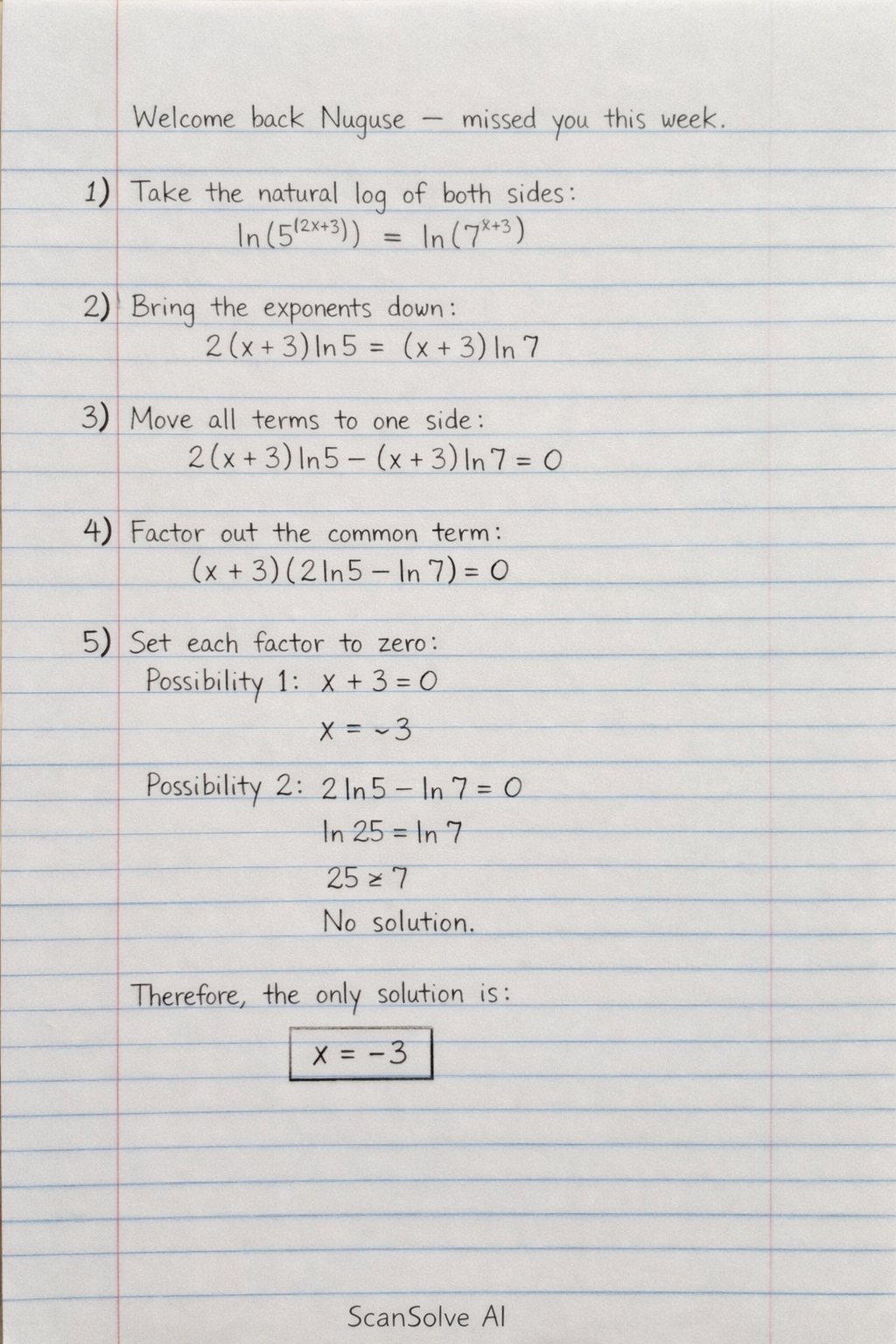
Handwritten Step-by-Step Solution
Get this as a handwritten image on WhatsApp — like a tutor wrote it for you.
Try on WhatsApp