
We read your photo as:
Express the following in a true polar form, z = (40^) - i(40^). 2. Find the imaginary part of (1)/(1+i).
ScanSolve AI Answer
1. Express the following in a true polar form, .
-
Step 1: Identify the modulus and argument. The given complex number is . The modulus is 1. The standard polar form is . We use the trigonometric identities and .
-
Step 2: Rewrite the expression in standard polar form.
The angle is a valid argument. Alternatively, we can express the angle as a positive value by adding : .
Both forms are correct. We will use the form with the negative angle. The true polar form is .
2. Find the imaginary part of .
-
Step 1: Rationalize the denominator. To find the imaginary part, we need to express the complex number in the form . We multiply the numerator and denominator by the conjugate of the denominator. The conjugate of is .
-
Step 2: Perform the multiplication.
-
Step 3: Separate the real and imaginary parts.
The imaginary part is the coefficient of . The imaginary part is .
3. Find ; , if .
-
Step 1: Equate the real parts. For two complex numbers to be equal, their real parts must be equal, and their imaginary parts must be equal. The real part of the left side is . The real part of the right side is .
-
Step 2: Equate the imaginary parts. The imaginary part of the left side is . The imaginary part of the right side is 10.
-
Step 3: Solve the system of equations. From , we find :
Substitute into equation :
The values are and . So, .
4. Evaluate the following powers of :
Recall the cycle of powers of :
For any integer , . If , then .
-
a) Divide the exponent by 4: with a remainder of 0.
Alternatively, . The value is .
-
b) Divide the exponent by 4: with a remainder of 3.
The value is .
-
c) Divide the exponent by 4: with a remainder of 2.
The value is .
-
d) Divide the exponent by 4: with a remainder of 1.
The value is .
Still stuck on this one?
Ask a follow-up, and the answer starts from this question.
More Mathematics Questions
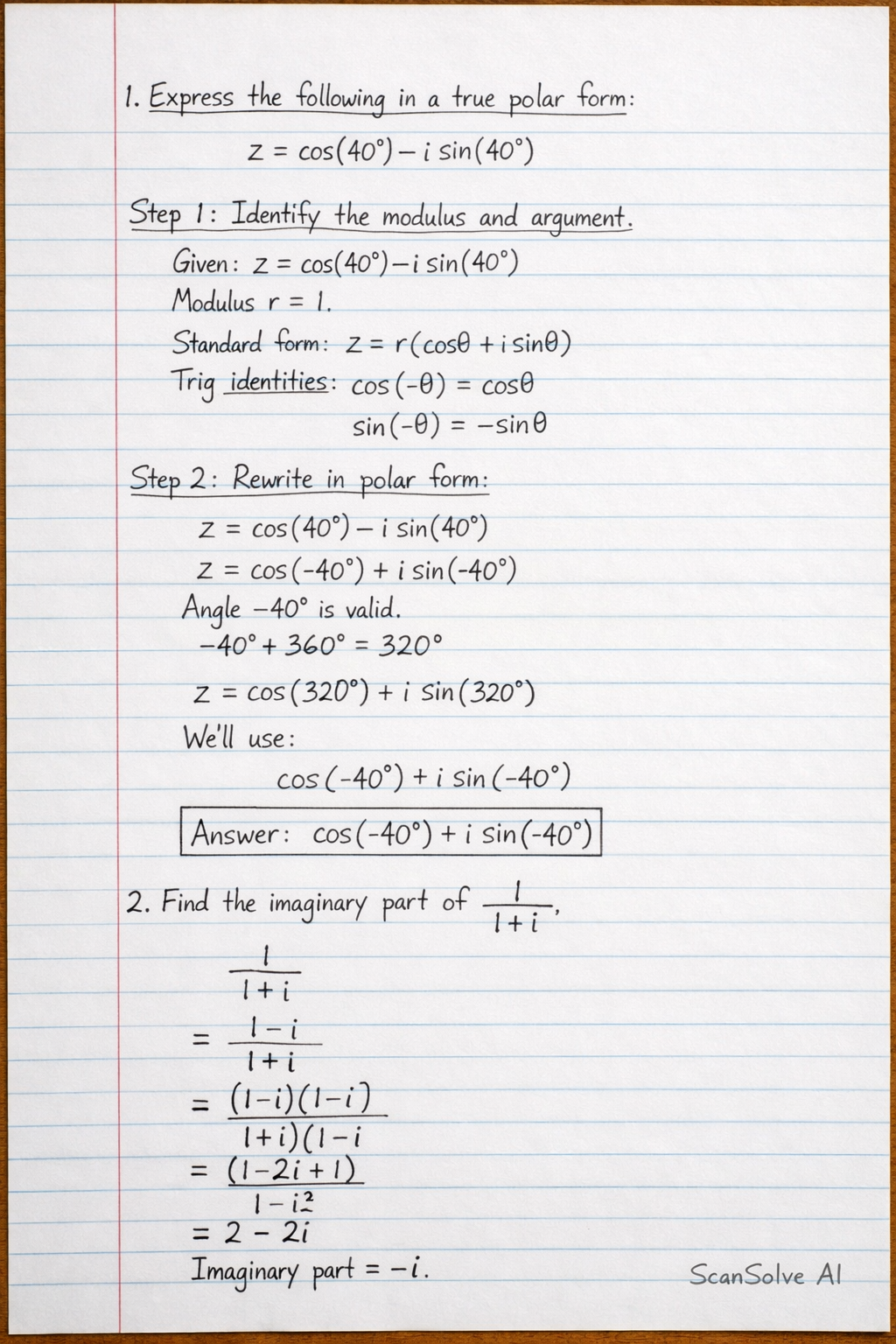
Handwritten Step-by-Step Solution
Get this as a handwritten image on WhatsApp — like a tutor wrote it for you.
Try on WhatsApp