
We read your photo as:
Express the series 12 + 22 + 32 + s + 92 using sigma notation.
ScanSolve AI Answer
Answer
Step-by-step solution
3 stepsTo express the series using sigma notation, we need to identify the general term and the range of the index.
Identify the general term.
The terms in the series are squares of consecutive integers: .
The general term can be represented as , where is an integer.Determine the range of the index.
The series starts with , so the lower limit of the index is 1.
The series ends with , so the upper limit of the index is 9.
Thus, the sigma notation is .Compare with the given options.
Let's examine the options:
- (a) : This sum is . Since , this is equivalent to .
- (b) : This sum is .
- (c) : This sum is .
- (d) : This sum is .
Option (a) correctly represents the given series because adding does not change the sum.
The final answer is .
Try one yourself
A new problem that tests the same skill.
Still stuck on this one?
Ask a follow-up, and the answer starts from this question.
More Mathematics Questions
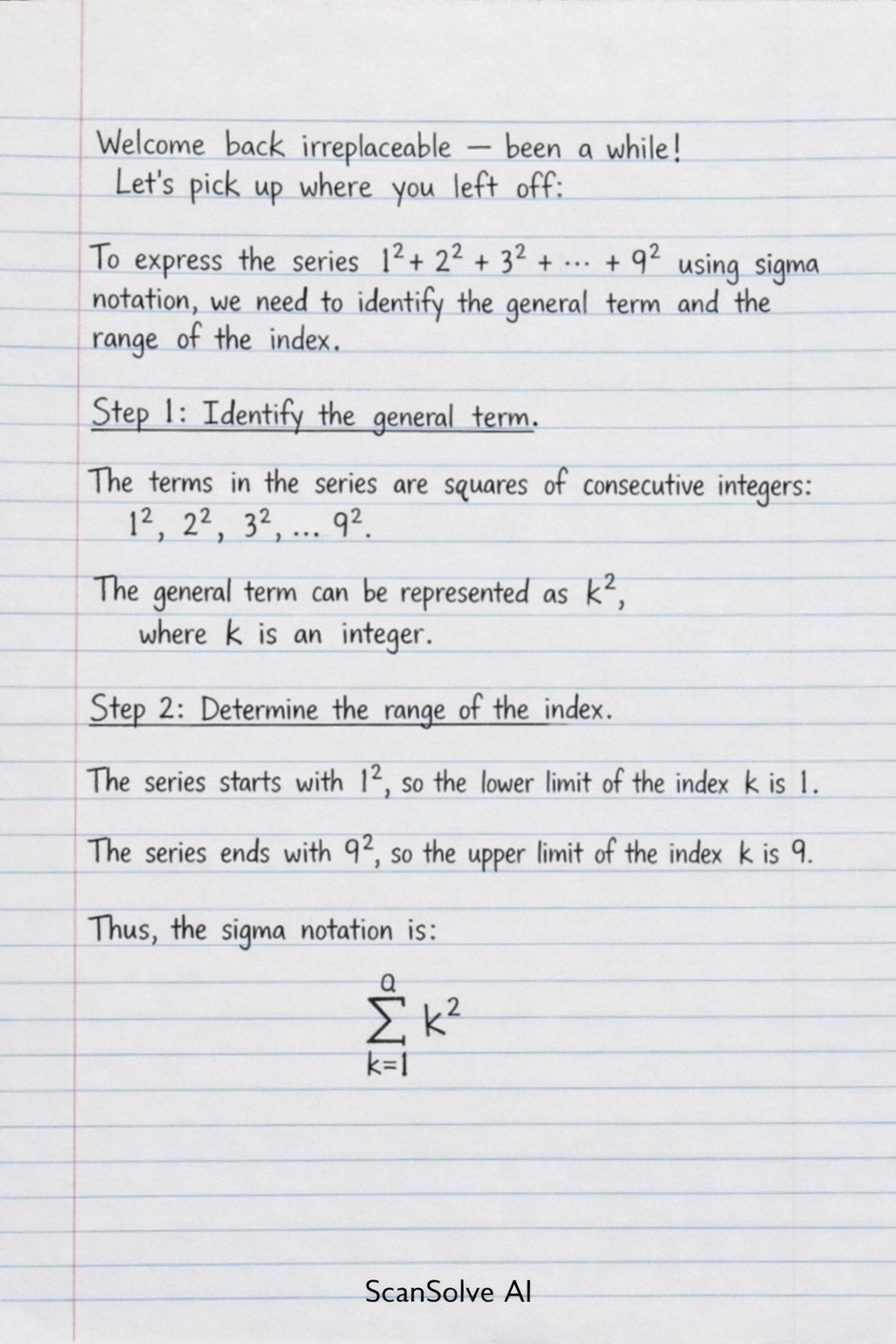
Handwritten Step-by-Step Solution
Get this as a handwritten image on WhatsApp — like a tutor wrote it for you.
Try on WhatsApp