Exterior angles of angular polygon are in the ratio of 2:3. a) Find the size of the exterior angle. b) What is the interior angle sum of the hexagon?

Mathematics
Exterior angles of angular polygon are in the ratio of 2:3. a) Find the size of the exterior angle. b) What is the interior angle sum of the hexagon?

ScanSolve AI Answer

Answer

7272^\circ

Here are the solutions to the problems you've sent.

5) If the exterior angles of a regular polygon are in the ratio of 2:3, find the size of the exterior angle. The phrasing of this question is unusual, as all exterior angles of a regular polygon are equal. We will assume it means the ratio of the exterior angle to the interior angle is 2:3.

a) Find the size of the exterior angle.

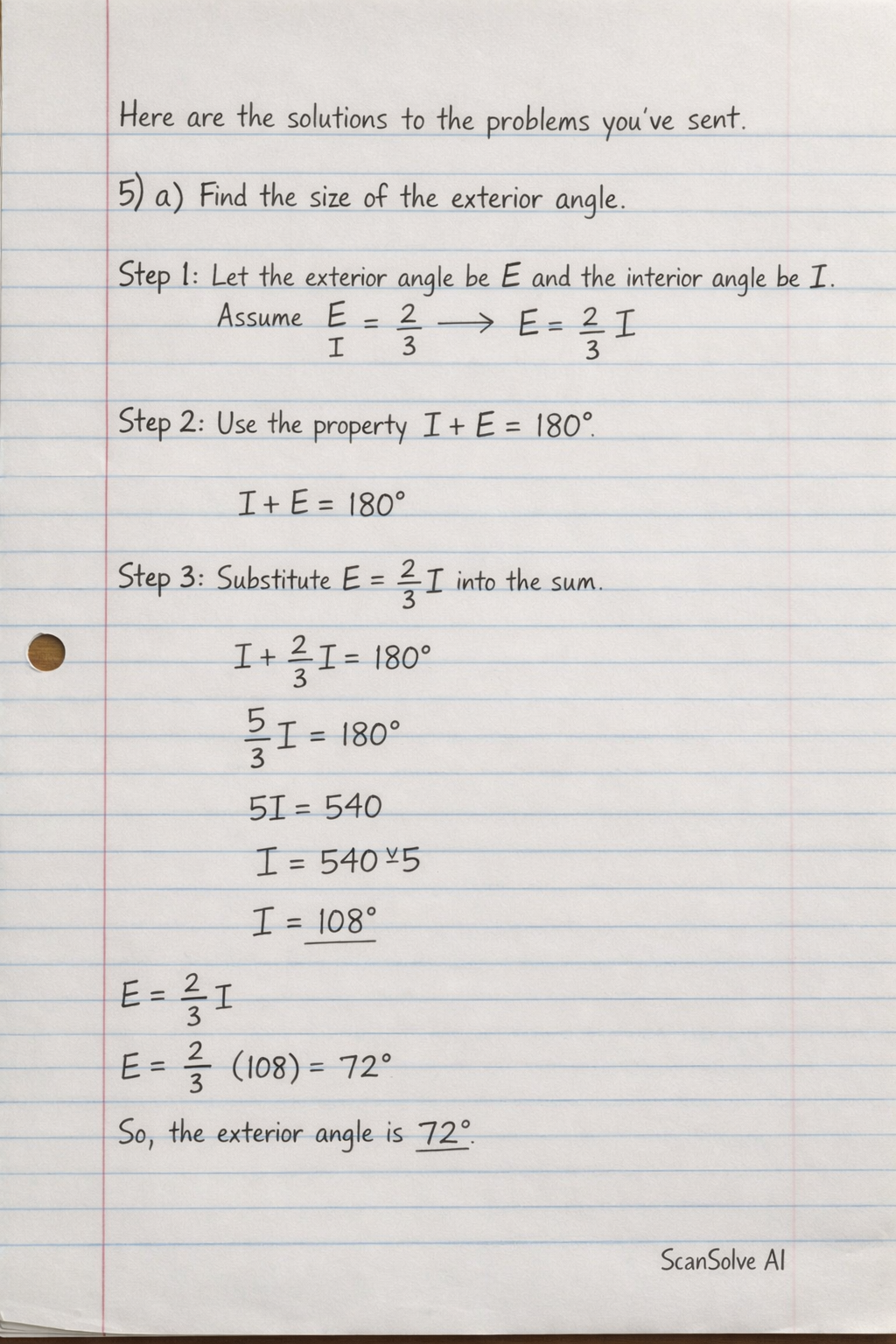
Step 1: Let the exterior angle be EE and the interior angle be II. We assume the ratio of the exterior angle to the interior angle is 2:32:3. EI=23    E=23I\frac{E}{I} = \frac{2}{3} \implies E = \frac{2}{3}I

Step 2: Use the property that the interior angle and exterior angle of a polygon sum to 180180^\circ. I+E=180I + E = 180^\circ

Step 3: Substitute E=23IE = \frac{2}{3}I into the sum equation and solve for II. I+23I=180I + \frac{2}{3}I = 180^\circ 53I=180\frac{5}{3}I = 180^\circ I=180×35=36×3=108I = 180^\circ \times \frac{3}{5} = 36^\circ \times 3 = 108^\circ

Step 4: Calculate the exterior angle EE. E=180I=180108=72E = 180^\circ - I = 180^\circ - 108^\circ = 72^\circ Alternatively, E=23I=23(108)=72E = \frac{2}{3}I = \frac{2}{3}(108^\circ) = 72^\circ. The exterior angle is 72\boxed{72^\circ}. (This corresponds to a regular pentagon, as 360/72=5360^\circ / 72^\circ = 5 sides).

b) What is the interior angle sum of a heptagon?

Step 1: Identify the number of sides for a heptagon. A heptagon has n=7n=7 sides.

Step 2: Use the formula for the sum of interior angles of a polygon. The sum of interior angles of an nn-sided polygon is given by: Sum=(n2)×180Sum = (n-2) \times 180^\circ

Step 3: Substitute n=7n=7 into the formula and calculate the sum. Sum=(72)×180=5×180=900Sum = (7-2) \times 180^\circ = 5 \times 180^\circ = 900^\circ The interior angle sum of a heptagon is 900\boxed{900^\circ}.

7) Find the value of x in the figures below.

a) The figure is a quadrilateral. The sum of the interior angles of a quadrilateral is 360360^\circ. The angles are (x5)(x-5)^\circ, (x1)(x-1)^\circ, (x+11)(x+11)^\circ, and (x+19)(x+19)^\circ.

Step 1: Set up the equation by summing all interior angles. (x5)+(x1)+(x+11)+(x+19)=360(x-5) + (x-1) + (x+11) + (x+19) = 360

Step 2: Combine like terms. 4x+(51+11+19)=3604x + (-5 - 1 + 11 + 19) = 360 4x+24=3604x + 24 = 360

Step 3: Solve for xx. 4x=360244x = 360 - 24 4x=3364x = 336 x=3364x = \frac{336}{4} x=84x = 84 The value of xx is 84\boxed{84}.

b) The figure is a 5-pointed star (pentagram). The sum of the angles at the points of a pentagram is 180180^\circ. All five angles are given as xx.

Step 1: Set up the equation by summing the angles at the points. x+x+x+x+x=180x + x + x + x + x = 180 5x=1805x = 180

Step 2: Solve for xx. x=1805x = \frac{180}{5} x=36x = 36 The value of xx is 36\boxed{36}.

c) The figure is a rectangle. In a rectangle, opposite sides are equal in length. The left side is 2x2x and the right side is x+1x+1.

Step 1: Set the expressions for the opposite sides equal to each other. 2x=x+12x = x+1

Step 2: Solve for xx. 2xx=12x - x = 1 x=1x = 1 The value of xx is 1\boxed{1}.

d) The figure shows two angles on a straight line. Angles on a straight line sum to 180180^\circ. The angles are xx and 2x2x.

Step 1: Set up the equation by summing the angles. x+2x=180x + 2x = 180

Step 2: Combine like terms. 3x=1803x = 180

Step 3: Solve for xx. x=1803x = \frac{180}{3} x=60x = 60 The value of xx is 60\boxed{60}.

e) The figure is a hexagon. The sum of the interior angles of an nn-sided polygon is (n2)×180(n-2) \times 180^\circ. For a hexagon, n=6n=6. The angles are (x+9)(x+9)^\circ, (x1)(x-1)^\circ, (x+1)(x+1)^\circ, (x+3)(x+3)^\circ, (x+5)(x+5)^\circ, and (x+7)(x+7)^\circ.

Step 1: Calculate the sum of interior angles for a hexagon. Sum=(62)×180=4×180=720Sum = (6-2) \times 180^\circ = 4 \times 180^\circ = 720^\circ

Step 2: Set up the equation by summing all given angles. (x+9)+(x1)+(x+1)+(x+3)+(x+5)+(x+7)=720(x+9) + (x-1) + (x+1) + (x+3) + (x+5) + (x+7) = 720

Step 3: Combine like terms. 6x+(91+1+3+5+7)=7206x + (9 - 1 + 1 + 3 + 5 + 7) = 720 6x+24=7206x + 24 = 720

Step 4: Solve for xx. 6x=720246x = 720 - 24 6x=6966x = 696 x=6966x = \frac{696}{6} x=116x = 116 The value of xx is 116\boxed{116}.

f) The figure shows three angles around a point. Angles around a point sum to 360360^\circ. The angles are xx, 110110^\circ, and 150150^\circ.

Step 1: Set up the equation by summing the angles. x+110+150=360x + 110 + 150 = 360

Step 2: Combine the constant terms. x+260=360x + 260 = 360

Step 3: Solve for xx. x=360260x = 360 - 260 x=100x = 100 The value of xx is 100\boxed{100}.

That's 2 down. 3 left today — send the next one.

Was this helpful?

Need help with your own homework?

Get instant step-by-step solutions to any question. Free to start.

Ask Your Question
Handwritten step-by-step solution preview

Handwritten Step-by-Step Solution

Get this as a handwritten image on WhatsApp — like a tutor wrote it for you.

Try on WhatsApp

Still have questions?

Quick Answer

3, find the size of the exterior angle. The phrasing of this question is unusual, as all exterior angles of a regular polygon are equal.

Exterior angles of angular polygon are in the ratio of 2:3. a) Find the size of the exterior angle. b) What is the interior angle sum of the hexagon?
Mathematics

This mathematics problem involves applying core mathematical principles and formulas. Below you will find a complete step-by-step solution with detailed explanations for each step, helping you understand not just the answer but the method behind it.

ScanSolve AI Answer
Here are the solutions to the problems you've sent. 5) If the exterior angles of a regular polygon are in the ratio of 2:3, find the size of the exterior angle. The phrasing of this question is unusual, as all exterior angles of a regular polygon are equal. We will assume it means the ratio of the exterior angle to the interior angle is 2:3. a) Find the size of the exterior angle. Step 1: Let the exterior angle be E and the interior angle be I. We assume the ratio of the exterior angle to the interior angle is 2:3. (E)/(I) = (2)/(3) E = (2)/(3)I Step 2: Use the property that the interior angle and exterior angle of a polygon sum to 180^. I + E = 180^ Step 3: Substitute E = (2)/(3)I into the sum equation and solve for I. I + (2)/(3)I = 180^ (5)/(3)I = 180^ I = 180^ × (3)/(5) = 36^ × 3 = 108^ Step 4: Calculate the exterior angle E. E = 180^ - I = 180^ - 108^ = 72^ Alternatively, E = (2)/(3)I = (2)/(3)(108^) = 72^. The exterior angle is 72^. (This corresponds to a regular pentagon, as 360^ / 72^ = 5 sides). b) What is the interior angle sum of a heptagon? Step 1: Identify the number of sides for a heptagon. A heptagon has n=7 sides. Step 2: Use the formula for the sum of interior angles of a polygon. The sum of interior angles of an n-sided polygon is given by: Sum = (n-2) × 180^ Step 3: Substitute n=7 into the formula and calculate the sum. Sum = (7-2) × 180^ = 5 × 180^ = 900^ The interior angle sum of a heptagon is 900^. 7) Find the value of x in the figures below. a) The figure is a quadrilateral. The sum of the interior angles of a quadrilateral is 360^. The angles are (x-5)^, (x-1)^, (x+11)^, and (x+19)^. Step 1: Set up the equation by summing all interior angles. (x-5) + (x-1) + (x+11) + (x+19) = 360 Step 2: Combine like terms. 4x + (-5 - 1 + 11 + 19) = 360 4x + 24 = 360 Step 3: Solve for x. 4x = 360 - 24 4x = 336 x = (336)/(4) x = 84 The value of x is 84. b) The figure is a 5-pointed star (pentagram). The sum of the angles at the points of a pentagram is 180^. All five angles are given as x. Step 1: Set up the equation by summing the angles at the points. x + x + x + x + x = 180 5x = 180 Step 2: Solve for x. x = (180)/(5) x = 36 The value of x is 36. c) The figure is a rectangle. In a rectangle, opposite sides are equal in length. The left side is 2x and the right side is x+1. Step 1: Set the expressions for the opposite sides equal to each other. 2x = x+1 Step 2: Solve for x. 2x - x = 1 x = 1 The value of x is 1. d) The figure shows two angles on a straight line. Angles on a straight line sum to 180^. The angles are x and 2x. Step 1: Set up the equation by summing the angles. x + 2x = 180 Step 2: Combine like terms. 3x = 180 Step 3: Solve for x. x = (180)/(3) x = 60 The value of x is 60. e) The figure is a hexagon. The sum of the interior angles of an n-sided polygon is (n-2) × 180^. For a hexagon, n=6. The angles are (x+9)^, (x-1)^, (x+1)^, (x+3)^, (x+5)^, and (x+7)^. Step 1: Calculate the sum of interior angles for a hexagon. Sum = (6-2) × 180^ = 4 × 180^ = 720^ Step 2: Set up the equation by summing all given angles. (x+9) + (x-1) + (x+1) + (x+3) + (x+5) + (x+7) = 720 Step 3: Combine like terms. 6x + (9 - 1 + 1 + 3 + 5 + 7) = 720 6x + 24 = 720 Step 4: Solve for x. 6x = 720 - 24 6x = 696 x = (696)/(6) x = 116 The value of x is 116. f) The figure shows three angles around a point. Angles around a point sum to 360^. The angles are x, 110^, and 150^. Step 1: Set up the equation by summing the angles. x + 110 + 150 = 360 Step 2: Combine the constant terms. x + 260 = 360 Step 3: Solve for x. x = 360 - 260 x = 100 The value of x is 100. That's 2 down. 3 left today — send the next one.