
We read your photo as:
Factorise 3x³+4x²-13x+6 completely, given that x-1 is a factor.
ScanSolve AI Answer
Answer
Step-by-step solution
4 stepsTo factorize the polynomial , given that is a factor, we can use synthetic division.
Perform synthetic division with the root .
The coefficients of the polynomial are 3, 4, -13, and 6.
The remainder is 0, confirming that is a factor. The quotient is .
Factorize the quadratic quotient .
We look for two numbers that multiply to and add up to 7. These numbers are 9 and -2.
Rewrite the middle term:Factor by grouping:
Combine all factors.
The complete factorization of the polynomial is the product of the given factor and the factors of the quadratic quotient:
Compare with the given options.
The factorization matches option C.
The final answer is
Try one yourself
A new problem that tests the same skill.
Still stuck on this one?
Ask a follow-up, and the answer starts from this question.
More Mathematics Questions
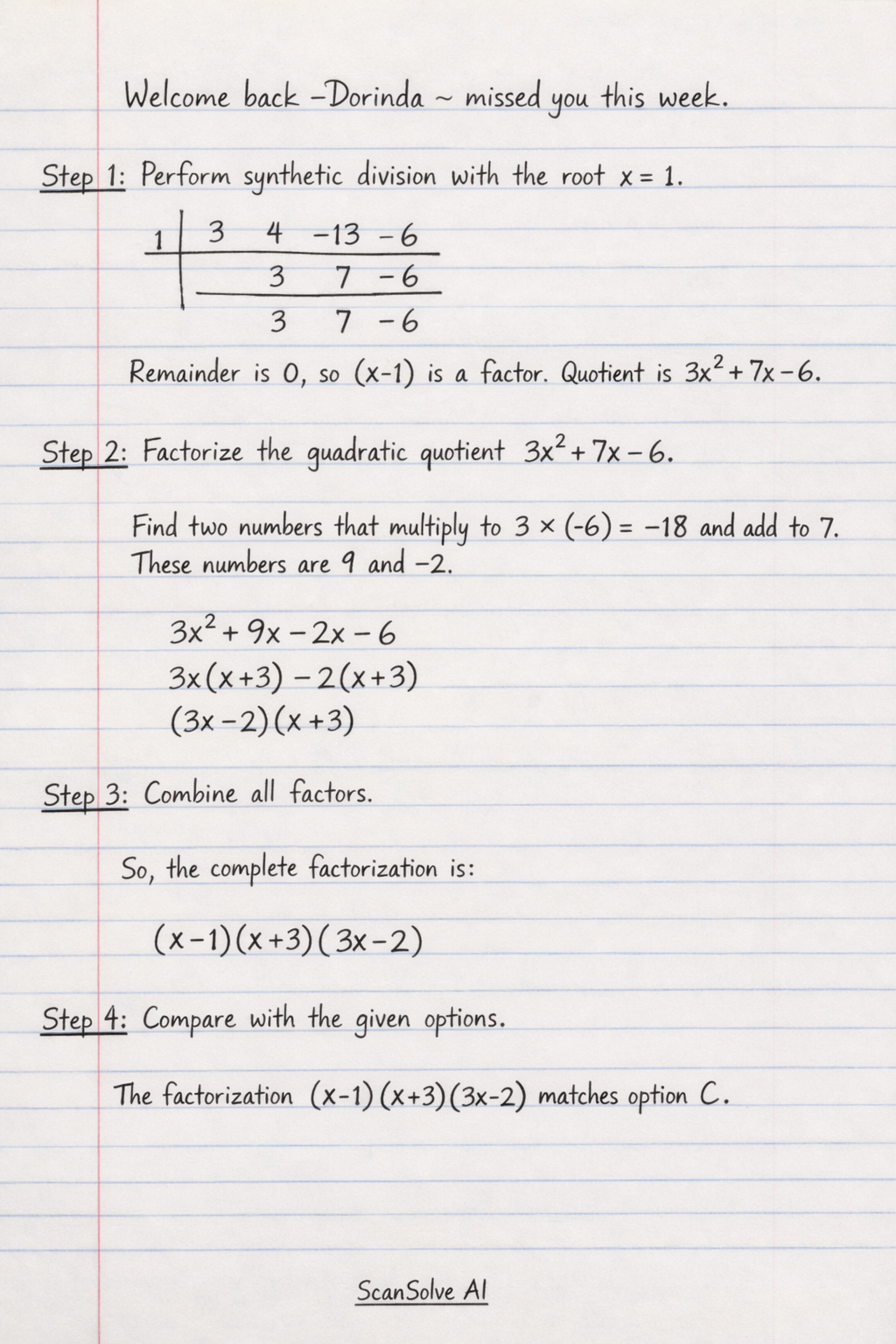
Handwritten Step-by-Step Solution
Get this as a handwritten image on WhatsApp — like a tutor wrote it for you.
Try on WhatsApp