
We read your photo as:
Simplify 3(x+3) - 2x(x-1). Evaluate 4 1/2 x 4. Factorise completely 3a - c - 3ab + bc.
Mathematics
ScanSolve AI Answer
Step-by-step solution
8 stepsHere are the solutions to the problems:
1 Simplify .
Expand the terms by distributing.
Combine the expanded terms.
Group and combine like terms.
The simplified expression is .
2 Evaluate .
Evaluate the fractional exponent.
is equivalent to .
Perform the multiplication.
The evaluated expression is .
3 Factorise completely .
Rearrange the terms to group common factors.
Factor out common terms from each pair of terms.
From the first pair (), factor out :
From the second pair (), factor out :
Factor out the common binomial factor .
The completely factorised expression is .
Was this helpful?
Still stuck on this one?
Ask a follow-up, and the answer starts from this question.
Got a different question?Ask your own question
More Mathematics Questions
QSimplify 3(x + 3) − 2x(x − 1) Evaluate 4½ x 4 Solve the equation (x − 1)2 - 25 = 0 Factorise 15 − 4x…QFactorise the following expressions: 2.1 4x2 - 9c6 2.2 −7a2b + 28b 2.3 n4 - 1 2.4 (2x − 1)2 - 49QSimplify and factorize the following algebraic expressions: −9x(x2 - 3) − 5x(2x2 - 5), 3(2a − 7)2…QFactorise Completely: 6ab - 3ac A. 3a(2b − c) B. 3(2ab - ac) C. ca(6b − 3c) D. 6a(b − c)QA. Simplify 3 − 2/(x−3) + 1/(x−3)2 b. Simplify x/(3y-x) − y/(3x) + 1
Browse by topic:Algebra
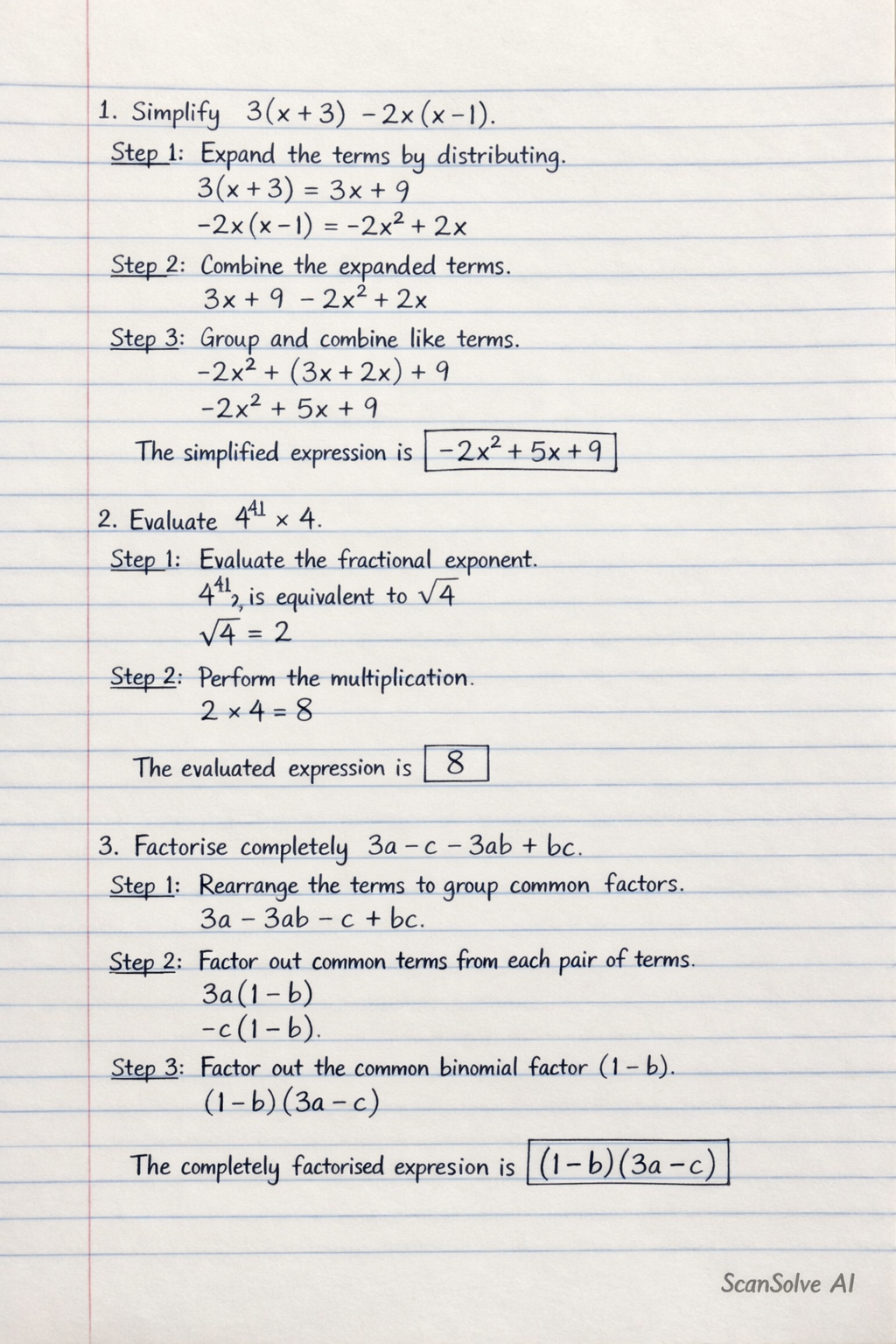
Handwritten Step-by-Step Solution
Get this as a handwritten image on WhatsApp — like a tutor wrote it for you.
Try on WhatsApp