
We read your photo as:
Evaluate the ff limits, if they exist (i) lim x->1 (x8 - 1)/(x10 - 1) (ii) lim x->3 (x2 - 9)/(x2 + 2x - 3)
ScanSolve AI Answer
Answers
2 partsStep-by-step solution
7 stepsHere are the evaluations of the limits.
Part i· 3 steps
Evaluate
Check the form of the limit.
If we substitute into the expression, we get , which is an indeterminate form. This means we can apply L'Hôpital's Rule.
Apply L'Hôpital's Rule.
Take the derivative of the numerator and the derivative of the denominator with respect to .
Derivative of the numerator:
Derivative of the denominator:Evaluate the limit of the new expression.
Substitute :
The limit exists and is:
Part ii
Evaluate
Check the form of the limit.
If we substitute into the expression, we get , which is an indeterminate form. We can apply L'Hôpital's Rule or factor the expression. Let's use factoring for this one.
Factor the numerator and the denominator.
Numerator:
Denominator:Substitute the factored expressions back into the limit and simplify.
Since , , so we can cancel the term.
Evaluate the limit by direct substitution.
Substitute :
The limit exists and is:
Try one yourself
A new problem that tests the same skill.
Still stuck on this one?
Ask a follow-up, and the answer starts from this question.
More Mathematics Questions
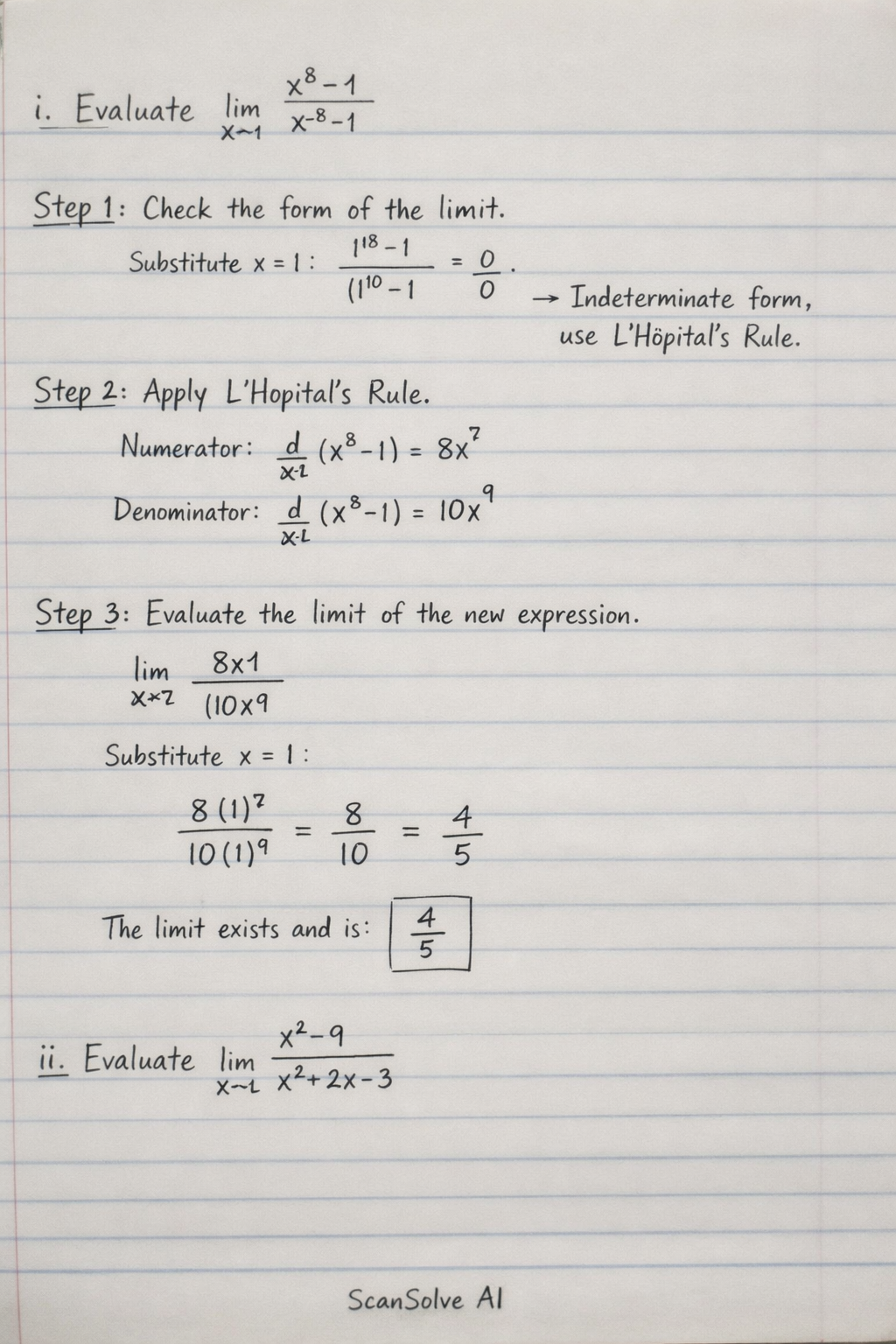
Handwritten Step-by-Step Solution
Get this as a handwritten image on WhatsApp — like a tutor wrote it for you.
Try on WhatsApp