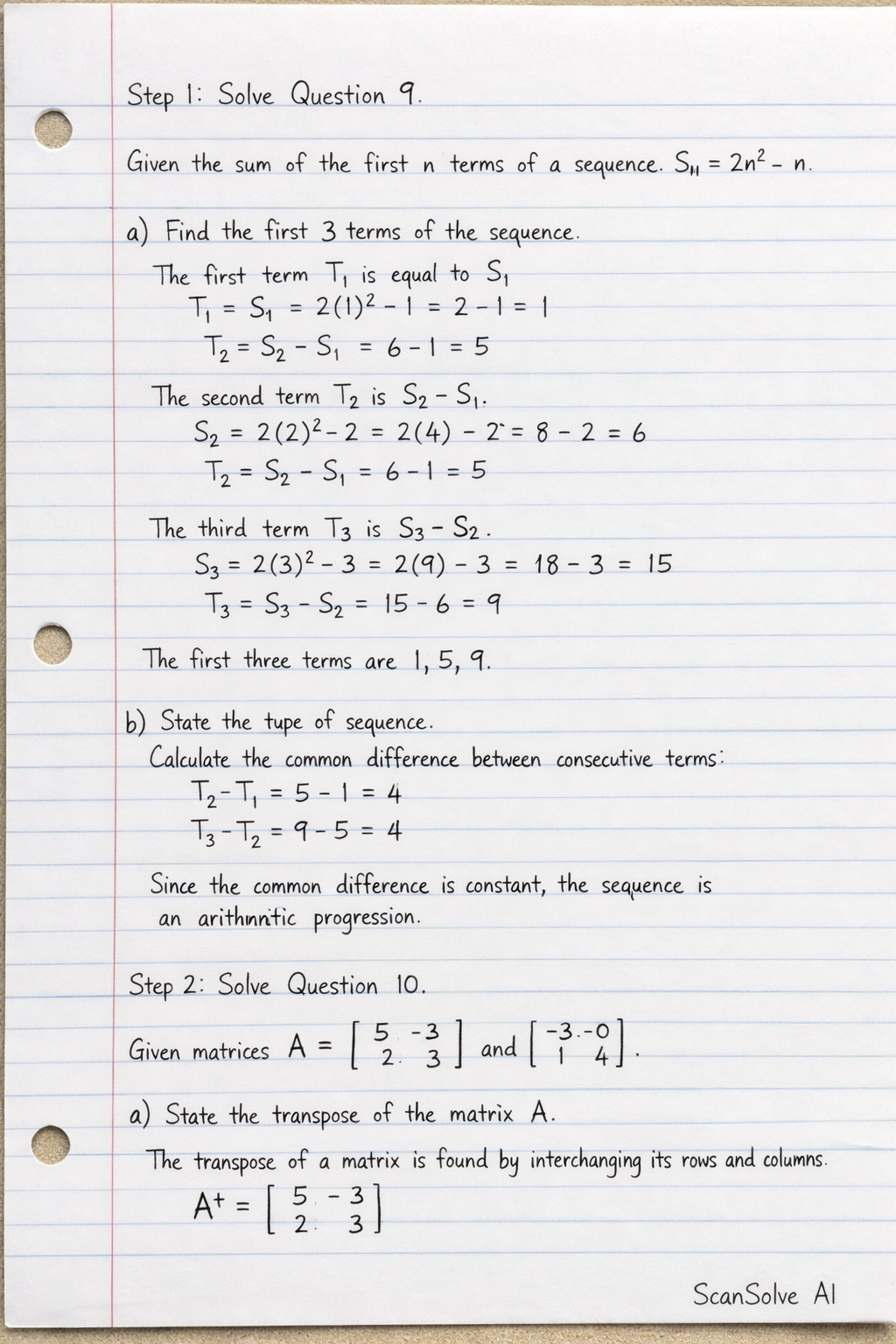
We read your photo as:

Find the first 3 terms of the sequence with sum Sn = 2n2 − n and state its type. Also, for matrices A and B, find the transpose of A and A-B.

Mathematics

ScanSolve AI Answer

Step 1: Solve Question 9.
Given the sum of the first nn terms of a sequence Sn=2n2−nS_n = 2n^2 - n.

a) Find the first 3 terms of the sequence.
The first term T1T_1 is equal to S1S_1.

T1=S1=2(1)2−1=2−1=1T_1 = S_1 = 2(1)^2 - 1 = 2 - 1 = 1

The second term T2T_2 is S2−S1S_2 - S_1.

S2=2(2)2−2=2(4)−2=8−2=6S_2 = 2(2)^2 - 2 = 2(4) - 2 = 8 - 2 = 6 T2=S2−S1=6−1=5T_2 = S_2 - S_1 = 6 - 1 = 5

The third term T3T_3 is S3−S2S_3 - S_2.

S3=2(3)2−3=2(9)−3=18−3=15S_3 = 2(3)^2 - 3 = 2(9) - 3 = 18 - 3 = 15 T3=S3−S2=15−6=9T_3 = S_3 - S_2 = 15 - 6 = 9

The first three terms are 1,5,91, 5, 9.

b) State the type of sequence.
Calculate the common difference between consecutive terms:
T2−T1=5−1=4T_2 - T_1 = 5 - 1 = 4
T3−T2=9−5=4T_3 - T_2 = 9 - 5 = 4
Since the common difference is constant, the sequence is an arithmetic progression.

Step 2: Solve Question 10.
Given matrices A=(52−13)A = \begin{pmatrix} 5 & 2 \\ -1 & 3 \end{pmatrix} and B=(−3014)B = \begin{pmatrix} -3 & 0 \\ 1 & 4 \end{pmatrix}.

a) State the transpose of the matrix A.
The transpose of a matrix is found by interchanging its rows and columns.

AT=(5−123)A^T = \begin{pmatrix} 5 & -1 \\ 2 & 3 \end{pmatrix}

b) Find the matrix A−BA - B.
Subtract the corresponding elements of matrix B from matrix A.

A−B=(52−13)−(−3014)A - B = \begin{pmatrix} 5 & 2 \\ -1 & 3 \end{pmatrix} - \begin{pmatrix} -3 & 0 \\ 1 & 4 \end{pmatrix} A−B=(5−(−3)2−0−1−13−4)A - B = \begin{pmatrix} 5 - (-3) & 2 - 0 \\ -1 - 1 & 3 - 4 \end{pmatrix} A−B=(5+32−2−1)A - B = \begin{pmatrix} 5 + 3 & 2 \\ -2 & -1 \end{pmatrix} A−B=(82−2−1)A - B = \begin{pmatrix} 8 & 2 \\ -2 & -1 \end{pmatrix}

Step 3: Solve Question 11.
In Figure 3, APQ is a circum-circle with center O. The chord AP subtends an angle of 120∘120^\circ at the center, so ∠AOP=120∘\angle AOP = 120^\circ.

a) Find the value of angle x.
Angle xx is ∠AQP\angle AQP, which is the angle subtended by arc AP at the circumference. The angle subtended by an arc at the center is twice the angle subtended by the same arc at the circumference.

∠AOP=2×∠AQP\angle AOP = 2 \times \angle AQP 120∘=2x120^\circ = 2x x=120∘2=60∘x = \frac{120^\circ}{2} = 60^\circ

b) Find the value of angle y.
In △AOP\triangle AOP, OA and OP are radii of the circle, so OA=OPOA = OP. This means △AOP\triangle AOP is an isosceles triangle.
The base angles are equal: ∠OAP=∠OPA=y\angle OAP = \angle OPA = y.
The sum of angles in a triangle is 180∘180^\circ.

∠AOP+∠OAP+∠OPA=180∘\angle AOP + \angle OAP + \angle OPA = 180^\circ 120∘+y+y=180∘120^\circ + y + y = 180^\circ 120∘+2y=180∘120^\circ + 2y = 180^\circ 2y=180∘−120∘2y = 180^\circ - 120^\circ 2y=60∘2y = 60^\circ y=60∘2=30∘y = \frac{60^\circ}{2} = 30^\circ

Step 4: Solve Question 12.
The coordinates of points A, B, C are (1,3)(1, 3), (2,y)(2, y) and (4,6)(4, 6) respectively. A, B, and C are on a straight line.
For points on a straight line, the gradient between any two pairs of points is equal.
Gradient of AB (mABm_{AB}):

mAB=y−32−1=y−31=y−3m_{AB} = \frac{y - 3}{2 - 1} = \frac{y - 3}{1} = y - 3

Gradient of BC (mBCm_{BC}):

mBC=6−y4−2=6−y2m_{BC} = \frac{6 - y}{4 - 2} = \frac{6 - y}{2}

Set the gradients equal:

y−3=6−y2y - 3 = \frac{6 - y}{2}

Multiply both sides by 2:

2(y−3)=6−y2(y - 3) = 6 - y 2y−6=6−y2y - 6 = 6 - y

Add yy to both sides:

3y−6=63y - 6 = 6

Add 6 to both sides:

3y=123y = 12

Divide by 3:

y=123=4y = \frac{12}{3} = 4

Step 5: Solve Question 13.
Find the length of the line segment AB, leaving your answer in surd form.
From Question 12, A = (1,3)(1, 3) and B = (2,y)(2, y). We found y=4y=4, so B = (2,4)(2, 4).
The distance formula is (x2−x1)2+(y2−y1)2\sqrt{(x_2 - x_1)^2 + (y_2 - y_1)^2}.

Length of AB=(2−1)2+(4−3)2\text{Length of AB} = \sqrt{(2 - 1)^2 + (4 - 3)^2} Length of AB=(1)2+(1)2\text{Length of AB} = \sqrt{(1)^2 + (1)^2} Length of AB=1+1\text{Length of AB} = \sqrt{1 + 1} Length of AB=2\text{Length of AB} = \sqrt{2}

Step 6: Solve Question 14.
A bag contains 6 red balls, 4 white balls, and 5 blue balls.
Total number of balls = 6+4+5=156 + 4 + 5 = 15.

a) Determine the probability of drawing a white ball.
Number of white balls = 4.

P(white ball)=Number of white ballsTotal number of balls=415P(\text{white ball}) = \frac{\text{Number of white balls}}{\text{Total number of balls}} = \frac{4}{15}

b) Determine the probability of not drawing a red ball.
Number of red balls = 6.
Number of non-red balls = Total balls - Number of red balls = 15−6=915 - 6 = 9.

P(not red ball)=Number of non-red ballsTotal number of balls=915=35P(\text{not red ball}) = \frac{\text{Number of non-red balls}}{\text{Total number of balls}} = \frac{9}{15} = \frac{3}{5}

c) Determine the probability of drawing a red or white ball.
Number of red balls = 6.
Number of white balls = 4.
Number of red or white balls = 6+4=106 + 4 = 10.

P(red or white ball)=Number of red or white ballsTotal number of balls=1015=23P(\text{red or white ball}) = \frac{\text{Number of red or white balls}}{\text{Total number of balls}} = \frac{10}{15} = \frac{2}{3}

Final Answers:
9a) The first three terms are 1,5,9\boxed{1, 5, 9}.
9b) The sequence is an arithmetic progression\boxed{\text{arithmetic progression}}.
10a) The transpose of matrix A is $\boxed{\begin{pmatrix} 5 & -1 \

Was this helpful?

Still stuck on this one?

Ask a follow-up, and the answer starts from this question.

Got a different question?Ask your own question
Handwritten step-by-step solution preview

Handwritten Step-by-Step Solution

Get this as a handwritten image on WhatsApp — like a tutor wrote it for you.

Try on WhatsApp