Solve the following equations: a) 22x+3 - 9 imes 2^x+1 + 1 = 0 b) 3^x imes 3^x - 28 imes 3^x-1 + 3 = 0
|Mathematics
Solve the following equations: a) 22x+3 - 9 imes 2^x+1 + 1 = 0 b) 3^x imes 3^x - 28 imes 3^x-1 + 3 = 0
ScanSolve AI Answer
Answer
x=log2(89+73),log2(89−73)
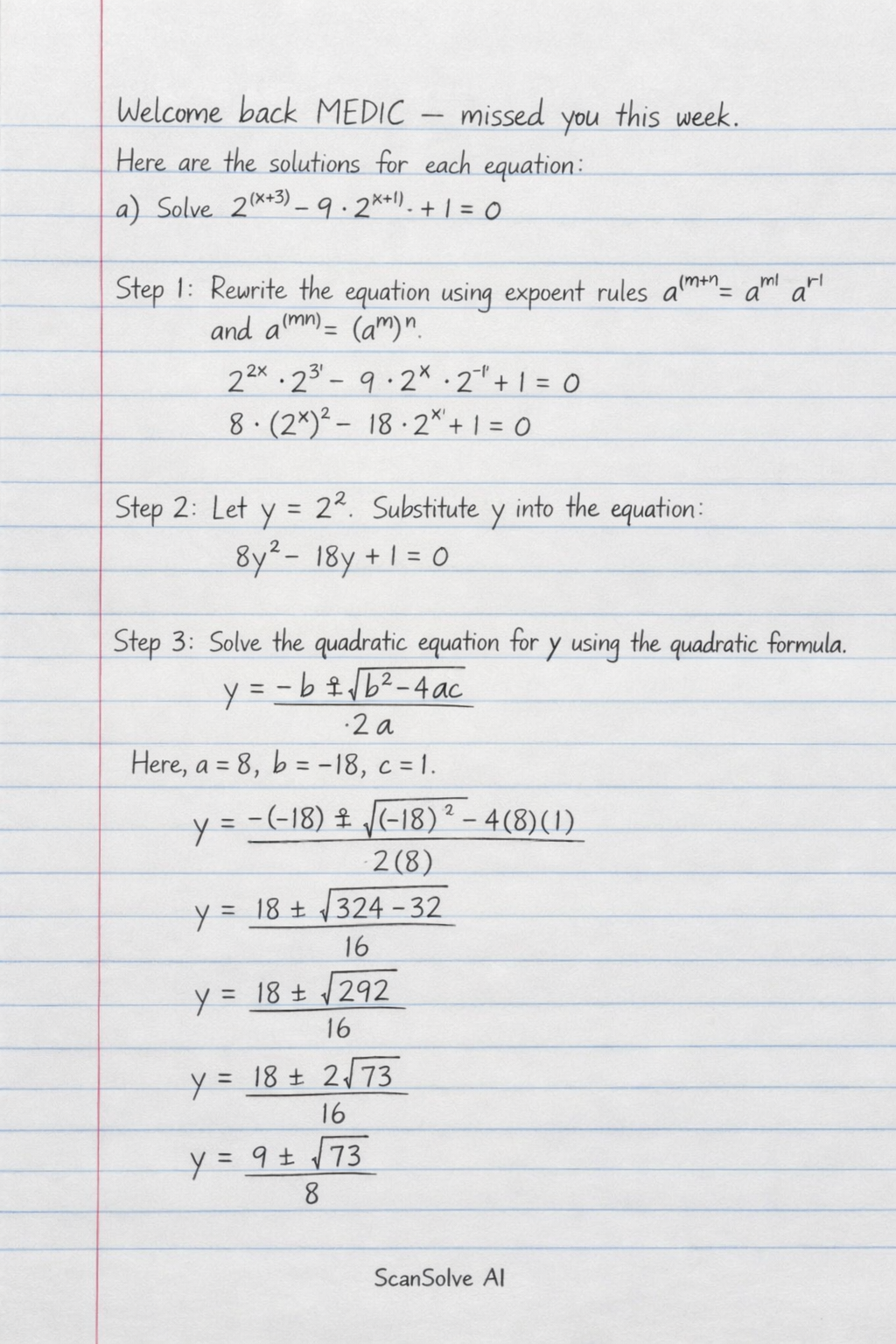
Welcome back MEDIC — missed you this week.
Here are the solutions for each equation:
a) Solve 22x+3−9×2x+1+1=0
Step 1: Rewrite the equation using exponent rules am+n=am⋅an and amn=(am)n.
22x⋅23−9⋅2x⋅21+1=08⋅(2x)2−18⋅2x+1=0
Step 2: Let y=2x. Substitute y into the equation to form a quadratic equation.
8y2−18y+1=0
Step 3: Solve the quadratic equation for y using the quadratic formula y=2a−b±b2−4ac.
Here, a=8, b=−18, c=1.
y=2(8)−(−18)±(−18)2−4(8)(1)y=1618±324−32y=1618±292y=1618±273y=89±73
Step 4: Substitute back y=2x and solve for x.
2x=89+73or2x=89−73
Take the logarithm base 2 on both sides.
x=log2(89+73)orx=log2(89−73)
Since 73≈8.54, 89−73≈89−8.54=80.46>0. Both solutions are valid.
The solutions are x=log2(89+73),log2(89−73).
b) Solve 3x×3x−28×3x−1+3=0
Step 1: Rewrite the equation using exponent rules (am)n=amn and am−n=anam.
(3x)2−28×313x+3=0(3x)2−328⋅3x+3=0
Step 2: Let y=3x. Substitute y into the equation.
y2−328y+3=0
Multiply by 3 to clear the fraction:
3y2−28y+9=0
Step 3: Solve the quadratic equation for y by factoring.
We look for two numbers that multiply to 3×9=27 and add to −28. These numbers are −27 and −1.
3y2−27y−y+9=03y(y−9)−1(y−9)=0(3y−1)(y−9)=0
So, 3y−1=0⟹y=31 or y−9=0⟹y=9.
Step 4: Substitute back y=3x and solve for x.
For y=31:
3x=313x=3−1x=−1
For y=9:
3x=93x=32x=2
The solutions are x=−1,2.
c) Solve 22x−1−5×2x−1=12
Step 1: Rewrite the equation using exponent rules am−n=anam and amn=(am)n.
2122x−5×212x=122(2x)2−25⋅2x=12
Step 2: Let y=2x. Substitute y into the equation.
2y2−25y=12
Multiply by 2 to clear the fractions:
y2−5y=24
Step 3: Rearrange the equation into standard quadratic form ay2+by+c=0.
y2−5y−24=0
Step 4: Solve the quadratic equation for y by factoring.
We look for two numbers that multiply to −24 and add to −5. These numbers are −8 and 3.
(y−8)(y+3)=0
So, y−8=0⟹y=8 or y+3=0⟹y=−3.
Step 5: Substitute back y=2x and solve for x.
For y=8:
2x=82x=23x=3
For y=−3:
2x=−3
This equation has no real solution, as 2x is always positive.
The solution is x=3.
d) Solve 5x+3−5÷5x+120=0
Step 1: Rewrite the equation using exponent rules am+n=am⋅an and am÷an=am−n or anam.
5x⋅53−5x5+120=0125⋅5x−5x5+120=0
Step 2: Let y=5x. Substitute y into the equation.
125y−y5+120=0
Step 3: Multiply the entire equation by y to eliminate the fraction. Note that y=5x must be positive, so y=0.
125y2−5+120y=0
Step 4: Rearrange the equation into standard quadratic form ay2+by+c=0.
125y2+120y−5=0
Divide by 5 to simplify:
25y2+24y−1=0
Step 5: Solve the quadratic equation for y by factoring.
We look for two numbers that multiply to 25×(−1)=−25 and add to 24. These numbers are 25 and −1.
25y2+25y−y−1=025y(y+1)−1(y+1)=0(25y−1)(y+1)=0
So, 25y−1=0⟹y=251 or y+1=0⟹y=−1.
Step 6: Substitute back y=5x and solve for x.
For y=251:
5x=2515x=5−2x=−2
For y=−1:
5x=−1
This equation has no real solution, as 5x is always positive.
The solution is x=−2.
e) Solve 3x×3x−10×3x−1+1=0
Step 1: Rewrite the equation using exponent rules (am)n=amn and am−n=anam.
(3x)2−10×313x+1=0(3x)2−310⋅3x+1=0
Step 2: Let y=3x. Substitute y into the equation.
y2−310y+1=0
Multiply by 3 to clear the fraction:
3y2−10y+3=0
Step 3: Solve the quadratic equation for y by factoring.
We look for two numbers that multiply to 3×3=9 and add to −10. These numbers are −9 and −1.
3y2−9y−y+3=03y(y−3)−1(y−3)=0(3y−1)(y−3)=0
So, 3y−1=0⟹y=31 or y−3=0⟹y=3.
Step 4: Substitute back y=3x and solve for x.
For y=31:
3x=313x=3−1x=−1
For y=3:
3x=33x=31x=1
The solutions are x=−1,1.
Drop the next question!
Was this helpful?
Need help with your own homework?
Get instant step-by-step solutions to any question. Free to start.
Welcome back MEDIC — missed you this week. Here are the solutions for each equation: a) Solve 2^2x+3 - 9 × 2^x+1 + 1 = 0 Step 1: Rewrite the equation using exponent rules a^m+n = a^m · a^n and a^mn = (a^m)^n.
Solve the following equations: a) 22x+3 - 9 imes 2^x+1 + 1 = 0 b) 3^x imes 3^x - 28 imes 3^x-1 + 3 = 0
This mathematics problem involves applying core mathematical principles and formulas. Below you will find a complete step-by-step solution with detailed explanations for each step, helping you understand not just the answer but the method behind it.
ScanSolve AI Answer
Welcome back MEDIC — missed you this week. Here are the solutions for each equation: a) Solve 2^2x+3 - 9 × 2^x+1 + 1 = 0 Step 1: Rewrite the equation using exponent rules a^m+n = a^m · a^n and a^mn = (a^m)^n. 2^2x · 2^3 - 9 · 2^x · 2^1 + 1 = 0 8 · (2^x)^2 - 18 · 2^x + 1 = 0 Step 2: Let y = 2^x. Substitute y into the equation to form a quadratic equation. 8y^2 - 18y + 1 = 0 Step 3: Solve the quadratic equation for y using the quadratic formula y = -b ± sqrt(b^2 - 4ac)2a. Here, a=8, b=-18, c=1. y = -(-18) ± sqrt((-18)^2 - 4(8)(1))2(8) y = 18 ± sqrt(324 - 32)16 y = 18 ± sqrt(292)16 y = 18 ± 2sqrt(73)16 y = 9 ± sqrt(73)8 Step 4: Substitute back y = 2^x and solve for x. 2^x = 9 + sqrt(73)8 or 2^x = 9 - sqrt(73)8 Take the logarithm base 2 on both sides. x = _2(9 + sqrt(73)8) or x = _2(9 - sqrt(73)8) Since sqrt(73) ≈ 8.54, 9 - sqrt(73)8 ≈ (9 - 8.54)/(8) = (0.46)/(8) > 0. Both solutions are valid. The solutions are x = _2(9 + sqrt(73)8), _2(9 - sqrt(73)8). b) Solve 3^x × 3^x - 28 × 3^x-1 + 3 = 0 Step 1: Rewrite the equation using exponent rules (a^m)^n = a^mn and a^m-n = (a^m)/(a^n). (3^x)^2 - 28 × (3^x)/(3^1) + 3 = 0 (3^x)^2 - (28)/(3) · 3^x + 3 = 0 Step 2: Let y = 3^x. Substitute y into the equation. y^2 - (28)/(3)y + 3 = 0 Multiply by 3 to clear the fraction: 3y^2 - 28y + 9 = 0 Step 3: Solve the quadratic equation for y by factoring. We look for two numbers that multiply to 3 × 9 = 27 and add to -28. These numbers are -27 and -1. 3y^2 - 27y - y + 9 = 0 3y(y - 9) - 1(y - 9) = 0 (3y - 1)(y - 9) = 0 So, 3y - 1 = 0 y = (1)/(3) or y - 9 = 0 y = 9. Step 4: Substitute back y = 3^x and solve for x. For y = (1)/(3): 3^x = (1)/(3) 3^x = 3^-1 x = -1 For y = 9: 3^x = 9 3^x = 3^2 x = 2 The solutions are x = -1, 2. c) Solve 2^2x-1 - 5 × 2^x-1 = 12 Step 1: Rewrite the equation using exponent rules a^m-n = (a^m)/(a^n) and a^mn = (a^m)^n. 2^2x2^1 - 5 × (2^x)/(2^1) = 12 ((2^x)^2)/(2) - (5 · 2^x)/(2) = 12 Step 2: Let y = 2^x. Substitute y into the equation. (y^2)/(2) - (5y)/(2) = 12 Multiply by 2 to clear the fractions: y^2 - 5y = 24 Step 3: Rearrange the equation into standard quadratic form ay^2 + by + c = 0. y^2 - 5y - 24 = 0 Step 4: Solve the quadratic equation for y by factoring. We look for two numbers that multiply to -24 and add to -5. These numbers are -8 and 3. (y - 8)(y + 3) = 0 So, y - 8 = 0 y = 8 or y + 3 = 0 y = -3. Step 5: Substitute back y = 2^x and solve for x. For y = 8: 2^x = 8 2^x = 2^3 x = 3 For y = -3: 2^x = -3 This equation has no real solution, as 2^x is always positive. The solution is x = 3. d) Solve 5^x+3 - 5 ÷ 5^x + 120 = 0 Step 1: Rewrite the equation using exponent rules a^m+n = a^m · a^n and a^m ÷ a^n = a^m-n or (a^m)/(a^n). 5^x · 5^3 - (5)/(5^x) + 120 = 0 125 · 5^x - (5)/(5^x) + 120 = 0 Step 2: Let y = 5^x. Substitute y into the equation. 125y - (5)/(y) + 120 = 0 Step 3: Multiply the entire equation by y to eliminate the fraction. Note that y = 5^x must be positive, so y ≠ 0. 125y^2 - 5 + 120y = 0 Step 4: Rearrange the equation into standard quadratic form ay^2 + by + c = 0. 125y^2 + 120y - 5 = 0 Divide by 5 to simplify: 25y^2 + 24y - 1 = 0 Step 5: Solve the quadratic equation for y by factoring. We look for two numbers that multiply to 25 × (-1) = -25 and add to 24. These numbers are 25 and -1. 25y^2 + 25y - y - 1 = 0 25y(y + 1) - 1(y + 1) = 0 (25y - 1)(y + 1) = 0 So, 25y - 1 = 0 y = (1)/(25) or y + 1 = 0 y = -1. Step 6: Substitute back y = 5^x and solve for x. For y = (1)/(25): 5^x = (1)/(25) 5^x = 5^-2 x = -2 For y = -1: 5^x = -1 This equation has no real solution, as 5^x is always positive. The solution is x = -2. e) Solve 3^x × 3^x - 10 × 3^x-1 + 1 = 0 Step 1: Rewrite the equation using exponent rules (a^m)^n = a^mn and a^m-n = (a^m)/(a^n). (3^x)^2 - 10 × (3^x)/(3^1) + 1 = 0 (3^x)^2 - (10)/(3) · 3^x + 1 = 0 Step 2: Let y = 3^x. Substitute y into the equation. y^2 - (10)/(3)y + 1 = 0 Multiply by 3 to clear the fraction: 3y^2 - 10y + 3 = 0 Step 3: Solve the quadratic equation for y by factoring. We look for two numbers that multiply to 3 × 3 = 9 and add to -10. These numbers are -9 and -1. 3y^2 - 9y - y + 3 = 0 3y(y - 3) - 1(y - 3) = 0 (3y - 1)(y - 3) = 0 So, 3y - 1 = 0 y = (1)/(3) or y - 3 = 0 y = 3. Step 4: Substitute back y = 3^x and solve for x. For y = (1)/(3): 3^x = (1)/(3) 3^x = 3^-1 x = -1 For y = 3: 3^x = 3 3^x = 3^1 x = 1 The solutions are x = -1, 1. Drop the next question!