
We read your photo as:
Solve the following equations: A) 4^(2x2+x−6) = 1, B) (x2−3x+1)6 = 1, C) (x2-3x+1)^(2x2+x−6) = 1
ScanSolve AI Answer
Step-by-step solution
4 stepsSolve equation A.
Equation A is .
For an equation of the form , if and , then the exponent must be 0.
Here, the base is 4, so we set the exponent to 0:We can solve this quadratic equation by factoring. We look for two numbers that multiply to and add to 1. These numbers are 4 and .
Setting each factor to zero:
a) Solutions for equation A:
Solve equation B.
Equation B is .
For an equation of the form , where is an even integer (here ), the base can be 1 or .Case 1: The base is 1.
This gives or .
Case 2: The base is .
Factoring the quadratic:
This gives or .
b) Solutions for equation B:
Solve equation C.
Equation C is .
Let the base be and the exponent be .
We need to solve . There are three cases:Case 1: The exponent is 0, provided the base is not 0.
From Step 1, the solutions are and .
We check the base for these values:
For : . Since , is a solution.
For : . Since , is a solution.Case 2: The base is 1.
From Step 2, the solutions are and .
For these values, holds for any real exponent . So, and are solutions.Case 3: The base is , and the exponent is an even integer.
From Step 2, the solutions are and .
We check if the exponent is even for these values:
For : . Since is an odd integer, is not a solution.
For : . Since 4 is an even integer, is a solution.Combining all valid solutions from the three cases:
c) Solutions for equation C:
State how many values of x satisfy each equation.
a) Equation A:
From Step 1, there are 2 solutions: .
Number of values:b) Equation B:
From Step 2, there are 4 solutions: .
Number of values:c) Equation C:
From Step 3, there are 5 solutions: .
Number of values:
Still stuck on this one?
Ask a follow-up, and the answer starts from this question.
More Mathematics Questions
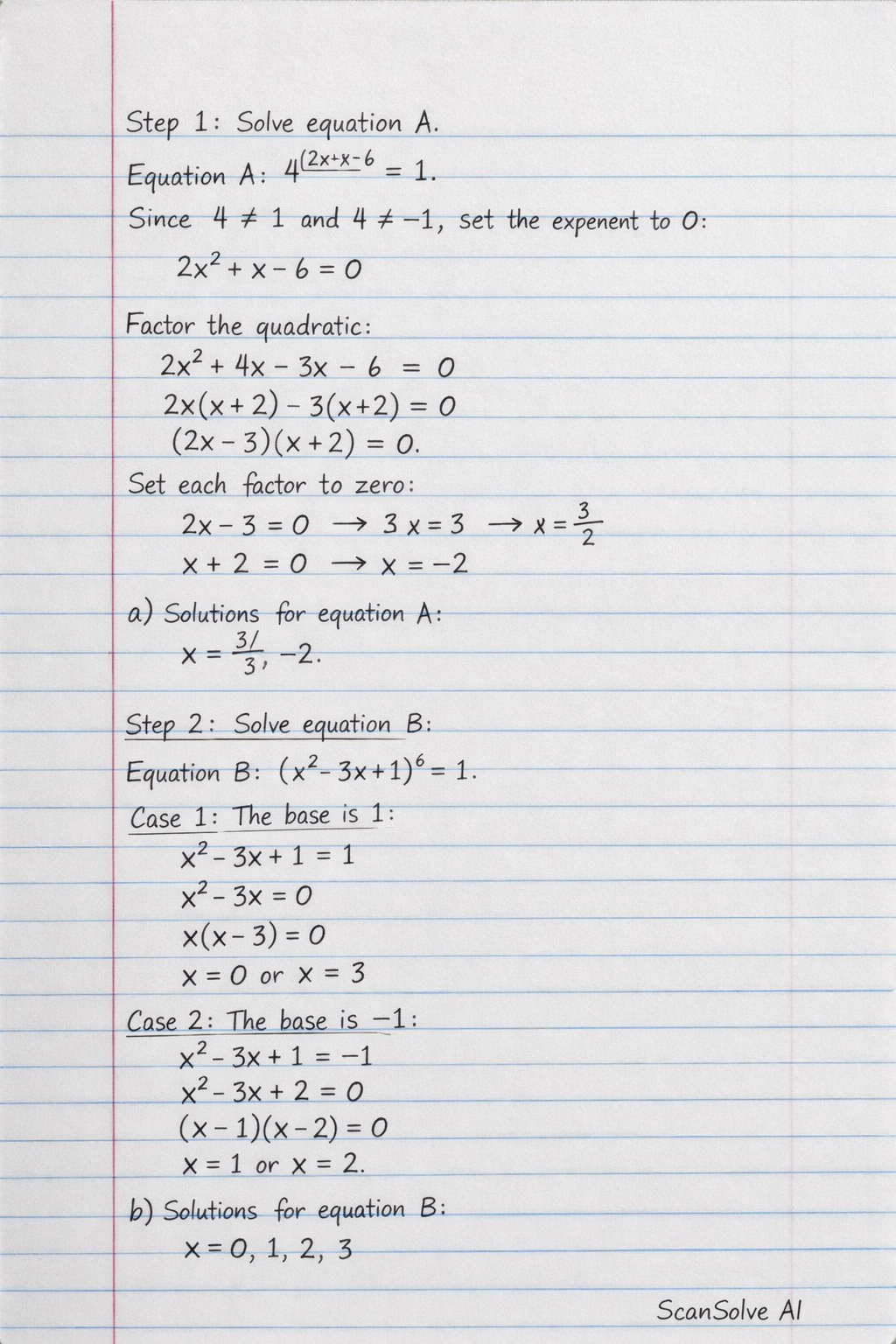
Handwritten Step-by-Step Solution
Get this as a handwritten image on WhatsApp — like a tutor wrote it for you.
Try on WhatsApp